The big idea: Before a cell divides it must copy all of its DNA — this is DNA replication. Two enzymes do the key work.
Helicase
- Unzips the double helix
DNA polymerase
- Builds a new strand against each separated half
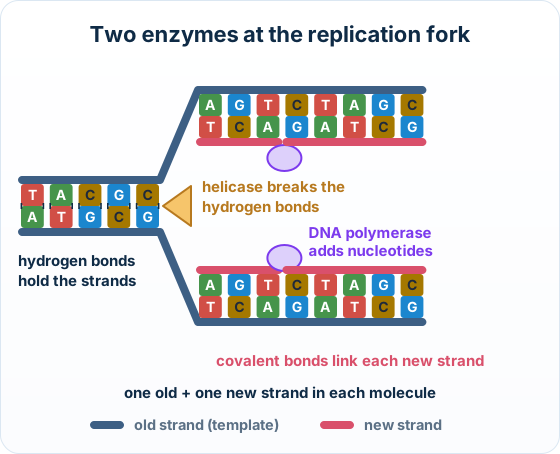
The result: The result is two identical DNA molecules, each keeping one old (template) strand and one new strand — this is what 'semi-conservative' means.
At the replication fork, helicase unzips the double helix by breaking the hydrogen bonds between the bases; DNA polymerase then builds a new complementary strand against each exposed template (A–T, G–C).
Interactive diagram
Explore the labelled diagram, charts and maps for this topic in full study mode.
- DNA replication
- The process of copying a DNA molecule to make two identical molecules, each with one original strand and one new strand.
- Helicase
- The enzyme that unwinds and unzips the double helix by breaking the hydrogen bonds between the paired bases.
- DNA polymerase
- The enzyme that builds each new strand by adding complementary nucleotides to a template strand and joining them with covalent bonds.
- Template strand
- One of the two original (parental) strands; its base sequence is read to decide which nucleotides are added to the new strand.
- Complementary base pairing
- The rule that A pairs with T and G pairs with C, so each template strand specifies exactly one new strand.
Two enzymes, two jobs: Keep the division of labour clear:
Helicase = unzips (separates the strands). DNA polymerase = builds (adds the new nucleotides).
Helicase goes first to open the helix; DNA polymerase follows to fill in the new strands.
Free preview
This is the free notes preview
You're reading the free notes. Aimnova Pro unlocks the full study experience — and you can try it with your first topic free to keep:
- FlashcardsLock in vocabulary and key terms with spaced repetition.
- Practice questionsAnswer exam-style questions and get instant AI marking.
- Mock exams & past-paper vaultSit full mocks and see exactly how examiners award marks.
- Personalised study planA daily plan built around your exam date and weak areas.
The two strands of DNA are held together by hydrogen bonds between the paired bases (A–T, G–C).
Two kinds of bond: Along each strand, the nucleotides are joined into a backbone by much stronger covalent bonds.
The exam expects you to know which bond each enzyme acts on — and they act on different ones.
Helicase BREAKS hydrogen bonds: Helicase moves along the double helix and breaks the hydrogen bonds between the paired bases.
This unzips the two strands apart, separating the parental helix into two single template strands and creating the replication fork where copying happens.
Helicase works at the fork: it breaks the hydrogen bonds holding the two strands together, separating the parental double helix into two single template strands.
Interactive diagram
Explore the labelled diagram, charts and maps for this topic in full study mode.
DNA polymerase FORMS covalent bonds: DNA polymerase then reads each template strand and adds the complementary nucleotides (A opposite T, G opposite C).
As it joins each new nucleotide to the growing strand, it forms covalent bonds along the sugar–phosphate backbone.
It builds the new strand one nucleotide at a time.
DNA polymerase moves along each template strand adding complementary nucleotides and joining them with covalent bonds.
Interactive diagram
Explore the labelled diagram, charts and maps for this topic in full study mode.
Helicase
- Unzips the double helix
- Breaks the hydrogen bonds between the bases
- Acts on the double-stranded parental DNA
- Works first, opening the replication fork
DNA polymerase
- Builds the new complementary strand
- Forms the covalent bonds in the backbone
- Acts on each single template strand
- Adds nucleotides one at a time
An easy way to remember the bonds: Helicase handles the Hydrogen bonds — and it breaks them.
Polymerase Puts nucleotides together — forming the covalent bonds of the new backbone.
Different enzyme, different bond, opposite action: one breaks, one forms.
| Bond | Where it is | Which enzyme acts on it during replication |
|---|---|---|
| Hydrogen bond | Holds the two strands together (between paired bases A–T, G–C) | Helicase BREAKS it to separate the strands |
| Covalent bond | Joins nucleotides along the sugar-phosphate backbone of a strand | DNA polymerase FORMS it to build the new strand |
Both enzymes at work, one step at a time:
Real example: E. coli. In E. coli each replication fork moves at roughly 1,000 nucleotides per second, so helicase and DNA polymerase copy the whole chromosome in under an hour.
Feeling unprepared for exams?
Get a clear study plan, practice with real questions, and know exactly where you stand before exam day. No more guessing.
How this is tested: This micro is tested as short recall: name each enzyme, then say exactly what it does.
| Paper | What you are asked | The answer |
|---|---|---|
| Paper 1 (1 mark) | State the role of DNA polymerase | It adds complementary nucleotides to the template strand to build the new strand |
| Paper 1A matching item | Which bonds helicase and DNA polymerase respectively break or form | Helicase breaks hydrogen bonds, DNA polymerase forms covalent bonds |
| Paper 2 | The same idea inside a longer 'describe replication' answer | Name the enzyme, then say exactly what it does |
Exam-style question — state the role of DNA polymerase
State the role of DNA polymerase in DNA replication. [1]
How to score the mark
- Name what it builds. DNA polymerase builds a new strand against each template strand.
- Say exactly how. It does this by adding complementary nucleotides (A opposite T, G opposite C) and joining them with covalent bonds.
Final answer
DNA polymerase adds complementary nucleotides to a template strand, building the new (daughter) strand and joining the nucleotides with covalent bonds.
Why this scores the mark: The mark is for the action — adding nucleotides / building the new strand.
Just naming the enzyme is not enough; 'state the role' wants what it actually does.
Now contrast the two enzymes side by side:
Exam-style question — which bonds does each enzyme act on?
During DNA replication, state which type of bond helicase breaks and which type of bond DNA polymerase forms. [2]
How to score both marks
- Helicase. Helicase breaks the hydrogen bonds between the paired bases, separating the two strands.
- DNA polymerase. DNA polymerase forms covalent bonds between the nucleotides of the new strand (the sugar–phosphate backbone).
Final answer
Helicase breaks the hydrogen bonds between the bases; DNA polymerase forms covalent bonds between the nucleotides of the new strand.
| Feature | Helicase | DNA polymerase |
|---|---|---|
| What it does | Unwinds and unzips the double helix | Builds the new complementary strand |
| Bonds it acts on | BREAKS the hydrogen bonds between the bases | FORMS the covalent bonds joining nucleotides in the new strand |
| Acts on which strand? | The double-stranded parental helix (separates it into two) | Each single template strand exposed by helicase |
| Direction / order | Works first, at the replication fork | Works after, adding nucleotides one at a time |
| Result | Two separated template strands | A new complementary strand against each template |