The big idea: Osmosis is the net movement of water across a partially permeable membrane. It always moves water from where there is more free water to where there is less.
Why some solutions have less free water
- When a solute (like salt or sugar) dissolves in water, the water molecules gather around each solute particle and hold it in solution — this is called solvation.
- Some of the water is now busy surrounding solute particles.
- So a concentrated solution effectively has fewer free water molecules than a dilute one.
Water moves by osmosis from a higher water potential (dilute solution) to a lower water potential (concentrated solution): into a cell in a hypotonic solution, out of a cell in a hypertonic solution, with no net movement in an isotonic one.
Interactive diagram
Explore the labelled diagram, charts and maps for this topic in full study mode.
- Solvent
- The liquid that does the dissolving. In living things the solvent is almost always water.
- Solute
- A substance dissolved in the solvent (for example salt, sugar or glucose).
- Solvation
- The process in which water molecules surround and separate each dissolved solute particle, holding it in solution.
- Partially permeable membrane
- A membrane that lets water molecules pass through but blocks (most of) the larger dissolved solute particles.
- Osmosis
- The net movement of water molecules across a partially permeable membrane, from a region of higher water potential to a region of lower water potential.
- Water potential
- A measure of how freely water can move out of a solution. Pure water has the highest water potential; adding solute lowers it.
What 'water potential' really tells you: Think of water potential as a ranking of how 'free' the water is to leave.
Pure water = the highest water potential.
Add solute → water potential drops (the more solute, the lower it goes).
So a dilute solution has a higher water potential than a concentrated one — and water always flows from high to low water potential.
Free preview
This is the free notes preview
You're reading the free notes. Aimnova Pro unlocks the full study experience — and you can try it with your first topic free to keep:
- FlashcardsLock in vocabulary and key terms with spaced repetition.
- Practice questionsAnswer exam-style questions and get instant AI marking.
- Mock exams & past-paper vaultSit full mocks and see exactly how examiners award marks.
- Personalised study planA daily plan built around your exam date and weak areas.
Osmosis is not random — it has a direction, and water potential is what sets it.
Two ways to say the direction
- Water always moves from the side with the higher water potential (the more dilute side) to the side with the lower water potential (the more concentrated side).
- Another way to say the same thing: water moves toward the side with more solute, spreading itself out until both sides have the same water potential.
The rule, in one line: Water moves by osmosis from a higher water potential to a lower water potential — that is, from the dilute side toward the concentrated side.
It keeps moving until the two sides are equal (isotonic), at which point there is no net movement — water still crosses both ways, but in equal amounts.
Higher water potential
- The dilute side (less solute)
- More free water molecules
- Water tends to leave this side
- Closest to pure water
Lower water potential
- The concentrated side (more solute)
- Fewer free water molecules
- Water tends to enter this side
- Furthest from pure water
| Side of the membrane | Solute concentration | Water potential | Net water movement |
|---|---|---|---|
| Dilute side | Low solute (lots of water) | Higher water potential | Water leaves this side |
| Concentrated side | High solute (less water) | Lower water potential | Water enters this side |
| Overall | — | Higher → lower | Water moves toward the more concentrated side until water potential is equal |
The conditions osmosis needs: For osmosis to happen across a membrane, two things must be true.
The two conditions
- 1. A partially permeable membrane — it must let water through but hold back the solute.
- 2. A difference in solute concentration — the two sides must differ in solute concentration, so there is a gradient for water to move down.
When there is no osmosis: If the solute could cross freely, or if both sides were already equal, there would be no net osmosis.
| Condition for osmosis | What it means | What happens without it |
|---|---|---|
| A partially permeable membrane | A membrane that lets water through but blocks (most of) the dissolved solute | If solute could cross freely, the two sides would simply mix — there would be no osmosis |
| A difference in solute concentration | The two sides differ in how dilute they are (a solute concentration gradient) | If both sides are equal (isotonic), there is no net movement of water |
| Liquid water on both sides | Water molecules must be free to move across the membrane | With no free water there is nothing to move by osmosis |
Water follows the solute: Water follows the solute. Wherever the solute is more concentrated, that side has the lower water potential, so water moves toward it.
And osmosis is passive — it needs no energy (ATP); the water simply moves towards the more concentrated solution.
Stop wasting time on topics you know
Our AI identifies your weak areas and focuses your study time where it matters. No more overstudying easy topics.
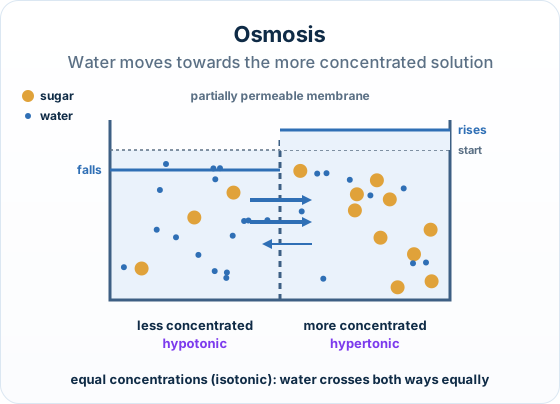
Say it with solute concentration: In osmosis, water moves across a partially permeable membrane from the less concentrated solution to the more concentrated solution (concentration of solute).
The points to remember
- The membrane lets water through but not the solute.
- Water crosses both ways; the net movement is towards the more concentrated side.
- The less concentrated solution is hypotonic to the other; the more concentrated one is hypertonic.
- Two solutions with the same concentration are isotonic: no net movement.
- Osmosis is passive: no ATP is used.
Remember it as: Water moves towards more solute.
Real example: Visking tubing. A bag of Visking tubing (a partially permeable membrane) filled with sugar solution and left in water swells and becomes firm, because water moves into the more concentrated solution inside.
How it is asked: Short answers on the conditions for osmosis and the direction water moves, and 1A items comparing two solutions as hypotonic or hypertonic.
Outline the conditions required for osmosis to take place across a membrane.
Model answer plan
See the answer broken into clear points, with guidance on how each point earns marks.
Solute, not water: Describe the direction with solute concentration: towards the more concentrated solution. Avoid 'water concentration'.