The big idea: Mitosis divides the nucleus into two identical nuclei. But the cell still has to split its cytoplasm (and everything in it) into two separate daughter cells.
Cytokinesis: That final step is called cytokinesis — the division of the cytoplasm. It happens differently in animal cells and plant cells, because plant cells have a rigid cell wall and animal cells do not.
- Cytokinesis
- The division of a cell's cytoplasm to form two separate daughter cells, after the nucleus has divided by mitosis.
- Cleavage furrow
- A groove that forms in an animal cell's membrane and deepens until the cell is pinched in two.
- Contractile ring
- A ring of the proteins actin and myosin just inside an animal cell's membrane that tightens to pull the membrane inwards.
- Cell plate
- A new membrane and wall built from vesicles across the middle of a dividing plant cell, growing outwards until it separates the two daughter cells.
- Daughter cells
- The two cells produced when one parent cell divides.
Nucleus first, then cytoplasm: Mitosis sorts out the chromosomes; cytokinesis splits the cytoplasm.
They are two separate jobs: a cell could finish mitosis and still be one cell until cytokinesis physically pinches or walls it into two.
Free preview
This is the free notes preview
You're reading the free notes. Aimnova Pro unlocks the full study experience — and you can try it with your first topic free to keep:
- FlashcardsLock in vocabulary and key terms with spaced repetition.
- Practice questionsAnswer exam-style questions and get instant AI marking.
- Mock exams & past-paper vaultSit full mocks and see exactly how examiners award marks.
- Personalised study planA daily plan built around your exam date and weak areas.
Both animal and plant cells must end up as two separate cells, but they get there in opposite ways.
An animal cell pinches inwards; a plant cell builds a new wall outwards.
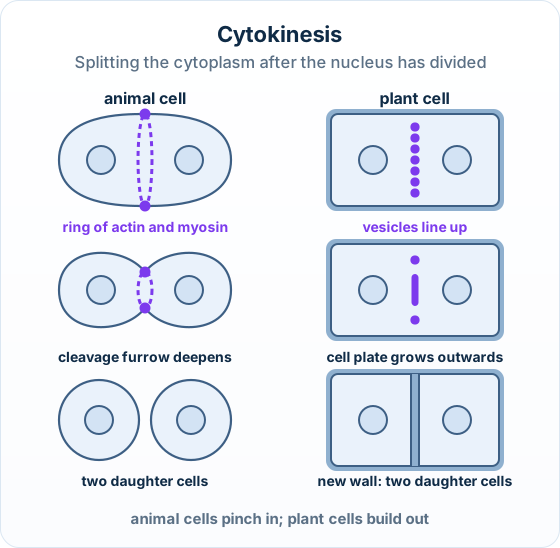
Animal cells — a cleavage furrow pinches inwards: In an animal cell, a ring of the proteins actin and myosin (the contractile ring) forms just inside the membrane around the middle of the cell.
What the ring does
- The ring contracts and tightens, pulling the membrane inwards.
- This makes a deepening groove called a cleavage furrow.
- The furrow gets deeper and deeper until the membrane meets in the middle and the cell is pinched into two separate daughter cells.
Plant cells — a cell plate builds outwards: A plant cell has a rigid cell wall, so it cannot pinch inwards.
Instead, small vesicles carrying membrane and wall material gather along the middle of the cell and fuse together to form a cell plate.
The cell plate grows outwards from the centre until it reaches the existing walls, forming a new membrane and wall that separate the two daughter cells.
| Feature | Animal cell | Plant cell |
|---|---|---|
| How it divides | The membrane pinches inwards | A new wall is built outwards |
| Structure formed | A cleavage furrow (a groove that deepens) | A cell plate that grows across the middle |
| What pulls or builds it | A ring of actin and myosin contracts and tightens | Vesicles bring wall material to the centre and fuse |
| Direction of growth | Inwards, from the edge towards the centre | Outwards, from the centre towards the edges |
| Why the difference | Animal cells have a flexible membrane, no wall | The rigid cell wall cannot pinch, so a wall must be made |
Animal cytokinesis
- A contractile ring of actin and myosin forms inside the membrane
- The ring contracts, pulling the membrane inwards
- A cleavage furrow deepens until the cell is pinched in two
- Division works inwards, from the edge to the centre
Plant cytokinesis
- Vesicles of wall material gather at the centre
- They fuse to form a cell plate
- The cell plate grows outwards to the existing walls
- A new wall and membrane separate the two cells
Usually equal — but not always: In most divisions, the cytoplasm (and its organelles) is split roughly equally, so each daughter cell gets about the same amount.
The exception: egg formation: When an egg (gamete) cell forms, the division is unequal. Almost all the cytoplasm goes to one large egg cell, while the other products are tiny cells (polar bodies) with very little cytoplasm. This makes sure the egg is packed with the nutrients a future embryo will need.
An easy way to remember: Animal = pinch in (furrow). Plant = wall out (plate).
And equal sharing is the rule — the egg is the famous unequal exception.
Study smarter, not longer
Most students waste 40% of study time on topics they already know. Our AI tracks your progress and optimizes every minute.
The big idea: Cytokinesis splits the cytoplasm of the parent cell between the two daughter cells. Animal cells pinch in; plant cells build out.
The points to remember
- Cytokinesis comes after the nucleus has divided.
- Animal cell: a ring of actin and myosin under the membrane contracts.
- It pulls the membrane inwards into a cleavage furrow until the cell splits in two.
- Plant cell: vesicles gather at the middle and fuse into a cell plate.
- The plate grows outwards to the side walls, giving each cell a new membrane and wall.
Remember it as: Animal: a drawstring. Plant: a wall built brick by brick.
Real example: early embryos. The cells of early fish and sea urchin embryos divide quickly one after another, so slides of them show many cells caught part-way through cytokinesis, each with a deep cleavage furrow.
How it is asked: A 1A item on a micrograph (what is happening at X?), or a short written answer on how a named animal or plant cell splits its cytoplasm.
Cells in an early chick embryo are dividing. Explain how cytokinesis occurs in these animal cells.
Model answer plan
See the answer broken into clear points, with guidance on how each point earns marks.
Read which cell it is: If the question names an animal cell, the answer is a ring and a furrow. A cell plate is for plant cells only.