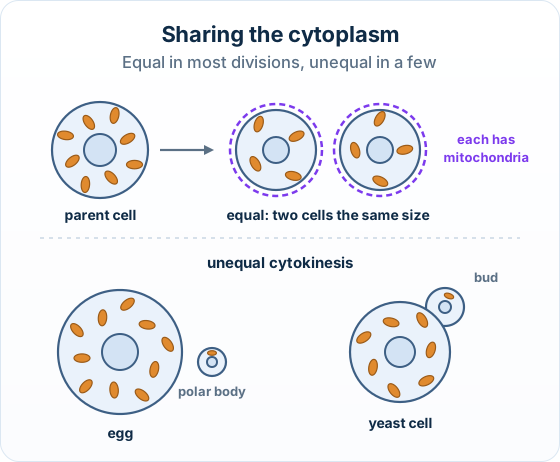
The big idea: Cytokinesis usually shares the cytoplasm equally, but not always. Whatever the split, each daughter cell needs at least one mitochondrion.
The points to remember
- Equal cytokinesis: two daughter cells of about the same size. This is the usual case.
- Unequal cytokinesis: one daughter cell gets much more cytoplasm than the other.
- Human oogenesis (egg formation): the egg keeps most of the cytoplasm; the polar body gets little.
- Budding in yeast: a small bud grows out of the parent cell and separates.
- Every daughter cell must get at least one mitochondrion, because new mitochondria only come from old ones dividing.
Remember it as: Fair shares usually; the egg and the yeast bud are the exceptions.
Real example: the human egg. A human egg is about 0.1 mm across, one of the largest cells in the body and big enough to see without a microscope. The polar bodies made alongside it are tiny and soon break down.
Free preview
This is the free notes preview
You're reading the free notes. Aimnova Pro unlocks the full study experience — and you can try it with your first topic free to keep:
- FlashcardsLock in vocabulary and key terms with spaced repetition.
- Practice questionsAnswer exam-style questions and get instant AI marking.
- Mock exams & past-paper vaultSit full mocks and see exactly how examiners award marks.
- Personalised study planA daily plan built around your exam date and weak areas.
Start Studying Free Full access to Aimnova Pro · cancel anytime
Organelles that cannot be made from scratch: A cell cannot build a mitochondrion (or, in plants, a chloroplast) from nothing. New ones form only when existing ones grow and divide, so each daughter cell must inherit at least one.
| Example | What happens | Why it is unequal |
|---|---|---|
| Oogenesis in humans | Meiosis makes one large egg and small polar bodies | The egg stores the cytoplasm and organelles an early embryo needs |
| Budding in yeast | A small bud grows from the parent cell and pinches off | The bud starts small and grows after it separates |
Unequal is not unfair: Even the tiny polar body and the yeast bud each get a nucleus and at least one mitochondrion.
Practice with exam-style questions
Answer exam-style questions and get AI feedback that shows you exactly what examiners want to see in a full-marks response.
Try Practice FreeYour first topic is free to keep • No credit card required
How it is asked: Usually a 1A item: which cell comes from unequal cytokinesis (an egg), or which example is the exception to equal sharing (yeast budding). Sometimes a short written answer on yeast reproduction.
IB-style questionOutline[2 marks]
Outline why cytokinesis is unequal when a human egg cell is formed.
Model answer plan
See the answer broken into clear points, with guidance on how each point earns marks.