aımnova
DashboardMy LearningCrash CoursesStudy Plan

Aimnova site navigation

Stay in the loop

Get the latest study resources and updates

New features, study tips and exam insights — straight to your inbox.

IB Diploma

  • IB Past Papers
  • IB Study Notes
  • IB Question Bank
  • IB Mock Exams
  • IB Revision

IB Subjects

  • IB Math AA
  • IB Math AI
  • IB Economics
  • IB Business Management
  • IB Physics
  • IB Biology
  • View all IB subjects→

IB Past Papers

  • IB Math AA HL Past Papers
  • IB Math AA SL Past Papers
  • IB Math AI HL Past Papers
  • IB Math AI SL Past Papers
  • IB Economics HL Past Papers
  • IB Economics SL Past Papers
  • IB ESS Past Papers
  • View all past papers→

Study Resources

  • Study Notes
  • Question Bank
  • Mock Exams
  • Crash Courses
  • Flashcards
  • Revision Guide
  • Exam Skills
  • Command Terms
  • Grade Calculator
  • Exam Timetable 2026

Aimnova

  • Features
  • Pricing
  • For Teachers
  • For Schools
  • For Parents
  • About Us
  • Blog
  • Contact
aımnova

IB study, practice and feedback built around the real exam.

TermsPrivacyCookies·© 2026 Aimnova. All rights reserved.06bfe1b

Aimnova is not affiliated with or endorsed by the International Baccalaureate Organization (IB).

NotesBiologyTopic 4.4Generation of new cells in living organisms by cell division
Back to Biology Topics
4.4.13 min read

Generation of new cells in living organisms by cell division

IB Biology · Unit 4

Smart study tools

Turn reading into results

Move beyond passive notes. Answer exam-style questions, get AI feedback, and build the skills that earn top marks.

Get Started Free

Contents

  1. 1Cells come from cells
  2. 2What cell division is for
  3. 3Exam-style question (step by step)
The big idea: New cells are made only by cell division: a parent cell divides to produce two daughter cells.
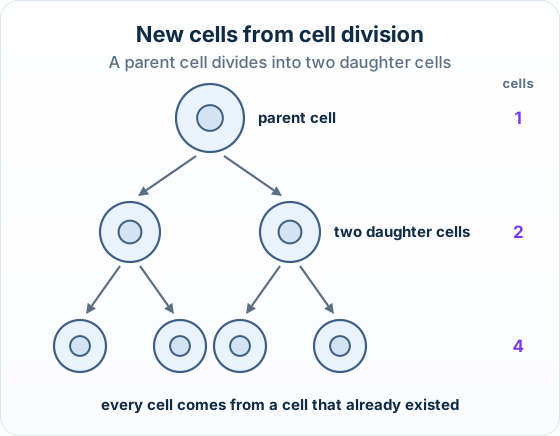
One parent cell dividing into two daughter cells, and each of those dividing again into four
Every new cell comes from a cell that already existed.

The points to remember

  • This is true in all living organisms: bacteria, plants, fungi and animals.
  • The cell that divides is the parent cell (often called the mother cell).
  • The two new cells it produces are the daughter cells.
  • Cells are never made from non-living material: every cell comes from a pre-existing cell.
  • Each division doubles the number of cells: 1, 2, 4, 8 ...
Remember it as: One cell in, two cells out.

Real example: you. You began as one cell, a fertilised egg. About a day after fertilisation it divided into two cells, then four, then eight. Every one of the tens of trillions of cells in your body today came from that first cell by cell division.

Free preview

This is the free notes preview

You're reading the free notes. Aimnova Pro unlocks the full study experience — and you can try it with your first topic free to keep:

  • FlashcardsLock in vocabulary and key terms with spaced repetition.
  • Practice questionsAnswer exam-style questions and get instant AI marking.
  • Mock exams & past-paper vaultSit full mocks and see exactly how examiners award marks.
  • Personalised study planA daily plan built around your exam date and weak areas.
Start Studying Free Full access to Aimnova Pro · cancel anytime
What cell division is for: The same process, a cell dividing in two, does different jobs in different organisms.
OrganismWhat cell division doesExample
One cell (unicellular)Reproduction: each division makes a new organismA yeast cell or a bacterium
Many cells (multicellular)Growth: more cells, a bigger bodyA root tip growing
Many cells (multicellular)Replacement of cells that wear out or dieSkin cells
Many cells (multicellular)Repair of damaged tissueA cut healing
Sexually reproducingMaking gametes (by meiosis)Sperm and egg cells
The nucleus divides first: In a eukaryotic cell the nucleus divides before the cell does, so that each daughter cell gets a nucleus. The next pages show how.

Never wonder what to study next

Get a personalized daily plan based on your exam date, progress, and weak areas. We'll tell you exactly what to review each day.

Try Free Study PlanYour first topic is free to keep • No credit card required
How it is asked: Usually as the first part of a longer question on cell division: where new cells come from, or how many cells one division makes.
IB-style questionOutline[2 marks]

Outline how new cells are produced in living organisms.

Model answer plan

See the answer broken into clear points, with guidance on how each point earns marks.

Claim your free topic

Try an IB Exam Question — Free AI Feedback

Test yourself on Generation of new cells in living organisms by cell division. Write your answer and get instant AI feedback — just like a real IB examiner.

A cell in the root tip of an onion divides once.

the number and name of the cells produced.
[1 mark]

Related Biology Topics

Continue learning with these related topics from the same unit:

4.1.1DNA replication as production of exact copies of DNA with identical base sequences4.1.2Semi-conservative nature of DNA replication and role of complementary base pairing4.1.3Role of helicase and DNA polymerase in DNA replication4.1.4Polymerase chain reaction and gel electrophoresis as tools for amplifying and separating DNA
View all Biology topics
Improve your exam techniqueCommand terms, paper structure, and mark-scheme tips for Biology
Previous4.3.99Gene editing & genetic modificationNextCytokinesis as splitting of cytoplasm in a parent cell between daughter cells4.4.2

5 questions to test your understanding

Reading is just the start. Students who tested themselves scored 82% on average — try IB-style questions with AI feedback.

Start FreeView All Biology Topics