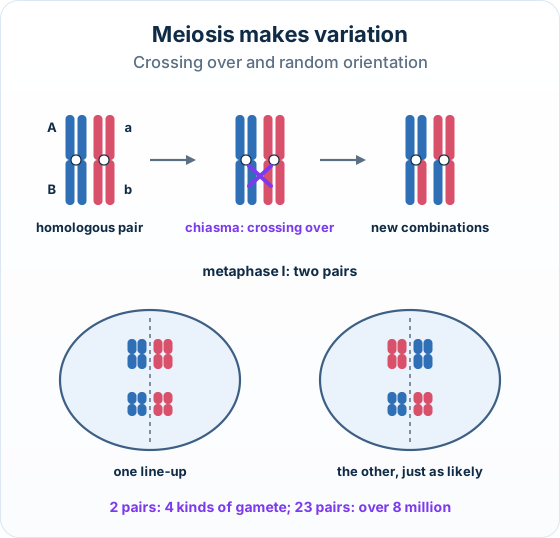
The big idea: Meiosis makes every gamete genetically different in two ways: crossing over and the random orientation of bivalents.
The points to remember
- A bivalent is a pair of homologous chromosomes lying together in meiosis I.
- Crossing over (prophase I): non-sister chromatids swap sections, making new combinations of alleles on a chromosome.
- Random orientation (metaphase I): each bivalent faces either pole, independently of the others.
- So gametes get different mixes of chromosomes from the mother and the father.
- With n pairs there are 2 to the power n possible combinations, before crossing over.
Remember it as: Swap sections, then shuffle the pairs.
Real example: brothers and sisters. Brothers and sisters have the same two parents, yet (unless they are identical twins) they look different, because each came from a different egg and sperm, made with different shuffles in meiosis.
Free preview
This is the free notes preview
You're reading the free notes. Aimnova Pro unlocks the full study experience — and you can try it with your first topic free to keep:
- FlashcardsLock in vocabulary and key terms with spaced repetition.
- Practice questionsAnswer exam-style questions and get instant AI marking.
- Mock exams & past-paper vaultSit full mocks and see exactly how examiners award marks.
- Personalised study planA daily plan built around your exam date and weak areas.
Start Studying Free Full access to Aimnova Pro · cancel anytime
Two sources, compared: Both happen in the first division of meiosis, and both are random.
| Crossing over | Random orientation | |
|---|---|---|
| When | Prophase I | Metaphase I |
| What happens | Non-sister chromatids swap sections | Each bivalent lines up facing either pole |
| What it mixes | Alleles along one chromosome | Whole chromosomes from each parent |
| Result | Recombinant chromatids | Different chromosome mixes in gametes |
And then fertilisation: Meiosis makes varied gametes; random fertilisation of any egg by any sperm from two different parents adds still more variation.
Study smarter, not longer
Most students waste 40% of study time on topics they already know. Our AI tracks your progress and optimizes every minute.
Try Smart Study FreeYour first topic is free to keep • No credit card required
How it is asked: A 1A item on what increases variation (random orientation of bivalents, not mitosis or asexual reproduction), or a long Paper 2 answer on how meiosis leads to variation.
IB-style questionExplain[4 marks]
Explain how meiosis produces gametes that are genetically different.
Model answer plan
See the answer broken into clear points, with guidance on how each point earns marks.