The big idea: Most mutations change just a few DNA bases inside one gene. A chromosome mutation is bigger: a whole chromosome is gained or lost.
How it happens
Non-disjunction
The usual cause: chromosomes fail to separate correctly during meiosis (the division that makes gametes).
Wrong gamete
A gamete ends up with the wrong number of chromosomes.
Fertilisation
If that gamete is fertilised, the new individual has an extra (or missing) whole chromosome.
Example
Three copies of chromosome 21 causes Down syndrome.
- Chromosome mutation
- A change to whole chromosomes — usually a change in the NUMBER of chromosomes in a cell, rather than a change to the DNA bases of a single gene.
- Non-disjunction
- The failure of chromosomes (in meiosis I) or sister chromatids (in meiosis II) to separate properly during meiosis, so they end up in the same gamete.
- Aneuploidy
- Having an abnormal number of chromosomes — one too many or one too few — rather than a complete extra or missing set.
- Trisomy
- Having three copies of a particular chromosome instead of the normal two (for example trisomy 21).
- Down syndrome
- The condition caused by having three copies of chromosome 21 (trisomy 21).
The word tells you what happens: Disjunction means 'separating'. Non-disjunction therefore means 'not separating'.
The chromosomes that should move to opposite ends of the cell instead go to the same end — so one gamete gets too many and the other gets too few.
Free preview
This is the free notes preview
You're reading the free notes. Aimnova Pro unlocks the full study experience — and you can try it with your first topic free to keep:
- FlashcardsLock in vocabulary and key terms with spaced repetition.
- Practice questionsAnswer exam-style questions and get instant AI marking.
- Mock exams & past-paper vaultSit full mocks and see exactly how examiners award marks.
- Personalised study planA daily plan built around your exam date and weak areas.
To see how non-disjunction causes Down syndrome, first recall what normal meiosis should do: separate chromosomes so each gamete carries exactly one copy of every chromosome.
Normal meiosis: homologous chromosomes separate in meiosis I and sister chromatids separate in meiosis II, so every gamete ends up with the correct, halved chromosome number. Non-disjunction is the failure of one of these separation steps.
Interactive diagram
Explore the labelled diagram, charts and maps for this topic in full study mode.
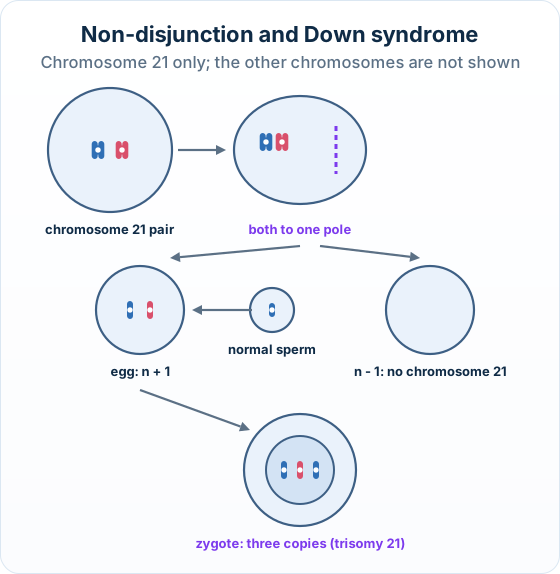
Step 1 — separation fails in meiosis: In non-disjunction, chromosome 21 (or its chromatids) fails to separate, so both copies go into the same cell.
Should separate in meiosis I
- Homologous chromosomes are meant to be pulled to opposite poles.
Should separate in meiosis II
- Sister chromatids are meant to be pulled to opposite poles.
The result: One gamete has an extra chromosome 21 (n + 1), while another gamete is left missing that chromosome (n − 1).
Step 2 — fertilisation adds the normal copy: The abnormal gamete already carries two copies of chromosome 21.
At fertilisation it joins a normal gamete, which brings one more copy.
The zygote therefore has three copies of chromosome 21 — trisomy 21. Because every cell of the body is made from this zygote by mitosis, all the cells carry the extra chromosome, giving Down syndrome.
| When it happens | What fails to separate | Result in the gamete |
|---|---|---|
| Meiosis I | A pair of homologous chromosomes does not separate | A gamete with an extra whole chromosome (n + 1) and another with one missing (n − 1) |
| Meiosis II | Sister chromatids do not separate | Again, one gamete gains an extra copy (n + 1) and another lacks one (n − 1) |
| After fertilisation | An n + 1 gamete joins a normal n gamete | A zygote with three copies of one chromosome (trisomy, 2n + 1) |
Normal meiosis
- Chromosomes separate correctly
- Each gamete gets one copy of each chromosome
- Fertilisation restores the normal number (2n)
- The offspring has the correct chromosome number
Non-disjunction
- Chromosomes fail to separate
- One gamete gets an extra copy (n + 1), another is short one (n − 1)
- Fertilisation adds a normal copy → three copies (2n + 1)
- The offspring has an extra whole chromosome (e.g. trisomy 21)
Why it is a WHOLE chromosome: Non-disjunction is not a change to the DNA bases — it does not rewrite a gene.
It moves an entire chromosome into the wrong gamete, so the error is on the scale of whole chromosomes and can even be seen on a karyogram as an extra band.
| Feature | Gene (point) mutation | Chromosome mutation |
|---|---|---|
| Scale of change | A change to a few DNA bases within one gene | A change to whole chromosomes (a whole chromosome added or lost) |
| What is altered | The base sequence of a single gene | The number (or structure) of chromosomes in the cell |
| Typical cause | An error in DNA replication or a mutagen | Non-disjunction during meiosis |
| Visible on a karyogram? | No — far too small to see | Yes — an extra or missing whole chromosome can be seen |
| Example | Sickle-cell anaemia (one base substitution) | Down syndrome (an extra chromosome 21 = trisomy 21) |
Know your predicted grade
Take timed mock exams and get detailed feedback on every answer. See exactly where you're losing marks.
The big idea: Down syndrome is an example of an error in meiosis: non-disjunction of chromosome 21 gives a gamete with two copies, and fertilisation makes three.
The points to remember
- Non-disjunction: chromosomes (meiosis I) or sister chromatids (meiosis II) fail to separate.
- One gamete gets an extra chromosome (n + 1); another is missing one (n - 1).
- An n + 1 gamete fused with a normal gamete gives 2n + 1: a trisomy.
- Three copies of chromosome 21 cause Down syndrome.
- The extra chromosome is in every cell, because all body cells come from the zygote by mitosis.
Remember it as: Fail to separate, one too many, three copies.
Real example: how common it is. Down syndrome is the most common chromosome condition at birth: in the United States about 1 in every 640 babies is born with it.
How it is asked: A 1A karyogram with an extra chromosome (what caused it?), a data item on parents' ages, or a three-mark 'explain how non-disjunction leads to trisomy 21'.
Explain how non-disjunction can lead to a child being born with Down syndrome.
Model answer plan
See the answer broken into clear points, with guidance on how each point earns marks.
Not a gene mutation: Down syndrome is not a change in the bases of a gene: a whole chromosome is extra, which is why it shows on a karyogram.