The big idea: A mutation is a random change in the DNA base sequence. What happens next depends on which cell it occurs in.
Germline mutation
- Happens in a cell that makes gametes (egg or sperm).
- It can be inherited — passed on to offspring.
Somatic mutation
- Happens in any other body cell.
- It cannot be inherited — it stays in that one individual and only affects the cells that descend from the mutated cell.
- Mutation
- A random change in the base (DNA) sequence of a gene or chromosome.
- Germline mutation
- A mutation in a gamete (egg or sperm) or in a cell that forms gametes. It can be passed on to offspring, so it is heritable.
- Somatic mutation
- A mutation in any body cell other than a gamete-forming cell. It is not passed on to offspring (it is non-heritable).
- Gamete
- A reproductive cell — an egg or a sperm — that joins with another to form offspring.
- Heritable
- Able to be passed from parent to offspring through the gametes.
| Feature | Germline mutation | Somatic mutation |
|---|---|---|
| Which cell it happens in | A gamete-forming cell (in the ovary or testis), or a gamete (egg or sperm) | Any other body cell (skin, lung, gut, etc.) |
| Can it be inherited? | YES — passed to offspring through the egg or sperm | NO — not passed to offspring; it stays in that individual |
| Who is affected | Every cell of the offspring carries it | Only the cells descended from the one mutated cell |
| Example | A mutation in a sperm cell that a child then inherits | A mutation in a lung cell caused by tobacco smoke |
The one question that decides it: To tell germline from somatic, ask: could this mutation be passed to a child?
If the mutated cell is a gamete (egg/sperm) or makes gametes → germline → heritable.
If it is any other body cell (skin, lung, gut...) → somatic → not heritable.
Free preview
This is the free notes preview
You're reading the free notes. Aimnova Pro unlocks the full study experience — and you can try it with your first topic free to keep:
- FlashcardsLock in vocabulary and key terms with spaced repetition.
- Practice questionsAnswer exam-style questions and get instant AI marking.
- Mock exams & past-paper vaultSit full mocks and see exactly how examiners award marks.
- Personalised study planA daily plan built around your exam date and weak areas.
Mutations happen at a low rate all the time. But some agents make them much more likely — these are called mutagens.
The link to cancer: When a mutagen damages a body cell's DNA and the mutation lands in a gene that controls cell division, the result can be cancer.
- Mutagen
- An agent that increases the rate of mutation — for example ultraviolet (UV) light, X-rays, or chemicals in tobacco smoke.
- Carcinogen
- A mutagen that specifically increases the risk of cancer (for example the chemicals in tobacco smoke).
- Tumour
- A mass of cells produced by uncontrolled cell division.
- Cancer
- A disease in which body cells divide uncontrollably, forming a tumour that can invade and spread to other tissues.
- Metastasis
- The spread of cancer cells from the original tumour to other parts of the body.
Mutagens — what raises the mutation rate: A mutagen is anything that makes mutations more likely. Common examples:
Radiation — ultraviolet (UV) light, X-rays and gamma rays.
Chemicals — the many chemicals in tobacco smoke, and some industrial chemicals.
A mutagen that causes cancer is also called a carcinogen.
| Mutagen | Type | Everyday example |
|---|---|---|
| Ultraviolet (UV) light | Radiation | Strong sunlight / sunbeds → skin-cell mutations |
| X-rays / gamma rays | Radiation | High doses of ionising radiation |
| Chemicals in tobacco smoke | Chemical | Smoking → lung-cell mutations |
| Some industrial chemicals | Chemical | Certain solvents and pollutants |
How a mutation becomes cancer: Cancer develops as a chain of events.
From mutagen to tumour
Damage
A mutagen damages a cell's DNA.
Mutation
A mutation arises in a gene that controls cell division.
Uncontrolled division
The cell divides uncontrollably.
Accumulation
Over time several mutations accumulate in that cell line.
Tumour
A tumour forms, which may become malignant and spread (metastasis).
Several mutations, not one: Cancer usually needs an accumulation of several mutations, not just one — which is why the risk rises with repeated exposure and with age.
| Step | What happens | Why it matters |
|---|---|---|
| 1. Mutagen acts | A mutagen (e.g. tobacco chemicals, UV light) damages the DNA of a body cell | Mutagens raise the mutation rate |
| 2. Mutation occurs | A mutation arises in a gene that controls cell division / the cell cycle | The cell loses its normal 'stop' signals |
| 3. Uncontrolled division | The cell divides repeatedly and uncontrollably | Cells are made faster than the body needs |
| 4. Mutations accumulate | Several mutations build up in the same cell line over time | More controls are lost; the cell becomes more abnormal |
| 5. Tumour forms | The mass of dividing cells forms a tumour (which may become malignant and spread) | A malignant tumour that spreads is cancer |
Germline mutation
- Happens in a gamete (egg/sperm) or gamete-forming cell
- Can be inherited by offspring
- Found in every cell of any child who inherits it
- Does not cause cancer in the parent
Somatic mutation
- Happens in any other body cell (skin, lung, gut...)
- Cannot be inherited
- Found only in cells descended from the mutated cell
- Can cause cancer if it hits a cell-division gene
An easy way to remember: Mutagen → mutation → uncontrolled division → tumour. That is the whole cancer story in four steps.
And cancer is almost always a somatic event: it arises in body cells, so it is not inherited — only the risk (from inherited genes) can run in families.
Learn what examiners really want
See exactly what to write to score full marks. Our AI shows you model answers and the key phrases examiners look for.
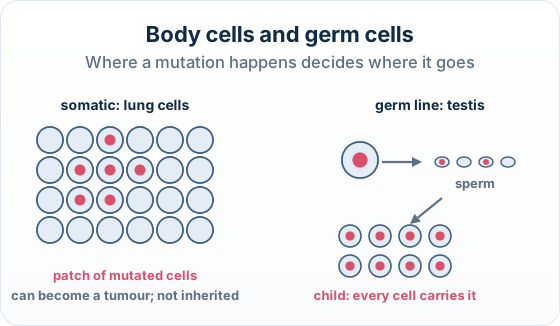
The big idea: A mutation in a germ cell can be inherited. A mutation in a somatic (body) cell stays in that person, and can lead to cancer.
The points to remember
- Germ cells make gametes (eggs or sperm); their mutations can pass to offspring.
- An inherited mutation is in every cell of the child.
- Somatic cells are all the other body cells; their mutations are not inherited.
- A somatic mutation is passed only to the daughter cells of the cell where it happened.
- If it hits genes that control cell division, a somatic mutation can lead to cancer.
Remember it as: Germ line: to the children. Soma: stays put, may become cancer.
Real example: two kinds of cancer risk. Some families carry an inherited (germline) mutation in the BRCA1 gene, which raises the risk of breast cancer. Most lung cancers, by contrast, come from somatic mutations caused by smoking and are not inherited.
How this is tested: Expect three question types here, from a 1-mark Identify up to a 4-mark Outline.
| Question | What is asked | What to give |
|---|---|---|
| 1-mark Identify | From a list of cells, which one's mutation could be inherited | A gamete-forming (germline) cell, such as a cell in the testis or ovary, or a sperm or egg |
| Short Explain | The mechanism by which smoking causes cancer | Link the chemicals (mutagens) to mutations in lung-cell DNA, then to uncontrolled division |
| 4-mark Outline | Outline how a mutation can lead to cancer | The separate scoring steps from mutagen through to tumour |
Exam-style question — outline how mutation leads to cancer
Outline how a mutation can lead to the development of cancer. [4]
How to score all four marks
- Start with the cause. A mutagen (such as the chemicals in tobacco smoke or UV light) causes a mutation in the DNA of a body cell.
- Hit a control gene. The mutation occurs in a gene that controls cell division (the cell cycle), so the cell's normal 'stop' signals are lost.
- Uncontrolled division. The affected cell then divides uncontrollably, producing far more cells than the body needs.
- Accumulate and form a tumour. As several mutations accumulate in that cell line, the dividing cells form a tumour, which may become malignant and spread.
Final answer
A mutagen causes a mutation in a gene controlling cell division; the cell then divides uncontrollably; further mutations accumulate; and the dividing cells form a tumour that can become malignant.
Why this scores full marks: Each sentence is a separate, distinct step — mutagen → mutation in a cell-division gene → uncontrolled division → accumulation → tumour.
A 4-mark 'outline' needs four scoring points in a clear cause-and-effect chain, not one idea written four ways.
| Step | What happens | Why it matters |
|---|---|---|
| 1. Mutagen acts | A mutagen (e.g. tobacco chemicals, UV light) damages the DNA of a body cell | Mutagens raise the mutation rate |
| 2. Mutation occurs | A mutation arises in a gene that controls cell division / the cell cycle | The cell loses its normal 'stop' signals |
| 3. Uncontrolled division | The cell divides repeatedly and uncontrollably | Cells are made faster than the body needs |
| 4. Mutations accumulate | Several mutations build up in the same cell line over time | More controls are lost; the cell becomes more abnormal |
| 5. Tumour forms | The mass of dividing cells forms a tumour (which may become malignant and spread) | A malignant tumour that spreads is cancer |