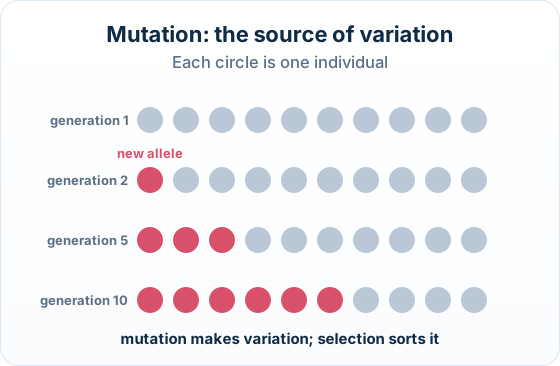
The big idea: Gene mutation is the original source of all genetic variation: every new allele began as a mutation.
The points to remember
- A mutation changes a gene's base sequence, producing a new allele.
- Meiosis and fertilisation reshuffle alleles, but only mutation makes new ones.
- For an individual, most mutations are harmful or neutral.
- Rarely a mutation is beneficial: it helps its carrier survive and reproduce.
- Natural selection makes beneficial alleles more common: in the long term mutation is essential for evolution.
Remember it as: Mutation makes the variation; natural selection sorts it.
Real example: the peppered moth. The dark form of the peppered moth in Britain traces back to a single mutation in one moth, around 1819. In soot-blackened industrial areas dark moths were eaten less by birds, so the new allele spread.
Free preview
This is the free notes preview
You're reading the free notes. Aimnova Pro unlocks the full study experience — and you can try it with your first topic free to keep:
- FlashcardsLock in vocabulary and key terms with spaced repetition.
- Practice questionsAnswer exam-style questions and get instant AI marking.
- Mock exams & past-paper vaultSit full mocks and see exactly how examiners award marks.
- Personalised study planA daily plan built around your exam date and weak areas.
Start Studying Free Full access to Aimnova Pro · cancel anytime
Harmful, neutral, beneficial: What happens to a new allele depends on its effect on survival and reproduction.
| Effect of the new allele | How common | What usually happens to it |
|---|---|---|
| Harmful | Common | Carriers leave fewer offspring, so it stays rare |
| Neutral | Most common | No effect on survival; it may stay, spread or vanish by chance |
| Beneficial | Rare | Carriers leave more offspring, so it becomes more common |
Only heritable mutations count: Only mutations in germ cells are passed on, so only they add variation to the next generation.
Learn what examiners really want
See exactly what to write to score full marks. Our AI shows you model answers and the key phrases examiners look for.
Try AI Feedback FreeYour first topic is free to keep • No credit card required
How it is asked: A one-mark 'cause of a new allele' (mutation), a 1A item on how alleles arise, or a long answer on causes and consequences of mutation over generations.
IB-style questionExplain[3 marks]
Explain the importance of mutation in the evolution of a species.
Model answer plan
See the answer broken into clear points, with guidance on how each point earns marks.