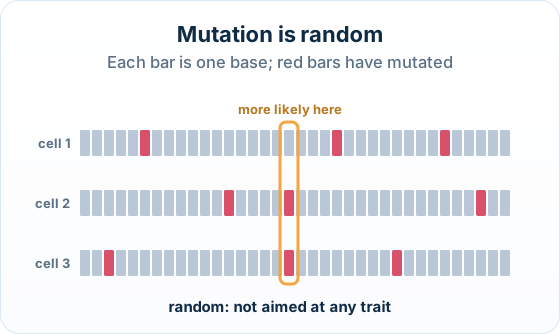
The big idea: Mutations are random: they can happen anywhere in the genome, and nothing aims them at a useful trait.
The points to remember
- A mutation can occur anywhere in the base sequence of a genome.
- Where and when a mutation happens cannot be predicted.
- Some bases have a higher probability of mutating than others.
- No natural mechanism makes a deliberate change to a particular base to change a trait.
- Mutagens raise the rate of mutation, but not its direction.
Remember it as: Anywhere, any time, never on purpose.
Real example: C next to G. In human DNA, a cytosine that is followed by a guanine mutates far more often than most other bases. Mutations are random, but not equally likely at every base.
Free preview
This is the free notes preview
You're reading the free notes. Aimnova Pro unlocks the full study experience — and you can try it with your first topic free to keep:
- FlashcardsLock in vocabulary and key terms with spaced repetition.
- Practice questionsAnswer exam-style questions and get instant AI marking.
- Mock exams & past-paper vaultSit full mocks and see exactly how examiners award marks.
- Personalised study planA daily plan built around your exam date and weak areas.
Start Studying Free Full access to Aimnova Pro · cancel anytime
What 'random' means: Random means unpredictable and not aimed, not 'equally likely everywhere'.
True of mutations
- Can happen anywhere in the genome
- Cannot be predicted
- Some bases mutate more often
- Rate raised by mutagens
Not true of mutations
- Happen only in certain genes
- Happen because the organism needs them
- Are aimed at a useful trait
- Only happen in germ cells
Need does not cause mutation: Bacteria do not mutate because an antibiotic is present. Resistant mutants arise by chance; the antibiotic then selects them.
Know your predicted grade
Take timed mock exams and get detailed feedback on every answer. See exactly where you're losing marks.
Try Mock Exams FreeYour first topic is free to keep • No credit card required
How it is asked: A 1A item asking for a true general feature of mutations: they occur randomly.
IB-style questionOutline[2 marks]
Outline what is meant by saying that mutations are random.
Model answer plan
See the answer broken into clear points, with guidance on how each point earns marks.