The big idea: Coral reefs face two threats from rising carbon dioxide. Ocean acidification suppresses calcification, so corals build their skeletons more slowly. Warmer water causes coral bleaching. Loss of corals can cause the collapse of the whole reef ecosystem.
See it drawn, step by step
In My Learning, handwritten diagrams build one step at a time. Play, pause and replay each explanation until it clicks. Create your free account to try it.
- Ocean acidification
- The fall in the pH of sea water as it absorbs more carbon dioxide, which forms carbonic acid.
- Calcification
- The building of calcium carbonate skeletons and shells, using carbonate ions from sea water.
- Zooxanthellae
- Photosynthetic algae that live inside coral tissues and supply the coral with most of its food.
- Coral bleaching
- The loss of zooxanthellae from stressed corals, which turn white.
The points to remember
- The sea is still slightly alkaline. 'Acidification' means its pH is falling.
- Acidification and bleaching have different causes: carbon dioxide dissolving v higher temperature.
- Bleached corals can recover if the heat ends quickly; long heatwaves kill them.
Remember it as: Carbon dioxide in: carbonate down.
Free preview
This is the free notes preview
You're reading the free notes. Aimnova Pro unlocks the full study experience — and you can try it with your first topic free to keep:
- FlashcardsLock in vocabulary and key terms with spaced repetition.
- Practice questionsAnswer exam-style questions and get instant AI marking.
- Mock exams & past-paper vaultSit full mocks and see exactly how examiners award marks.
- Personalised study planA daily plan built around your exam date and weak areas.
See it drawn, step by step
In My Learning, handwritten diagrams build one step at a time. Play, pause and replay each explanation until it clicks. Create your free account to try it.
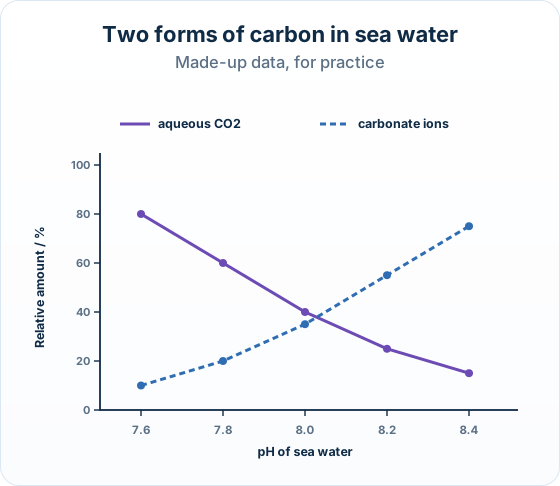
Real data: Surface ocean pH has fallen by about 0.1, from 8.2 to 8.1, since the industrial revolution (Garcia-Soto and others, 2021). The Great Barrier Reef had mass bleaching in 1998, 2002, 2016, 2017, 2020, 2022 and 2024 (Great Barrier Reef Marine Park Authority).
The points to remember
- Natural factors also change the pH of sea water: temperature, upwelling, photosynthesis, respiration, run-off from rivers.
- Corals are the foundation of the reef: when they die the whole ecosystem can collapse.
- Calcifying animals such as molluscs are also harmed by acidification.
Remember it as: Acid weakens, heat bleaches, the reef falls.
Feeling unprepared for exams?
Get a clear study plan, practice with real questions, and know exactly where you stand before exam day. No more guessing.
How it is asked: Paper 2 asks you to explain the effect of warmer water on corals [3], to describe how rising carbon dioxide alters reefs [4], or to read graphs of ocean chemistry and predict effects on reef species.
Explain the effect of an increase in water temperature on corals.
Model answer plan
See the answer broken into clear points, with guidance on how each point earns marks.