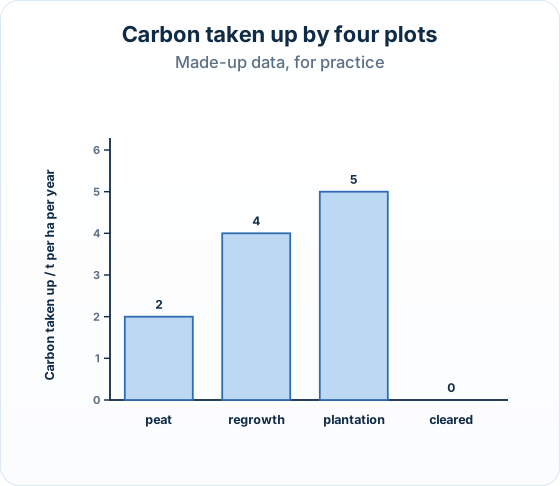
The big idea: Carbon sequestration is the long-term storage of carbon taken out of the atmosphere. Afforestation, forest regeneration and restoring peat-forming wetlands all make carbon sinks that take up more carbon dioxide than they release.
See it drawn, step by step
In My Learning, handwritten diagrams build one step at a time. Play, pause and replay each explanation until it clicks. Create your free account to try it.
- Carbon sequestration
- The long-term storage of carbon that has been removed from the atmosphere, for example in wood, soil or peat.
- Afforestation
- Planting trees on land that has not had forest for a long time.
- Forest regeneration
- Letting a cleared or damaged forest grow back, naturally or with help.
- Peat
- Partly decomposed plant matter that builds up in waterlogged soil, where lack of oxygen slows decomposition.
- Carbon sink
- A store or process that takes up more carbon dioxide than it releases.
The points to remember
- A forest is a sink only while it is growing or while its stores stay intact.
- Drained peat decomposes and becomes a carbon source.
- Rewetting a peatland increases sequestration; deforestation decreases it.
Remember it as: Sinks: growing forests and wet peat.
Free preview
This is the free notes preview
You're reading the free notes. Aimnova Pro unlocks the full study experience — and you can try it with your first topic free to keep:
- FlashcardsLock in vocabulary and key terms with spaced repetition.
- Practice questionsAnswer exam-style questions and get instant AI marking.
- Mock exams & past-paper vaultSit full mocks and see exactly how examiners award marks.
- Personalised study planA daily plan built around your exam date and weak areas.
Plantations of non-native trees
- Often fast-growing, so they take up carbon quickly
- Usually one species: little biodiversity
- Wood may be harvested, releasing carbon later
Rewilding with native species
- Slower at first, but stores carbon for a long time
- Supports many native species
- Forms a stable ecosystem that can regenerate itself
The points to remember
- Scientists still debate which is best. Speed of uptake is one point; biodiversity and how long the carbon stays stored are others.
- Deforestation decreases carbon sequestration: it removes a sink and burning releases the stored carbon.
- Peat forms in temperate and boreal zones, and very rapidly in some tropical wetlands.
Remember it as: Grow trees, wet the peat, lock the carbon away.
Study smarter, not longer
Most students waste 40% of study time on topics they already know. Our AI tracks your progress and optimizes every minute.
How it is asked: Paper 1A asks which action decreases (or increases) carbon sequestration. Paper 2 can ask how a forest or a peatland stores carbon, or to discuss plantations against rewilding.
A peatland was drained for farming fifty years ago. Explain how blocking its drains can help to reduce the carbon dioxide in the atmosphere.
Model answer plan
See the answer broken into clear points, with guidance on how each point earns marks.