The big idea: Each species lives where conditions are within its tolerance range. As the climate warms, those conditions move upslope on mountains and poleward across continents, so species shift their ranges to follow them.
See it drawn, step by step
In My Learning, handwritten diagrams build one step at a time. Play, pause and replay each explanation until it clicks. Create your free account to try it.
- Range (distribution)
- The geographical area in which a species is found.
- Upslope shift
- A move of a species' range to higher altitudes on a mountain.
- Poleward shift
- A move of a species' range towards the poles: north in the northern hemisphere.
- Hardiness zone
- An area defined by its average lowest winter temperature, which sets which plants can survive there.
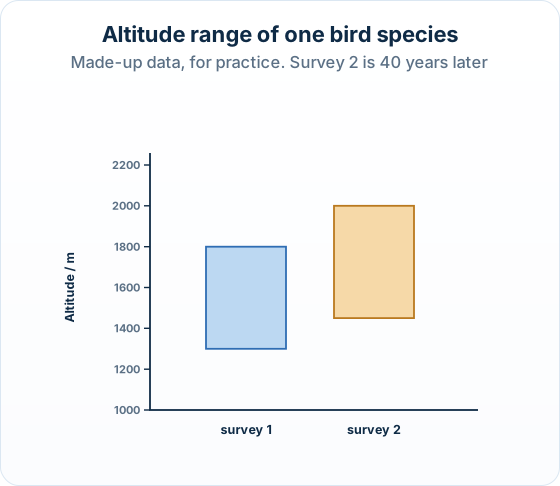
Two real cases: New Guinea: on Mount Karimui, bird surveys in 1965 and 2012 showed that the upper limits of the species had risen by 113 m on average (Freeman and Class Freeman, 2014).
North America: of 86 tree species of the eastern USA, 62% shifted their abundance towards the pole between 1980 and 2015 (Fei and others, 2017).
The points to remember
- Each species shifts at its own rate, so species that lived together may be separated.
- The warm edge retreats; the cool edge advances.
Remember it as: Up the mountain, towards the pole.
Free preview
This is the free notes preview
You're reading the free notes. Aimnova Pro unlocks the full study experience — and you can try it with your first topic free to keep:
- FlashcardsLock in vocabulary and key terms with spaced repetition.
- Practice questionsAnswer exam-style questions and get instant AI marking.
- Mock exams & past-paper vaultSit full mocks and see exactly how examiners award marks.
- Personalised study planA daily plan built around your exam date and weak areas.
Start Studying Free Full access to Aimnova Pro · cancel anytime
| Part of the range | What happens as the climate warms |
|---|---|
| Cool edge (higher up, or nearer the pole) | Becomes suitable: the species spreads into it |
| Warm edge (lower down, or nearer the equator) | Becomes too hot or dry: the range contracts |
| Species at a summit or a coast | Nowhere to move: may be lost |
Community change in a lake: In a warming lake, cold-water fish decline and warm-tolerant fish spread, so the community changes. Warmer water also holds less dissolved oxygen.
The points to remember
- A hardiness zone is an area with a given lowest winter temperature. As zones move north, trees can spread northwards.
- Species move at different rates, so the community structure changes.
- In an exam you may use the common name or the scientific name.
Remember it as: Too warm? Go up or go north.
Get feedback like a real examiner
Submit your answers and get instant feedback — what you did well, what's missing, and exactly what to write to score full marks.
Try AI Tutor FreeYour first topic is free to keep • No credit card required
How it is asked: Paper 1A shows a map of hardiness zones and asks for a likely consequence. Paper 2 asks you to describe the upslope shift of New Guinea birds [2] or to predict an effect of warming on a community [1].
IB-style questionDescribe[2 marks]
Describe the upslope range shift of montane bird species in New Guinea.
Model answer plan
See the answer broken into clear points, with guidance on how each point earns marks.