aımnova
DashboardMy LearningCrash CoursesStudy Plan

Aimnova site navigation

Stay in the loop

Get the latest study resources and updates

New features, study tips and exam insights — straight to your inbox.

IB Diploma

  • IB Past Papers
  • IB Study Notes
  • IB Question Bank
  • IB Mock Exams
  • IB Revision

IB Subjects

  • IB Math AA
  • IB Math AI
  • IB Economics
  • IB Business Management
  • IB Physics
  • IB Biology
  • View all IB subjects→

IB Past Papers

  • IB Math AA HL Past Papers
  • IB Math AA SL Past Papers
  • IB Math AI HL Past Papers
  • IB Math AI SL Past Papers
  • IB Economics HL Past Papers
  • IB Economics SL Past Papers
  • IB ESS Past Papers
  • View all past papers→

Study Resources

  • Study Notes
  • Question Bank
  • Mock Exams
  • Crash Courses
  • Flashcards
  • Revision Guide
  • Exam Skills
  • Command Terms
  • Grade Calculator
  • Exam Timetable 2027

Aimnova

  • Features
  • Pricing
  • For Teachers
  • For Schools
  • For Parents
  • About Us
  • Blog
  • Contact
aımnova

IB study, practice and feedback built around the real exam.

TermsPrivacyCookies·© 2026 Aimnova. All rights reserved.d9e1c61

Aimnova is not affiliated with or endorsed by the International Baccalaureate Organization (IB).

NotesBiologyTopic 4.12Changes in ocean currents altering the timing and extent of nutrient upwelling
Back to Biology Topics
4.12.53 min read

Changes in ocean currents altering the timing and extent of nutrient upwelling

IB Biology · Unit 4

Exam preparation

Practice the questions examiners actually ask

Our question bank mirrors real IB exam papers. Practice under timed conditions and track your progress across topics.

Start Practicing

Contents

  1. 1Upwelling and what blocks it
  2. 2Effects on food chains
  3. 3Exam-style question (step by step)
The big idea: Upwelling brings cold, nutrient-rich deep water to the surface. Warmer surface water and changes in ocean currents can prevent upwelling or change when it happens, so ocean primary production and energy flow through marine food chains decrease.

See it drawn, step by step

In My Learning, handwritten diagrams build one step at a time. Play, pause and replay each explanation until it clicks. Create your free account to try it.

Claim your free topic
Upwelling
The rising of cold, nutrient-rich deep water to the surface of the ocean, driven by winds and currents.
Phytoplankton
Microscopic producers in the surface water of the sea; they carry out most ocean primary production.
Ocean primary production
The rate at which producers in the ocean make organic matter by photosynthesis.

The points to remember

  • Nutrients sink, because dead organisms sink. Upwelling brings them back up.
  • Warm water is less dense, so it floats as a layer on top and blocks mixing.
  • Upwelling zones are among the most productive fisheries on Earth.
Remember it as: Warm on top stops the rise.

Free preview

This is the free notes preview

You're reading the free notes. Aimnova Pro unlocks the full study experience — and you can try it with your first topic free to keep:

  • FlashcardsLock in vocabulary and key terms with spaced repetition.
  • Practice questionsAnswer exam-style questions and get instant AI marking.
  • Mock exams & past-paper vaultSit full mocks and see exactly how examiners award marks.
  • Personalised study planA daily plan built around your exam date and weak areas.
Start Studying Free Full access to Aimnova Pro · cancel anytime
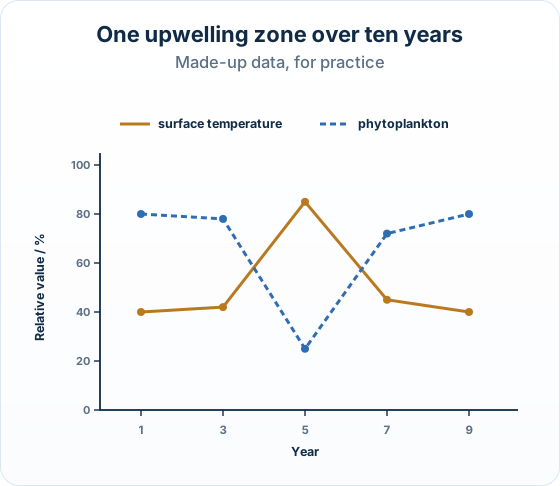
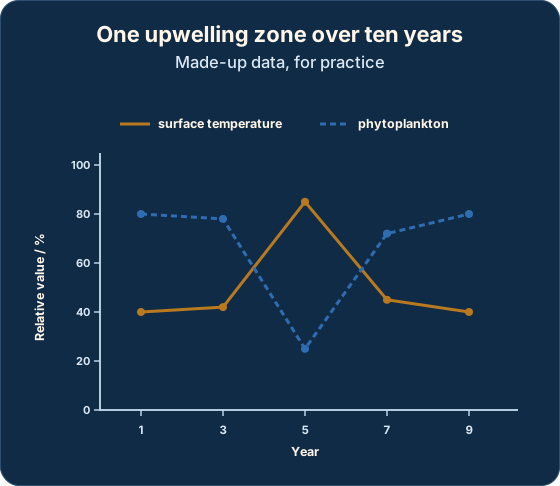
Line graph of an upwelling zone over ten years. In year 5 the surface temperature rises to 85 per cent while phytoplankton falls to 25 per cent; both return in later yearsLine graph of an upwelling zone over ten years. In year 5 the surface temperature rises to 85 per cent while phytoplankton falls to 25 per cent; both return in later years
Surface temperature and phytoplankton in one upwelling zone (made-up data). In the warm year, phytoplankton falls.
Level of the food chainEffect of less upwelling
Phytoplankton (producers)Fewer nutrients, so less growth: primary production falls
ZooplanktonLess food
Fish such as anchoviesFewer fish survive
Seabirds, seals, people who fishLess food, so populations and catches fall
A real case: During El Niño, weaker trade winds let a warm surface layer deepen in the eastern Pacific. Upwelling is suppressed and phytoplankton decline, with effects on fish, seabirds and marine mammals (NASA Earth Observatory).

The points to remember

  • Timing matters too: if upwelling starts later, the food peak may miss the time when young fish or birds need it.
  • Write less energy flow through marine food chains, not only 'fewer fish'.
Remember it as: No upwelling, no nutrients, no bloom.

See how examiners mark answers

Answer exam-style questions with model answers. Learn exactly what earns marks and what doesn't.

Try Exam Vault FreeYour first topic is free to keep • No credit card required
How it is asked: Paper 1A asks for a consequence of very warm ocean water (reduced upwelling). Paper 2 asks how changing currents affect marine ecosystems, often together with melting ice, in 2 to 4 marks.
IB-style questionExplain[3 marks]

The surface water of an ocean region has become warmer. Explain how this could reduce the number of fish in the region.

Model answer plan

See the answer broken into clear points, with guidance on how each point earns marks.

Claim your free topic

Try an IB Exam Question — Free AI Feedback

Test yourself on Changes in ocean currents altering the timing and extent of nutrient upwelling. Write your answer and get instant AI feedback — just like a real IB examiner.

how a change in the timing of upwelling could harm a population of seabirds that breed on a coast. [2 marks]

Related Biology Topics

Continue learning with these related topics from the same unit:

4.1.1DNA replication as production of exact copies of DNA with identical base sequences4.1.2Semi-conservative nature of DNA replication and role of complementary base pairing4.1.3Role of helicase and DNA polymerase in DNA replication4.1.4Polymerase chain reaction and gel electrophoresis as tools for amplifying and separating DNA
View all Biology topics
Improve your exam techniqueCommand terms, paper structure, and mark-scheme tips for Biology
Previous4.12.4Melting of landfast ice and sea ice as examples of polar habitat changeNextPoleward and upslope range shifts of temperate species4.12.6

7 questions to test your understanding

Reading is just the start. Students who tested themselves scored 82% on average — try IB-style questions with AI feedback.

Start FreeView All Biology Topics