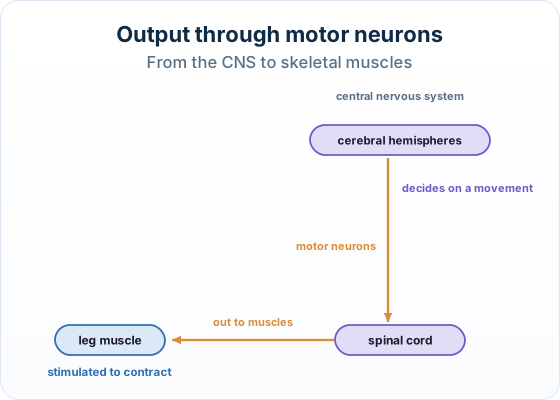
The big idea: When the cerebral hemispheres decide on a movement, motor neurons carry impulses out of the CNS: down through the spinal cord and out to skeletal muscles. The impulses stimulate the muscles to contract, and the body moves.
The points to remember
- The cerebral hemispheres decide on a voluntary movement.
- Motor neurons carry impulses away from the CNS.
- They run down the spinal cord and out in nerves.
- They end at skeletal muscles.
- The impulses stimulate the muscle to contract.
Remember it as: Motor: from the CNS, to make things move.
Real example: kicking a ball. To kick, your cerebral hemispheres send impulses along motor neurons down the spinal cord and out to the muscles of your leg. Each impulse that arrives stimulates muscle fibres to contract.
Trap: Motor neurons do not carry information to the brain: they carry impulses from the CNS to effectors, such as muscles.
Free preview
This is the free notes preview
You're reading the free notes. Aimnova Pro unlocks the full study experience — and you can try it with your first topic free to keep:
- FlashcardsLock in vocabulary and key terms with spaced repetition.
- Practice questionsAnswer exam-style questions and get instant AI marking.
- Mock exams & past-paper vaultSit full mocks and see exactly how examiners award marks.
- Personalised study planA daily plan built around your exam date and weak areas.
Start Studying Free Full access to Aimnova Pro · cancel anytime
How it is asked: Expect an MCQ on which neurons signal skeletal muscle, or a short question on how the brain makes a muscle contract.
IB-style questionOutline[2 marks]
Outline how the cerebral hemispheres cause a skeletal muscle to contract.
Model answer plan
See the answer broken into clear points, with guidance on how each point earns marks.