The key difference between the two halves of metabolism is the direction of the reaction and what happens to energy.
Anabolic reactions
- Join small subunits into larger molecules
- This costs energy
Catabolic reactions
- Split large molecules into smaller ones
- This releases energy
Anabolism — building, using energy: In anabolism, small subunits (monomers) are joined to make larger molecules (polymers and other macromolecules).
This building work requires energy.
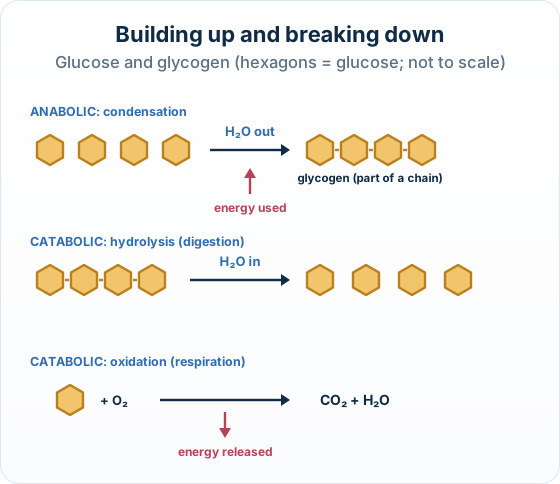
Most anabolic reactions are condensation reactions (they join subunits and release water).
Examples: making glycogen or starch from glucose; building a protein from amino acids; photosynthesis building glucose.
Catabolism — breaking down, releasing energy: In catabolism, larger molecules are broken down into smaller subunits.
This breaking-down releases energy that the cell can use.
Most catabolic reactions are hydrolysis reactions (they add water to split bonds).
Examples: aerobic respiration breaking down glucose; digestion breaking down food; hydrolysis of macromolecules into monomers.
| Feature | Anabolism | Catabolism |
|---|---|---|
| What it does | Builds larger molecules from smaller ones | Breaks larger molecules into smaller ones |
| Direction | Building up (synthesis) | Breaking down (degradation) |
| Energy | Uses (requires) energy | Releases energy |
| Typical reaction | Condensation (joins subunits, releases water) | Hydrolysis (adds water, splits bonds) |
| Examples | Protein synthesis; making glycogen or starch; photosynthesis | Respiration; digestion; hydrolysis of macromolecules |
Anabolism
- Builds larger molecules from smaller ones
- Uses (requires) energy
- Usually a condensation reaction
- e.g. making glycogen, protein synthesis, photosynthesis
Catabolism
- Breaks larger molecules into smaller ones
- Releases energy
- Usually a hydrolysis reaction
- e.g. respiration, digestion, hydrolysis of macromolecules
An easy way to remember: Anabolism = Add subunits, Absorbs energy (building up).
Catabolism = Cuts molecules up, releasing energy (breaking down).
If a process makes something bigger, it is anabolic; if it breaks something down, it is catabolic.
Free preview
This is the free notes preview
You're reading the free notes. Aimnova Pro unlocks the full study experience — and you can try it with your first topic free to keep:
- FlashcardsLock in vocabulary and key terms with spaced repetition.
- Practice questionsAnswer exam-style questions and get instant AI marking.
- Mock exams & past-paper vaultSit full mocks and see exactly how examiners award marks.
- Personalised study planA daily plan built around your exam date and weak areas.
The big idea: Anabolism builds macromolecules from monomers by condensation. Catabolism breaks macromolecules into monomers by hydrolysis, and oxidises substrates in respiration.
The points to remember
- Anabolic examples: protein synthesis, glycogen formation, photosynthesis.
- Catabolic examples: hydrolysis of macromolecules in digestion, oxidation of substrates such as glucose or fats in respiration.
- Condensation releases water; hydrolysis uses water.
- Anabolism uses energy; catabolism releases energy.
Remember it as: Bigger molecule = anabolic; smaller molecule = catabolic.
Real example: glycogen in the liver. After a meal, liver cells join glucose into glycogen by condensation: anabolism. Between meals they hydrolyse glycogen back into glucose, which is released into the blood: catabolism.
Trap: Respiration is catabolic even though it is not hydrolysis: it oxidises glucose or fats into smaller molecules.
Learn what examiners really want
See exactly what to write to score full marks. Our AI shows you model answers and the key phrases examiners look for.
How this is tested: Most questions ask you to sort cell processes into anabolic or catabolic.
| Type | Format | What to do |
|---|---|---|
| Multiple choice | A common multiple-choice question gives a list of cell processes. | Select the one that is an example of catabolism: the process that breaks a molecule down (such as respiration or the hydrolysis of a macromolecule). |
| Multiple choice | A frequent classification task: each option pairs a process with a label. | Choose the row where every process is sorted correctly, for example glycogen formation is anabolic while hydrolysis of macromolecules is catabolic. |
| Written | A short written question. | Distinguish between anabolism and catabolism, or state which type a named reaction belongs to. |
Exam-style question — classify each process
For each process, state whether it is anabolic or catabolic: (i) glucose molecules being joined to form glycogen, and (ii) a protein being hydrolysed into amino acids during digestion. [2]
Step by step
- Process (i) — glycogen formation. Many small glucose subunits are joined into a larger molecule (glycogen). Building a larger molecule from smaller ones means this is anabolic.
- Process (ii) — protein hydrolysis. A large protein is broken down into smaller amino-acid subunits using water. Breaking a larger molecule into smaller ones means this is catabolic.
Final answer
(i) Anabolic — small glucose subunits are joined into a larger molecule (glycogen). (ii) Catabolic — a large protein is broken down into smaller amino-acid subunits.
How to decide every time: Ask one question: does the molecule get bigger or smaller?
Bigger (subunits joined) → anabolic. Smaller (molecule split) → catabolic.
You do not need to know any numbers — just the direction of the change.
| Process | Anabolic or catabolic? | Why |
|---|---|---|
| Glycogen being made from glucose | Anabolic | Small subunits (glucose) joined into a larger molecule — building up |
| Hydrolysis of macromolecules in digestion | Catabolic | A large molecule split into smaller subunits — breaking down |
| Protein synthesis (amino acids → protein) | Anabolic | Subunits joined into a larger molecule, using energy |
| Aerobic respiration (glucose broken down) | Catabolic | A large molecule broken down, releasing energy |
Another question in the papers' style:
State, with a reason, whether each process is anabolic or catabolic: (a) photosynthesis; (b) the oxidation of fats in respiration.
Model answer plan
See the answer broken into clear points, with guidance on how each point earns marks.