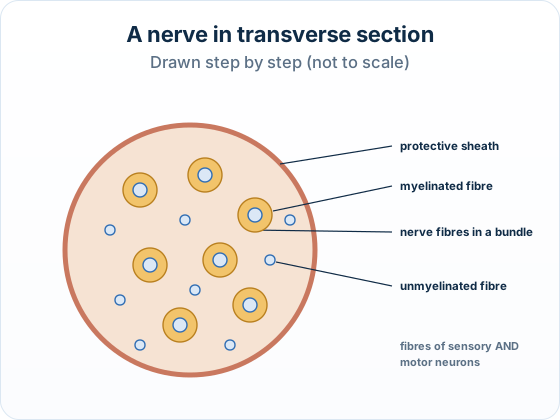
The big idea: A nerve is a bundle of nerve fibres inside a protective sheath. Some fibres are myelinated (a ring of myelin round each axon), others unmyelinated. The fibres belong to both sensory and motor neurons, so one nerve carries impulses towards the CNS and away from it.
The points to remember
- A nerve is a bundle of nerve fibres.
- A tough protective sheath surrounds it.
- Myelinated fibres: a ring of myelin round the axon.
- Unmyelinated fibres: no myelin ring.
- Fibres of sensory and motor neurons run in the same nerve.
Remember it as: One cable, many wires, both directions.
Real example: the sciatic nerve. The sciatic nerve runs from the lower back down the back of each leg and is the largest nerve in the body. Its sensory fibres carry impulses from the skin of the leg and foot; its motor fibres carry impulses to the leg muscles.
Trap: A nerve is not the same as a neuron: a neuron is one cell, while a nerve is a bundle of fibres from many neurons.
Free preview
This is the free notes preview
You're reading the free notes. Aimnova Pro unlocks the full study experience — and you can try it with your first topic free to keep:
- FlashcardsLock in vocabulary and key terms with spaced repetition.
- Practice questionsAnswer exam-style questions and get instant AI marking.
- Mock exams & past-paper vaultSit full mocks and see exactly how examiners award marks.
- Personalised study planA daily plan built around your exam date and weak areas.
Start Studying Free Full access to Aimnova Pro · cancel anytime
How it is asked: Expect an MCQ on what a nerve contains, or a question on a transverse section of a nerve.
IB-style questionOutline[2 marks]
Outline the structure of a nerve.
Model answer plan
See the answer broken into clear points, with guidance on how each point earns marks.