The big idea: Metabolism is the whole web of chemical reactions inside a living cell. Almost every one is catalysed by an enzyme, which is why metabolism is described as the cell's enzyme-catalysed reactions.
These reactions fall into two types
- Those that build larger molecules: anabolism
- Those that break molecules down: catabolism
- Metabolism
- All of the enzyme-catalysed chemical reactions that take place inside a living organism.
- Anabolism
- The reactions of metabolism that BUILD larger molecules from smaller ones. Anabolism uses (requires) energy.
- Catabolism
- The reactions of metabolism that BREAK larger molecules into smaller ones. Catabolism releases energy.
- Enzyme
- A biological catalyst — a protein that speeds up a metabolic reaction without being used up.
A name to remember it by: Anabolism = building up (think of an athlete building muscle).
Catabolism = breaking down (think of a catastrophe tearing things apart).
Both are part of metabolism, the cell's full set of enzyme-controlled reactions.
Free preview
This is the free notes preview
You're reading the free notes. Aimnova Pro unlocks the full study experience — and you can try it with your first topic free to keep:
- FlashcardsLock in vocabulary and key terms with spaced repetition.
- Practice questionsAnswer exam-style questions and get instant AI marking.
- Mock exams & past-paper vaultSit full mocks and see exactly how examiners award marks.
- Personalised study planA daily plan built around your exam date and weak areas.
Start Studying Free Full access to Aimnova Pro · cancel anytime
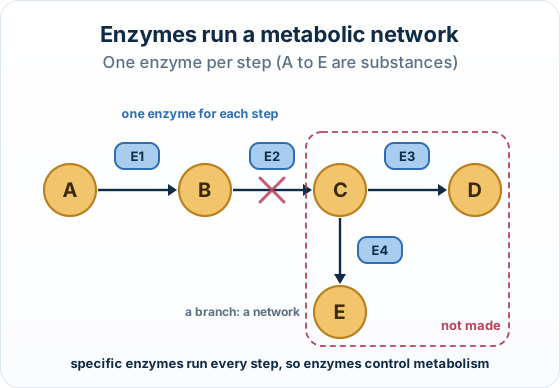
The big idea: Metabolism is a network of linked reactions. Each reaction needs its own enzyme, so a cell needs many different enzymes, and it controls metabolism by controlling them.
The points to remember
- Reactions are linked: the product of one reaction is the substrate of the next.
- Pathways branch and join, so they form a network that depends on every step.
- Enzymes are specific: each catalyses one reaction, so there is a different enzyme for each step.
- The cell controls metabolism by making, activating or inhibiting particular enzymes.
Remember it as: One step, one enzyme; control the enzyme, control the step.
Real example: glycolysis. Glycolysis, the first stage of respiration, changes glucose into pyruvate in ten steps. Each step is catalysed by a different enzyme, so ten enzymes are needed for this one pathway.
Trap: Do not say one enzyme can run a whole pathway. Because of specificity, each step needs its own enzyme.
Study smarter, not longer
Most students waste 40% of study time on topics they already know. Our AI tracks your progress and optimizes every minute.
Try Smart Study FreeYour first topic is free to keep • No credit card required
How it is asked: Expect a definition of metabolism, or an explanation of why so many enzymes are needed and how they control metabolism.
IB-style questionExplain[3 marks]
Explain why living organisms need many different enzymes.
Model answer plan
See the answer broken into clear points, with guidance on how each point earns marks.