The big idea: Receptor cells detect stimuli, such as light, sound or touch. Sensory neurons carry impulses from the receptors into the central nervous system: into the spinal cord, and up to the cerebral hemispheres, where the information is processed.
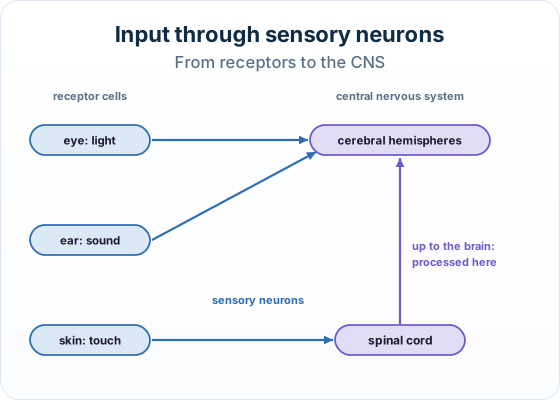
The points to remember
- Receptor cells detect a stimulus.
- Sensory neurons carry impulses from receptors.
- They carry them to the CNS: the spinal cord or the brain.
- Impulses can travel up the spinal cord to the cerebral hemispheres.
- There the information is processed.
Remember it as: Sensory: from the senses, into the CNS.
Real example: stepping on a pin. Receptors in the skin of your foot start impulses in sensory neurons. These run all the way up the leg into the spinal cord, and from there impulses travel up to the brain, where you feel the pin.
Trap: Sensory neurons carry impulses towards the CNS; motor neurons carry them away. Do not swap the directions.
Free preview
This is the free notes preview
You're reading the free notes. Aimnova Pro unlocks the full study experience — and you can try it with your first topic free to keep:
- FlashcardsLock in vocabulary and key terms with spaced repetition.
- Practice questionsAnswer exam-style questions and get instant AI marking.
- Mock exams & past-paper vaultSit full mocks and see exactly how examiners award marks.
- Personalised study planA daily plan built around your exam date and weak areas.
Start Studying Free Full access to Aimnova Pro · cancel anytime
How it is asked: Expect a one-line question contrasting sensory and motor neurons, or naming where sensory neurons carry impulses.
IB-style questionDistinguish[1 mark]
Distinguish between the functions of sensory neurons and motor neurons.
Model answer plan
See the answer broken into clear points, with guidance on how each point earns marks.