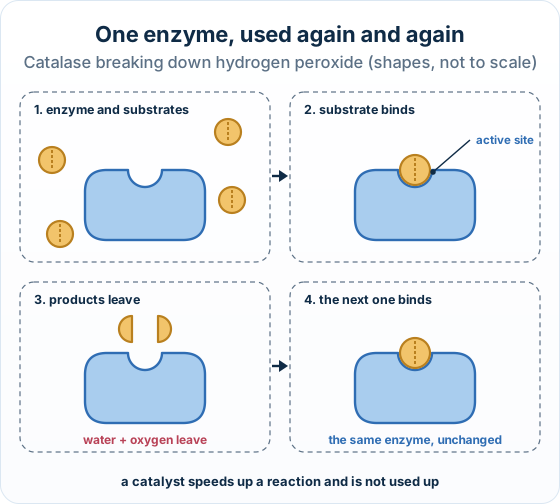
The big idea: An enzyme is a biological catalyst: it speeds up a reaction and is not used up, so the same enzyme molecule works again and again.
The points to remember
- Every enzyme acts on a substrate: the substrate binds and is changed into products.
- The enzyme is unchanged at the end, so a small amount of enzyme can convert a lot of substrate.
- Without enzymes, most reactions in cells would be far too slow at body temperature to keep the cell alive.
- Heating a cell to speed reactions up would damage its proteins, so cells use enzymes instead.
Remember it as: Faster, and not used up.
Real example: catalase. Liver cells make hydrogen peroxide, a harmful by-product. Catalase breaks it down into water and oxygen so fast that one catalase molecule deals with millions of hydrogen peroxide molecules every second.
Trap: An enzyme does not make a reaction happen that could not happen at all. It makes a possible reaction go much faster.
Free preview
This is the free notes preview
You're reading the free notes. Aimnova Pro unlocks the full study experience — and you can try it with your first topic free to keep:
- FlashcardsLock in vocabulary and key terms with spaced repetition.
- Practice questionsAnswer exam-style questions and get instant AI marking.
- Mock exams & past-paper vaultSit full mocks and see exactly how examiners award marks.
- Personalised study planA daily plan built around your exam date and weak areas.
Start Studying Free Full access to Aimnova Pro · cancel anytime
How it is asked: Expect a multiple-choice question on what is true of all enzymes, or a short explanation of why cells need catalysts.
IB-style questionExplain[3 marks]
Explain the benefit to living organisms of enzymes acting as catalysts.
Model answer plan
See the answer broken into clear points, with guidance on how each point earns marks.