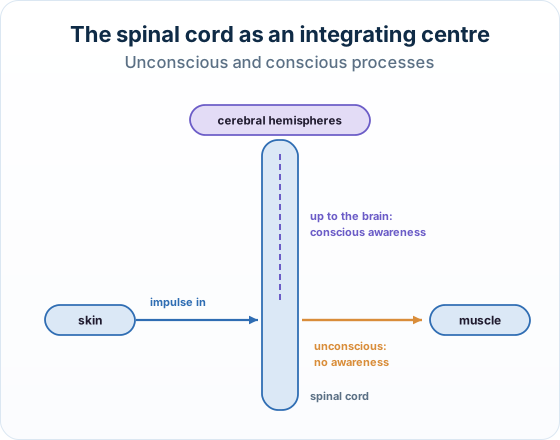
The big idea: The spinal cord is an integrating centre of its own. It receives impulses from receptors and can send a response straight back to the effectors, with no awareness: an unconscious process. Conscious processes, the ones we are aware of and can decide about, happen in the cerebral hemispheres of the brain.
The points to remember
- The spinal cord links the brain with the body, and integrates too.
- It can respond to an input on its own, without the brain.
- These responses are unconscious: we are not aware of them as they happen.
- Conscious processes happen in the cerebral hemispheres: awareness and decisions.
- Unconscious responses are automatic and fast.
Remember it as: Cord acts; brain knows.
Real example: the knee-jerk. When a doctor taps just below your kneecap, your leg kicks forward before you decide anything. The spinal cord makes this response on its own; you only become aware of it a moment later, when the impulses reach your brain.
Trap: Unconscious does not mean the brain is never told: impulses still reach the brain, but the response has already happened without a conscious decision.
Free preview
This is the free notes preview
You're reading the free notes. Aimnova Pro unlocks the full study experience — and you can try it with your first topic free to keep:
- FlashcardsLock in vocabulary and key terms with spaced repetition.
- Practice questionsAnswer exam-style questions and get instant AI marking.
- Mock exams & past-paper vaultSit full mocks and see exactly how examiners award marks.
- Personalised study planA daily plan built around your exam date and weak areas.
Start Studying Free Full access to Aimnova Pro · cancel anytime
How it is asked: Expect a question that distinguishes conscious and unconscious processes, or asks where each is integrated.
IB-style questionDistinguish[2 marks]
Distinguish between conscious and unconscious processes in the nervous system.
Model answer plan
See the answer broken into clear points, with guidance on how each point earns marks.