The big idea: Photosynthesis turns carbon dioxide and water into glucose and oxygen, using light energy trapped by chlorophyll.
Two products
- Glucose, which stores the chemical energy
- Oxygen, which is released as a waste gas
The gas changes we can measure: At the same time, the plant takes in carbon dioxide as a raw material. These two gas changes, oxygen released and carbon dioxide absorbed, are how we can tell photosynthesis is happening and how fast it is going.
Photosynthesis takes in carbon dioxide and water and releases two products: glucose (chemical energy) and oxygen. The oxygen given off and the carbon dioxide taken in are what we measure to find the rate.
Interactive diagram
Explore the labelled diagram, charts and maps for this topic in full study mode.
- Product
- A substance that is made by a reaction. The products of photosynthesis are glucose and oxygen.
- Raw material (reactant)
- A substance that is used up by a reaction. The raw materials of photosynthesis are carbon dioxide and water.
- Oxygen (O₂)
- A gas released as a waste product of photosynthesis. It comes from the splitting of water.
- Carbon dioxide (CO₂)
- A gas taken in (absorbed) during photosynthesis. Its carbon is built into glucose.
- Rate of photosynthesis
- How fast photosynthesis is happening — for example, how much oxygen is produced (or carbon dioxide used) each minute.
Two gases, opposite directions: Photosynthesis gives off oxygen and takes in carbon dioxide.
These are opposite to respiration (which uses oxygen and gives off carbon dioxide) — keep the two reactions clearly separate in your mind.
Free preview
This is the free notes preview
You're reading the free notes. Aimnova Pro unlocks the full study experience — and you can try it with your first topic free to keep:
- FlashcardsLock in vocabulary and key terms with spaced repetition.
- Practice questionsAnswer exam-style questions and get instant AI marking.
- Mock exams & past-paper vaultSit full mocks and see exactly how examiners award marks.
- Personalised study planA daily plan built around your exam date and weak areas.
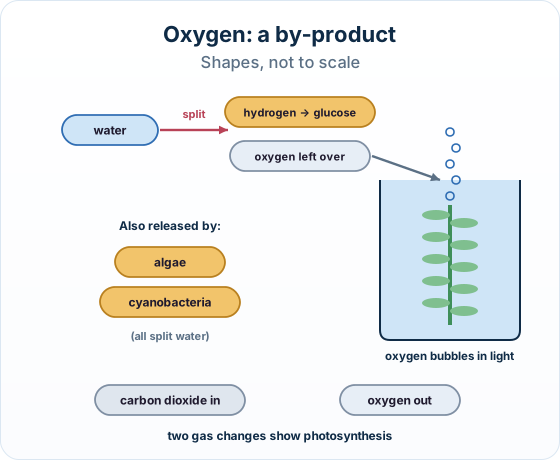
The big idea: The oxygen released by photosynthesis comes from splitting water. The plant does not need it, so it is a by-product. Plants, algae and cyanobacteria all release it.
The points to remember
- Water is split: hydrogen is used, oxygen is released.
- Oxygen is a by-product (a waste product) of photosynthesis.
- Released by plants, algae and cyanobacteria; not by fungi.
- Oxygen out, carbon dioxide in: the two gas changes we can detect.
Remember it as: Split water, keep the hydrogen, lose the oxygen.
Real example: pondweed in sunlight. On a sunny day, tiny bubbles collect on pondweed and rise to the surface. They are oxygen released by photosynthesis.
Trap: Fungi do not photosynthesise, so they release no oxygen.
Practice with exam-style questions
Answer exam-style questions and get AI feedback that shows you exactly what examiners want to see in a full-marks response.
How this is tested: Measuring photosynthesis is tested through gas bubbles, indicator colours and pH.
The common formats
- 1 mark: explain why an illuminated aquatic plant produces gas bubbles. Link the bubbles to oxygen released by photosynthesis.
- Data question: given the colour of a CO₂ indicator in different light conditions, say which tube's water ends up free of carbon dioxide.
- Suggest [2]: why faster photosynthesis raises the pH of the surrounding water. Reason from CO₂ removal to a rise in pH.
Exam-style question — explain the bubbles from a pondweed
A piece of pondweed is placed in water and brightly illuminated. Streams of gas bubbles rise from the cut end of the stem. Explain why the bubbles are produced and what they show about the rate of photosynthesis. [3]
Step by step
- Name the gas and its source. The bubbles are oxygen, which is a product (waste gas) of photosynthesis.
- Link to the light. In bright light the plant photosynthesises, splitting water and releasing oxygen, so the gas escapes from the stem as bubbles.
- Link to the rate. The faster the rate of photosynthesis, the more bubbles are released each minute — so counting bubbles measures the rate.
Final answer
The bubbles are oxygen — a product of photosynthesis, which the illuminated plant carries out. The faster it photosynthesises, the more bubbles per minute, so bubble count measures the rate.
Why this works: It names the gas (oxygen), explains where it comes from (a product of photosynthesis in the light), and connects it to the rate (more bubbles = faster).
Just saying 'the plant gives off gas' is not enough — you must state it is oxygen and that it is a product of photosynthesis.
| Gas | What photosynthesis does to it | Why |
|---|---|---|
| Oxygen (O₂) | Released (given off) — a waste product | Oxygen is split off from water during the reaction |
| Carbon dioxide (CO₂) | Absorbed (taken in) — a raw material | CO₂ supplies the carbon that is built into glucose |
Another question in the papers' style:
Explain why oxygen is described as a by-product of photosynthesis.
Model answer plan
See the answer broken into clear points, with guidance on how each point earns marks.