aımnova
DashboardMy LearningCrash CoursesStudy Plan

Aimnova site navigation

Stay in the loop

Get the latest study resources and updates

New features, study tips and exam insights — straight to your inbox.

IB Diploma

  • IB Past Papers
  • IB Study Notes
  • IB Question Bank
  • IB Mock Exams
  • IB Revision

IB Subjects

  • IB Math AA
  • IB Math AI
  • IB Economics
  • IB Business Management
  • IB Physics
  • IB Biology
  • View all IB subjects→

IB Past Papers

  • IB Math AA HL Past Papers
  • IB Math AA SL Past Papers
  • IB Math AI HL Past Papers
  • IB Math AI SL Past Papers
  • IB Economics HL Past Papers
  • IB Economics SL Past Papers
  • IB ESS Past Papers
  • View all past papers→

Study Resources

  • Study Notes
  • Question Bank
  • Mock Exams
  • Crash Courses
  • Flashcards
  • Revision Guide
  • Exam Skills
  • Command Terms
  • Grade Calculator
  • Exam Timetable 2026

Aimnova

  • Features
  • Pricing
  • For Teachers
  • For Schools
  • For Parents
  • About Us
  • Blog
  • Contact
aımnova

IB study, practice and feedback built around the real exam.

TermsPrivacyCookies·© 2026 Aimnova. All rights reserved.06bfe1b

Aimnova is not affiliated with or endorsed by the International Baccalaureate Organization (IB).

NotesBiologyTopic 3.3Separation and identification of photosynthetic pigments by chromatography
Back to Biology Topics
3.3.43 min read

Separation and identification of photosynthetic pigments by chromatography

IB Biology · Unit 3

Smart study tools

Turn reading into results

Move beyond passive notes. Answer exam-style questions, get AI feedback, and build the skills that earn top marks.

Get Started Free

Contents

  1. 1Chromatography and Rf values
  2. 2Exam-style question (step by step)
The big idea: Leaves contain several pigments. Chromatography separates them: each pigment travels up the paper or plate at its own speed. Pigments are identified by colour and by their Rf value.
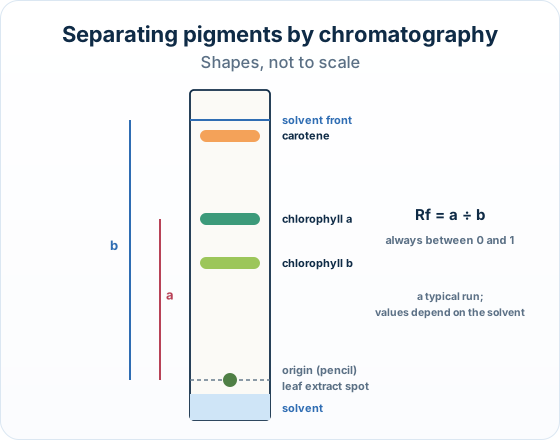
A chromatography strip drawn step by step: a spot of leaf extract on a pencil origin; solvent rising to the solvent front; coloured bands of carotene, chlorophyll a and chlorophyll b; then the distances a and b and Rf equals a divided by b
Chromatography, step by step.

The points to remember

  • Spot the extract on a pencil origin line, above the solvent level.
  • The solvent front is the furthest point the solvent reaches.
  • Rf = distance moved by pigment ÷ distance moved by solvent (0 to 1, no units).
  • Typical run: carotene (yellow-orange) highest; chlorophyll a (blue-green); chlorophyll b (yellow-green) lower.
  • Paper or thin-layer chromatography can be used.
Remember it as: Rf: how far the pigment ran, out of how far the solvent ran.

Real example: autumn leaves. Chromatography of a green leaf shows yellow-orange carotenoids hidden under the chlorophyll. In autumn the chlorophyll breaks down first, so those yellow and orange colours show.

Trap: Measure to the centre of each spot, and from the origin, not from the bottom of the paper.

Calculating an Rf value:

Worked example: an Rf value: The solvent moved 8.0 cm and a blue-green pigment moved 5.0 cm.

Rf = 5.0 ÷ 8.0 = 0.63 (no units).

A blue-green band with an Rf of about 0.6 matches chlorophyll a in a typical run.

Free preview

This is the free notes preview

You're reading the free notes. Aimnova Pro unlocks the full study experience — and you can try it with your first topic free to keep:

  • FlashcardsLock in vocabulary and key terms with spaced repetition.
  • Practice questionsAnswer exam-style questions and get instant AI marking.
  • Mock exams & past-paper vaultSit full mocks and see exactly how examiners award marks.
  • Personalised study planA daily plan built around your exam date and weak areas.
Start Studying Free Full access to Aimnova Pro · cancel anytime
How it is asked: Expect an Rf calculation, identifying a pigment from a chromatogram and a table of Rf values, or naming the method used.
IB-style questionCalculate[2 marks]

The solvent front is 9.0 cm from the origin. A yellow-orange spot is 8.4 cm from the origin. Calculate its Rf value and identify the pigment.

Model answer plan

See the answer broken into clear points, with guidance on how each point earns marks.

Claim your free topic

Try an IB Exam Question — Free AI Feedback

Test yourself on Separation and identification of photosynthetic pigments by chromatography. Write your answer and get instant AI feedback — just like a real IB examiner.

The solvent front of a chromatogram is 7.5 cm from the origin. A yellow-green spot is 3.4 cm from the origin.

the Rf value of the spot and which pigment it is.
[2 marks]

Related Biology Topics

Continue learning with these related topics from the same unit:

3.1.1Enzymes as catalysts3.1.2Role of enzymes in metabolism3.1.3Anabolic and catabolic reactions3.1.4Enzymes as globular proteins with an active site for catalysis
View all Biology topics
Improve your exam techniqueCommand terms, paper structure, and mark-scheme tips for Biology
Previous3.3.3Oxygen as a by-product of photosynthesis in plants, algae and cyanobacteriaNextAbsorption of specific wavelengths of light by photosynthetic pigments3.3.5

11 practice questions on Separation and identification of photosynthetic pigments by chromatography

Students who practiced this topic on Aimnova scored 82% on average. Try free practice questions and get instant AI feedback.

Try 3 Free QuestionsView All Biology Topics