To build glucose, the plant needs raw materials and a source of energy.
What goes in
- Carbon dioxide, taken from the air (raw material)
- Water, taken up by the roots (raw material)
- Light, the energy source, absorbed by chlorophyll in the chloroplasts
The word equation: Photosynthesis is summarised by a word equation:
carbon dioxide + water →(light, chlorophyll)→ glucose + oxygen
The arrow's label reminds you that light (absorbed by chlorophyll) is what drives the reaction — it is the energy input, not a raw material that ends up in the glucose.
Inputs on the left (light, CO₂, water), products on the right (glucose, O₂). The light energy is now stored as chemical energy in the glucose.
Interactive diagram
Explore the labelled diagram, charts and maps for this topic in full study mode.
- Raw materials
- The substances used up in photosynthesis: carbon dioxide and water.
- Products
- The substances made by photosynthesis: glucose and oxygen.
- Oxygen (O₂)
- A product of photosynthesis, released as a waste gas; it comes from the water that is split.
- Carbon dioxide (CO₂)
- A raw material of photosynthesis; its carbon is built into glucose.
Follow the energy: Trace the energy through the process:
Light energy arrives from the Sun → chlorophyll absorbs it → that energy is used to build glucose → the energy is now stored as chemical energy in glucose's bonds.
So the same energy changes form — from light to chemical — it is never made or destroyed, only converted.
| Stage | Form of energy | Where it is |
|---|---|---|
| Sunlight reaches the leaf | Light energy | In the sunlight / outside the cell |
| Chlorophyll absorbs the light | Light energy being captured | In the chloroplast |
| Glucose is built | Chemical energy | Stored in the bonds of glucose |
Goes IN
- Carbon dioxide (raw material, from the air)
- Water (raw material, from the roots)
- Light energy (the energy input, absorbed by chlorophyll)
Comes OUT
- Glucose (stores the chemical energy)
- Oxygen (released as a waste product)
- The light energy is now chemical energy in the glucose
An easy way to remember: 'CO₂ + water in, glucose + oxygen out.' And the energy: light in, chemical out.
The oxygen is the gas you see bubbling off a pondweed in the light — a sign that photosynthesis is happening.
Free preview
This is the free notes preview
You're reading the free notes. Aimnova Pro unlocks the full study experience — and you can try it with your first topic free to keep:
- FlashcardsLock in vocabulary and key terms with spaced repetition.
- Practice questionsAnswer exam-style questions and get instant AI marking.
- Mock exams & past-paper vaultSit full mocks and see exactly how examiners award marks.
- Personalised study planA daily plan built around your exam date and weak areas.
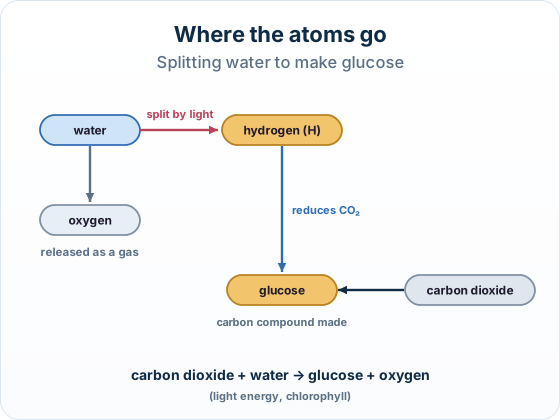
The big idea: Photosynthesis splits water to get hydrogen, and uses the hydrogen to turn carbon dioxide into glucose. The oxygen from the water is released.
The points to remember
- Water is split using light energy: hydrogen + oxygen.
- The hydrogen converts carbon dioxide into glucose (carbon dioxide is reduced).
- The oxygen is released as a by-product.
- carbon dioxide + water → glucose + oxygen.
Remember it as: Carbon from the air, hydrogen from water.
Real example: where a tree's mass comes from. Most of the dry mass of a tree is carbon compounds built from carbon dioxide taken from the air, not material taken from the soil.
Trap: The oxygen released comes from water, not from carbon dioxide.
From glucose to oils. Glucose made in photosynthesis is the starting point for the plant's other carbon compounds. For example, it is converted into glycerol and fatty acids, and one glycerol joins three fatty acids by condensation to form a triglyceride oil (see 2.1.9).
Know your predicted grade
Take timed mock exams and get detailed feedback on every answer. See exactly where you're losing marks.
How it is asked: Expect the word equation, the roles of carbon dioxide and water, and where the oxygen comes from.
Outline the roles of water and carbon dioxide in photosynthesis.
Model answer plan
See the answer broken into clear points, with guidance on how each point earns marks.