The big idea: Photosynthesis is how plants (and algae) make their own food using light.
The most important idea
- Photosynthesis is an energy conversion: it converts light energy into chemical energy.
- The light energy from the Sun is captured and locked away in the bonds of glucose.
- Glucose is a sugar the plant can later use for energy or building materials.
Photosynthesis converts light energy into chemical energy: carbon dioxide and water (raw materials) become glucose (chemical energy store) and oxygen.
Interactive diagram
Explore the labelled diagram, charts and maps for this topic in full study mode.
- Photosynthesis
- The process that converts light energy into chemical energy stored in glucose, using carbon dioxide and water as raw materials.
- Energy conversion (transformation)
- Changing energy from one form into another — here, light energy is changed into chemical energy.
- Chemical energy
- Energy stored in the bonds of a molecule (such as glucose); it can be released later by respiration.
- Chlorophyll
- The green pigment in chloroplasts that absorbs light energy to drive photosynthesis.
- Glucose
- The sugar made in photosynthesis; it stores the chemical energy that the light energy was converted into.
Why 'energy conversion' is the key phrase: Photosynthesis does not create energy — it converts it.
Light energy in → chemical energy (in glucose) out.
If an exam asks what photosynthesis does in terms of energy, this conversion is the answer.
Free preview
This is the free notes preview
You're reading the free notes. Aimnova Pro unlocks the full study experience — and you can try it with your first topic free to keep:
- FlashcardsLock in vocabulary and key terms with spaced repetition.
- Practice questionsAnswer exam-style questions and get instant AI marking.
- Mock exams & past-paper vaultSit full mocks and see exactly how examiners award marks.
- Personalised study planA daily plan built around your exam date and weak areas.
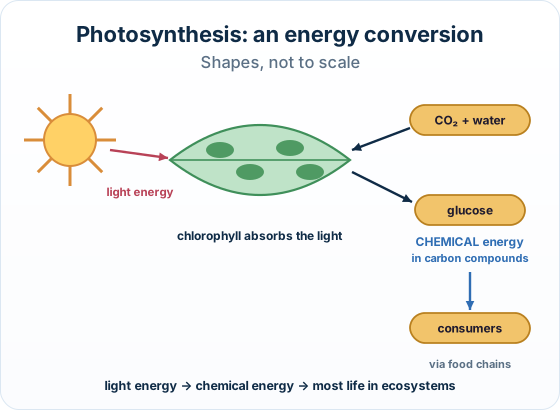
The big idea: Photosynthesis turns light energy into chemical energy in carbon compounds. Through food chains, this chemical energy supplies most of the energy for life in ecosystems.
The points to remember
- Light energy is absorbed by chlorophyll.
- It is converted into chemical energy in carbon compounds such as glucose.
- Energy is not created: it changes form.
- Consumers and decomposers depend on this chemical energy, passed along food chains.
Remember it as: Sunlight in, food out: light energy becomes chemical energy.
Real example: a fox's energy. A fox eats rabbits, and rabbits eat grass. The energy the fox uses to run was captured by the grass through photosynthesis.
Trap: Light is not a raw material built into glucose; it is the energy input that is converted.
See how examiners mark answers
Answer exam-style questions with model answers. Learn exactly what earns marks and what doesn't.
How this is tested: Photosynthesis questions test the energy idea, gas-bubble data and one common trap.
The common formats
- Outline or State: what photosynthesis does in terms of energy: the conversion of light energy into chemical energy (stored in glucose).
- Add CO₂ and water as the raw materials and glucose and oxygen as the products.
- Data question: an illuminated water plant releasing gas bubbles. Deduce that photosynthesis is occurring and that the gas is oxygen.
Common trap: Don't treat light as a raw material that ends up inside the glucose. It is the energy input, not a reactant that is built into the sugar.
Exam-style question — describe photosynthesis as an energy conversion
Outline photosynthesis as a conversion of energy, naming the raw materials and products. [4]
Step by step
- Name the energy conversion. Photosynthesis converts light energy into chemical energy.
- Say where the chemical energy ends up. The chemical energy is stored in glucose (in its bonds).
- Give the raw materials. The raw materials used are carbon dioxide and water.
- Give the products. The products made are glucose and oxygen.
Final answer
Photosynthesis converts light energy into chemical energy stored in glucose; it uses carbon dioxide and water as raw materials and produces glucose and oxygen.
Why this works: Each sentence makes a separate point — the energy conversion, where the energy is stored, the raw materials, the products.
Writing only 'plants make food from sunlight' misses the named raw materials, products and the light → chemical energy change.
| Goes IN (raw materials) | Comes OUT (products) | What happens to it |
|---|---|---|
| Carbon dioxide (CO₂) | — | Its carbon is built into glucose |
| Water (H₂O) | — | Split apart; supplies hydrogen and the oxygen released |
| Light energy | — | Absorbed by chlorophyll and converted to chemical energy |
| — | Glucose (C₆H₁₂O₆) | Stores the chemical energy in its bonds |
| — | Oxygen (O₂) | Released as a waste product (from the split water) |
Another question in the papers' style:
Explain why photosynthesis is important for the energy supply of organisms in an ecosystem.
Model answer plan
See the answer broken into clear points, with guidance on how each point earns marks.