The big idea: A xylem vessel is a long, hollow, lignified tube of dead cells: water flows through it unimpeded, and the walls do not collapse under tension.
This only works because the xylem is built for the job. The pulling force (tension) is strong enough to collapse an ordinary tube, so xylem vessels are specially adapted.
How xylem vessels are adapted
- Dead, hollow cells stacked end to end
- The end walls are removed, so they form one long continuous pipe with nothing blocking the flow
- Walls thickened with lignin (they are lignified) keep the vessel strong, so it does not collapse under the tension of the water column
- Their narrow diameter helps keep the water column continuous
| Xylem adaptation | What it is | Why it helps water transport |
|---|---|---|
| Hollow, dead cells | The cells lose their contents and die, leaving an empty tube | Water flows through with nothing blocking the way |
| No end walls | The end walls between stacked cells break down | The cells join into one long, continuous pipe from root to leaf |
| Lignified walls | The walls are thickened and strengthened with lignin | The vessel does not collapse under the tension (pull) of the water column |
| Narrow diameter | Each vessel is a thin tube | Helps the water column stay continuous and supports cohesion |
The points to remember
- No cell contents: nothing gets in the way of the flow.
- No end walls (or incomplete ones): one continuous tube from root to leaf.
- Lignified walls: strong enough to withstand the tension without collapsing.
- Pits: thin, unlignified patches that let water enter and leave sideways.
- Walls are polar, so water adheres to them; a narrow tube helps capillary action.
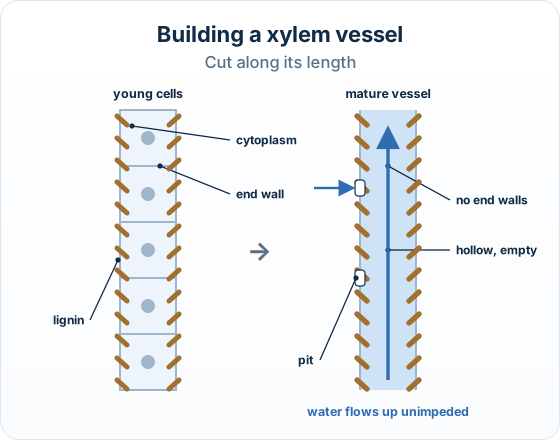
Remember it as: Empty, endless, strong, with doors: no contents, no end walls, lignin, pits.
Real example: wood. The wood of a tree trunk is mostly old xylem. Its lignified walls make it hard and strong, which is why wood is used for building.
Two traps: Each adaptation needs its reason: 'lignified walls' alone does not score; 'lignified walls withstand tension' does.
It is lignin, not cellulose, that stops the vessel collapsing.
Free preview
This is the free notes preview
You're reading the free notes. Aimnova Pro unlocks the full study experience — and you can try it with your first topic free to keep:
- FlashcardsLock in vocabulary and key terms with spaced repetition.
- Practice questionsAnswer exam-style questions and get instant AI marking.
- Mock exams & past-paper vaultSit full mocks and see exactly how examiners award marks.
- Personalised study planA daily plan built around your exam date and weak areas.
Start Studying Free Full access to Aimnova Pro · cancel anytime
How it is asked: Expect 'outline two adaptations of xylem vessels', often beside a micrograph of xylem, or 'explain the adaptations of xylem for its functions'.
IB-style questionOutline[2 marks]
Outline two adaptations of xylem vessels for water transport.
Model answer plan
See the answer broken into clear points, with guidance on how each point earns marks.