The big idea: Almost every molecule in a living thing is built around the element carbon. Carbon is special because one carbon atom can form four covalent bonds.
What four bonds allow
- Carbon atoms can link into long chains, branches and rings.
- So a small set of elements can be arranged into a huge variety of different molecules.
- This is the basis of all the macromolecules of life.
One carbon atom forms four covalent bonds, letting carbon skeletons grow into chains, branches and rings.
Interactive diagram
Explore the labelled diagram, charts and maps for this topic in full study mode.
- Carbon compound (organic molecule)
- A molecule built around a skeleton of carbon atoms — for example a carbohydrate, lipid, protein or nucleic acid.
- Covalent bond
- A bond in which two atoms share a pair of electrons.
- Macromolecule
- A very large molecule built from many smaller repeating subunits (for example a polysaccharide, a protein or a nucleic acid).
- Monomer
- A single small subunit that can be joined to others to build a larger molecule (for example glucose or an amino acid).
- Polymer
- A large molecule made of many monomers joined together (for example starch, a polymer of glucose).
Why four bonds matters: Because each carbon can bond four times, carbon skeletons can grow and branch in almost endless ways.
No other common element of life builds such varied frameworks — this single property is why carbon is the backbone of every biological molecule.
Free preview
This is the free notes preview
You're reading the free notes. Aimnova Pro unlocks the full study experience — and you can try it with your first topic free to keep:
- FlashcardsLock in vocabulary and key terms with spaced repetition.
- Practice questionsAnswer exam-style questions and get instant AI marking.
- Mock exams & past-paper vaultSit full mocks and see exactly how examiners award marks.
- Personalised study planA daily plan built around your exam date and weak areas.
The big idea: Carbon makes four covalent bonds, single or double, to carbon and to other elements. That lets it build chains, branches and rings.
The points to remember
- A covalent bond is a pair of electrons shared by two atoms.
- A carbon atom always makes four bonds in total.
- A bond can be single (one shared pair) or double (two pairs): a double bond counts as two.
- Carbon bonds to other carbon atoms and to other non-metals: hydrogen, oxygen, nitrogen, phosphorus, sulfur.
- So carbon skeletons can be unbranched or branched chains.
- They can also close into single rings or several rings joined together.
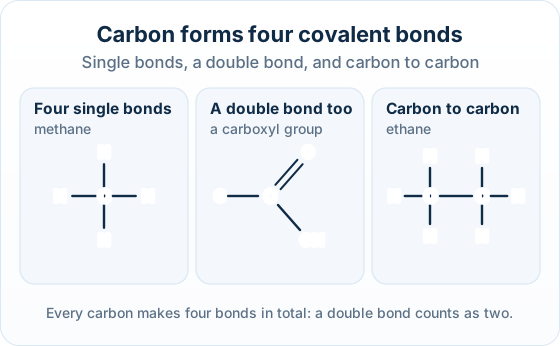
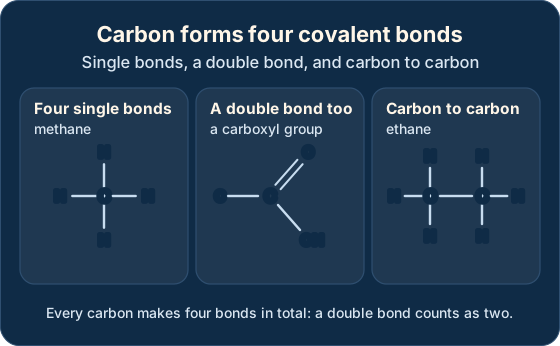
Remember it as: Four bonds, any partner, any shape.
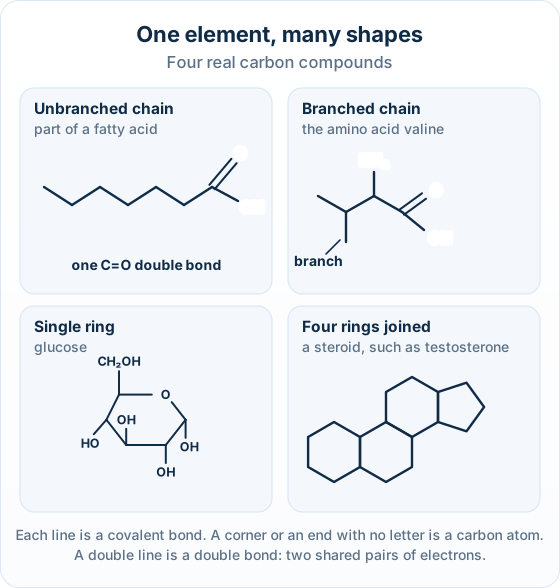
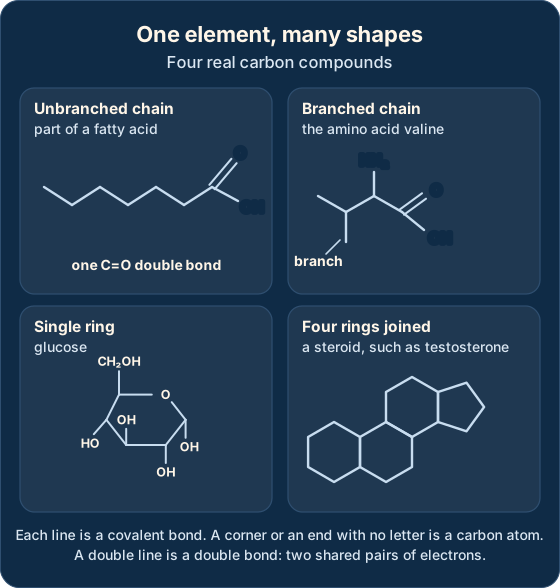
Real example: olive oil: Most of the fat in olive oil is oleic acid: an unbranched chain of 18 carbon atoms, with one C=C double bond in the middle.
One trap when you list the properties:
Give separate properties: "Carbon is strong" or "carbon is stable" is not a property that explains variety. Name the bonds, the partners and the shapes.
Feeling unprepared for exams?
Get a clear study plan, practice with real questions, and know exactly where you stand before exam day. No more guessing.
The big idea: Biologists measure tiny things, so they all use the same units and the same prefixes, agreed between countries.
The points to remember
- Scientists everywhere use the same units, the SI units, by international agreement.
- So a result measured in one country can be checked and compared in another.
- A prefix in front of a unit makes it bigger or smaller by a fixed power of ten.
- Cells are measured in micrometres (µm); molecules and viruses in nanometres (nm).
Remember it as: Kilo, centi, milli, micro, nano: each step down makes the unit smaller.
| Prefix | Symbol | Means | Example |
|---|---|---|---|
| kilo | k | × 1000 (10³) | 1 kg = 1000 g |
| centi | c | ÷ 100 (10⁻²) | 1 cm = 0.01 m |
| milli | m | ÷ 1000 (10⁻³) | 1 mm = 0.001 m |
| micro | µ | ÷ 1 000 000 (10⁻⁶) | 1 µm = 0.001 mm |
| nano | n | ÷ 1 000 000 000 (10⁻⁹) | 1 nm = 0.001 µm |
Real sizes: A red blood cell is about 7 µm across. A ribosome in a bacterium is about 20 nm across, more than 300 times smaller.
How this is tested: This comes up on Paper 2, as the first part of a long question. Each mark is one separate property of carbon.
What you may be asked
- Paper 2, Outline [4]: the chemical properties of carbon that let it form diverse compounds. Give separate, scoring points: four bonds, covalent bonds, single or double bonds, bonds to many elements, chains/branches/rings.
Exam-style question — outline carbon's bonding properties
Outline the chemical properties of carbon that allow it to form a wide variety of compounds. [4]
How to score all four marks
- Four covalent bonds. Each carbon atom can form four covalent bonds, so many other atoms can join to it.
- Bonds to itself and to other elements. Carbon bonds strongly to other carbon atoms and to elements such as hydrogen, oxygen and nitrogen, adding different chemical groups.
- Many shapes. Carbon skeletons can be straight chains, branched chains or rings, so the same atoms can be arranged in many different ways.
- Single or double bonds. Carbon can form single or double bonds, such as the C=O double bond in a carboxyl group. (One mark for each separate point, up to 4.)
Final answer
Carbon forms four covalent bonds; bonds to itself and to other elements (H, O, N); makes chains, branches and rings; and forms single or double bonds — together these build a huge variety of molecules.
Why this scores full marks: Each sentence is a separate, distinct property — four bonds, bonds to many elements, many shapes, single or double bonds.
An 'outline' worth 4 marks needs four scoring points, not one idea written four ways.
| Property of carbon | What it means | Why it gives diverse molecules |
|---|---|---|
| Forms four covalent bonds | Each carbon atom can bond to up to four other atoms | A huge number of different structures can be built around each carbon |
| Single or double bonds | A carbon can share one or two pairs of electrons with a neighbour | Different bonds give different shapes and groups, such as C=O |
| Bonds to many elements | Carbon bonds to H, O, N, P, S and to itself | Different elements add different chemical groups and properties |
| Chains, branches and rings | Carbon skeletons can be straight, branched or ring-shaped | The same atoms can be arranged into many different shapes |