aımnova
DashboardMy LearningCrash CoursesStudy Plan

Aimnova site navigation

Stay in the loop

Get the latest study resources and updates

New features, study tips and exam insights — straight to your inbox.

IB Diploma

  • IB Past Papers
  • IB Study Notes
  • IB Question Bank
  • IB Mock Exams
  • IB Revision

IB Subjects

  • IB Math AA
  • IB Math AI
  • IB Economics
  • IB Business Management
  • IB Physics
  • IB Biology
  • View all IB subjects→

IB Past Papers

  • IB Math AA HL Past Papers
  • IB Math AA SL Past Papers
  • IB Math AI HL Past Papers
  • IB Math AI SL Past Papers
  • IB Economics HL Past Papers
  • IB Economics SL Past Papers
  • IB ESS Past Papers
  • View all past papers→

Study Resources

  • Study Notes
  • Question Bank
  • Mock Exams
  • Crash Courses
  • Flashcards
  • Revision Guide
  • Exam Skills
  • Command Terms
  • Grade Calculator
  • Exam Timetable 2026

Aimnova

  • Features
  • Pricing
  • For Teachers
  • For Schools
  • For Parents
  • About Us
  • Blog
  • Contact
aımnova

IB study, practice and feedback built around the real exam.

TermsPrivacyCookies·© 2026 Aimnova. All rights reserved.06bfe1b

Aimnova is not affiliated with or endorsed by the International Baccalaureate Organization (IB).

NotesBiologyTopic 2.7Distribution of tissues in a transverse section of the stem of a dicotyledonous plant
Back to Biology Topics
2.7.93 min read

Distribution of tissues in a transverse section of the stem of a dicotyledonous plant

IB Biology · Unit 2

IB exam ready

Study like the top scorers do

Access a smart study planner, AI tutor, and exam vault — everything you need to hit your target grade.

Start Free

Contents

  1. 1The tissues of a dicot stem
  2. 2Drawing a plan diagram of a stem
  3. 3Exam-style question (step by step)
The big idea: In a dicot stem the vascular bundles form a ring, between the cortex outside and the pith in the centre.
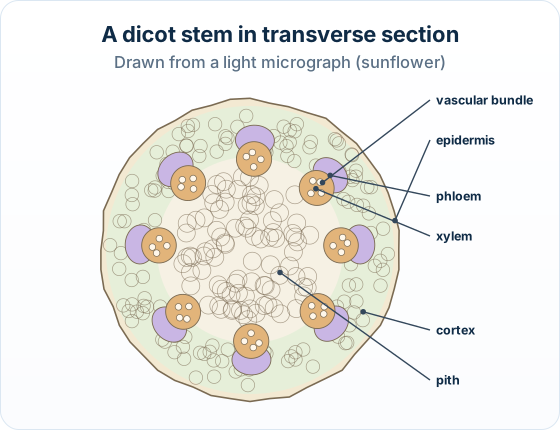
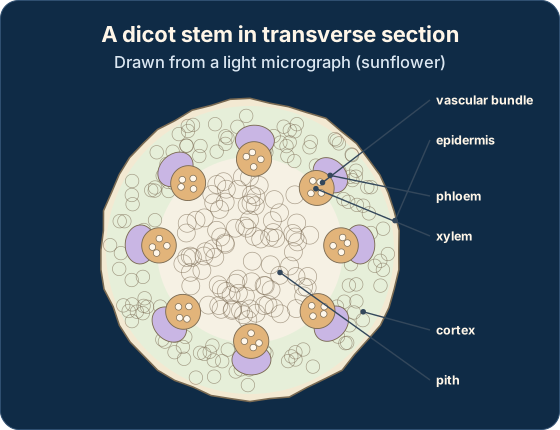
A dicot stem in transverse section: an outer epidermis, a cortex, a ring of vascular bundles each with phloem outside and xylem inside, and a central pithA dicot stem in transverse section: an outer epidermis, a cortex, a ring of vascular bundles each with phloem outside and xylem inside, and a central pith
The tissues of a dicot stem.
TissueWhereMain function
EpidermisOne thin outer layerProtects the stem; cuts water loss
CortexWide band under the epidermisSupport and storage
Vascular bundleIn a ring, between cortex and pithTransport and support
PhloemOuter side of each bundleCarries sugars and amino acids
XylemInner side of each bundleCarries water and minerals; support
PithThe centreStorage

The points to remember

  • Order from the outside: epidermis, cortex, vascular bundles, pith.
  • In each bundle, phloem faces outwards and xylem faces inwards, towards the centre.
  • Phloem carries sugars and amino acids, not 'food' or 'nutrients'.
Remember it as: Phloem out, xylem in.

Real example: alfalfa. Alfalfa (lucerne) is a common subject for stem micrographs: its vascular bundles sit in a neat ring between the cortex and the pith.

Free preview

This is the free notes preview

You're reading the free notes. Aimnova Pro unlocks the full study experience — and you can try it with your first topic free to keep:

  • FlashcardsLock in vocabulary and key terms with spaced repetition.
  • Practice questionsAnswer exam-style questions and get instant AI marking.
  • Mock exams & past-paper vaultSit full mocks and see exactly how examiners award marks.
  • Personalised study planA daily plan built around your exam date and weak areas.
Start Studying Free Full access to Aimnova Pro · cancel anytime
What a plan diagram is: A plan diagram shows where each tissue is, as outlines. It never shows cells.

The points to remember

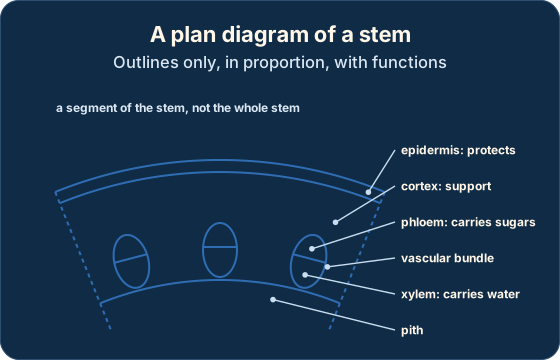
  • Draw the segment you are asked for (area X), not the whole stem, with more than one vascular bundle.
  • Outline the epidermis, the cortex under it, each vascular bundle and the pith, in proportion.
  • Split each bundle: phloem on the outer side, xylem on the inner side.
  • Label with ruled lines; add a short function for each tissue when asked to annotate.
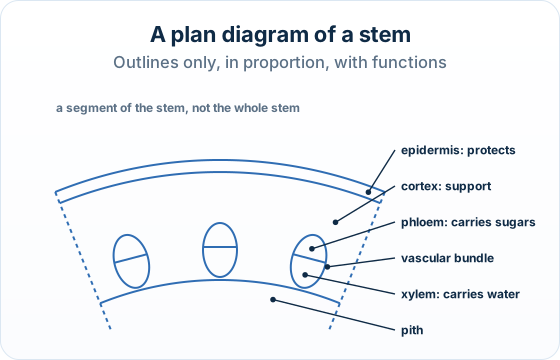
A plan diagram of a segment of a stem drawn one tissue at a time: the epidermis band, the cortex, the pith, three vascular bundles with phloem outside and xylem inside, then ruled labels with functions
From micrograph to plan, one tissue at a time.
Three traps: Drawing cells, or the whole stem when only part is asked for, loses marks.

The cortex label must point to the band just under the epidermis.

A leaf section is not a stem section: leaves have palisade and spongy layers.

Learn what examiners really want

See exactly what to write to score full marks. Our AI shows you model answers and the key phrases examiners look for.

Try AI Feedback FreeYour first topic is free to keep • No credit card required
How it is asked: Expect a stem micrograph: draw a plan of part of it, identify the tissue that carries water, or state what the phloem does.
IB-style questionDraw[3 marks]

The micrograph shows a transverse section of an alfalfa stem. Draw a labelled plan diagram of the area marked X.

Model answer plan

See the answer broken into clear points, with guidance on how each point earns marks.
Claim your free topic
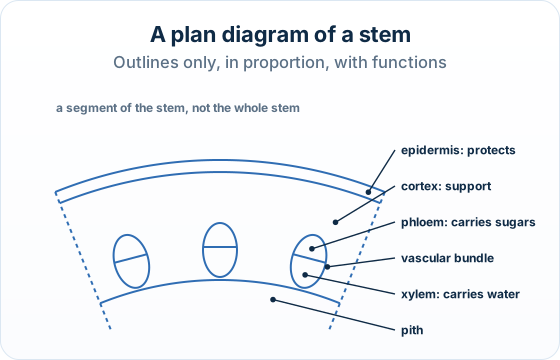
A plan diagram of a segment of a stem: epidermis, cortex, three vascular bundles with phloem outside and xylem inside, and pith, each labelled with its functionA plan diagram of a segment of a stem: epidermis, cortex, three vascular bundles with phloem outside and xylem inside, and pith, each labelled with its function
Model answer: a plan of part of the stem.

IB Exam Questions on Distribution of tissues in a transverse section of the stem of a dicotyledonous plant

Practice with IB-style questions filtered to Topic 2.7.9. Get instant AI feedback on every answer.

Practice Topic 2.7.9 QuestionsBrowse All Biology Topics

How Distribution of tissues in a transverse section of the stem of a dicotyledonous plant Appears in IB Exams

Examiners use specific command terms when asking about this topic. Here's what to expect:

  • Define

    Give the precise meaning of key terms related to Distribution of tissues in a transverse section of the stem of a dicotyledonous plant.

    AO1
  • Describe

    Give a detailed account of processes or features in Distribution of tissues in a transverse section of the stem of a dicotyledonous plant.

    AO2
  • Explain

    Give reasons WHY — cause and effect within Distribution of tissues in a transverse section of the stem of a dicotyledonous plant.

    AO3
  • Evaluate

    Weigh strengths AND limitations of approaches in Distribution of tissues in a transverse section of the stem of a dicotyledonous plant.

    AO3
  • Discuss

    Present arguments FOR and AGAINST with a balanced conclusion.

    AO3

See the full IB Command Terms guide

Related Biology Topics

Continue learning with these related topics from the same unit:

2.1.1Chemical properties of carbon that allow diverse compounds2.1.2Production of macromolecules by condensation reactions2.1.3Digestion of polymers into monomers by hydrolysis reactions2.1.4Form and function of monosaccharides
View all Biology topics
Improve your exam techniqueCommand terms, paper structure, and mark-scheme tips for Biology
Previous2.7.8Adaptations of xylem vessels for transport of waterNextDistribution of tissues in a transverse section of the root of a dicotyledonous plant2.7.10

9 practice questions on Distribution of tissues in a transverse section of the stem of a dicotyledonous plant

Students who practiced this topic on Aimnova scored 82% on average. Try free practice questions and get instant AI feedback.

Try 3 Free QuestionsView All Biology Topics