The big idea: A plant has no heart, yet it must move water from the roots all the way up to the leaves.
The route water takes
Into the roots
Water enters the roots.
Up the xylem
It travels up dead tubes called xylem vessels.
Out of the leaves
It evaporates out of the leaves as water vapour. This loss of water vapour is called transpiration.
Roots → xylem → leaves → air.
Transpiration does a job: Transpiration is not just waste — it is the very thing that pulls the water up the whole plant.
The transpiration stream: water enters at the root hairs, travels up the xylem and evaporates from the leaf as water vapour. Evaporation at the top pulls the whole water column up — the water molecules stick together (cohesion).
Interactive diagram
Explore the labelled diagram, charts and maps for this topic in full study mode.
- Transpiration
- The loss of water vapour from the leaves (and other above-ground parts) of a plant, mostly through tiny pores called stomata.
- Xylem
- The plant tissue made of long, hollow, dead tubes (xylem vessels) that carry water and dissolved minerals upwards from the roots to the leaves.
- Root hair cell
- A root cell with a long, thin extension that gives a large surface area for absorbing water and minerals from the soil.
- Stoma (plural: stomata)
- A tiny pore on the underside of a leaf through which water vapour leaves and gases are exchanged.
- Transpiration stream
- The continuous, one-way flow of water from the roots, up the xylem, to the leaves — driven by transpiration.
One direction only: The xylem carries water up in one direction: roots → stem → leaves.
It never carries water back down. (The other transport tissue, phloem, is what moves dissolved sugars — that is a different topic.)
Free preview
This is the free notes preview
You're reading the free notes. Aimnova Pro unlocks the full study experience — and you can try it with your first topic free to keep:
- FlashcardsLock in vocabulary and key terms with spaced repetition.
- Practice questionsAnswer exam-style questions and get instant AI marking.
- Mock exams & past-paper vaultSit full mocks and see exactly how examiners award marks.
- Personalised study planA daily plan built around your exam date and weak areas.
If there is no pump, what makes the water climb metres up a tree?
The answer is evaporation at the top, working together with the fact that water molecules stick to each other. Follow the chain of cause and effect from the leaf downwards.
The cohesion-tension mechanism, step by step
- Water evaporates from the wet surfaces of the leaf's mesophyll cells and diffuses out through the stomata — this is transpiration.
- Losing this water leaves the leaf cells short of water, so they pull water out of the nearest xylem vessel.
- Pulling on the top of the water column puts the whole column under tension (a pulling force, like sucking a straw).
- Because water molecules stick to one another (cohesion), the column does not break — the pull is passed all the way down.
- So water is pulled up the xylem from the roots, and fresh water is drawn into the root hairs from the soil to replace it.
Cohesion and tension — the two key words: Cohesion = water molecules stick to each other (because of hydrogen bonding), so they form one continuous, unbroken column.
Tension = the pull created when water evaporates at the leaf; this pull is transmitted down the unbroken column.
Together they are called the cohesion-tension mechanism: evaporation pulls, cohesion holds the column together, and the water rises.
Built for the job
- The pull is strong enough to collapse an ordinary tube. How xylem vessels are built to carry water under tension is the next page: 2.7.8 Adaptations of xylem vessels.
Finally, the rate of transpiration is not fixed — it speeds up or slows down with the weather. Anything that makes water evaporate faster from the leaf raises the rate.
What changes the transpiration rate: Transpiration is fastest in hot, dry, windy and bright conditions — the same weather that dries washing on a line.
Why each factor matters
- Light opens the stomata
- Heat gives water molecules more energy to evaporate
- Wind blows away the moist air at the leaf surface
- Low humidity means the air outside is dry, so water diffuses out faster
- High humidity does the opposite and slows transpiration down
| Factor | Increasing it does what to the rate? | Why |
|---|---|---|
| Light | Increases the rate | Light opens the stomata, so more water vapour can escape |
| Temperature | Increases the rate | Warmer air gives water molecules more energy, so they evaporate faster |
| Humidity | Decreases the rate | Moist air outside means a smaller difference, so less water diffuses out |
| Wind / air movement | Increases the rate | Wind blows away humid air at the leaf, keeping the difference large |
An easy way to remember: Think of drying the washing: it dries fastest when it is hot, dry and windy — exactly the conditions that speed up transpiration.
And remember the pull: transpiration at the top → tension → cohesion holds the column → water rises.
Learn what examiners really want
See exactly what to write to score full marks. Our AI shows you model answers and the key phrases examiners look for.
The big idea: Water is pulled up a plant from the top: evaporation in the leaf creates tension, and cohesion carries the pull all the way down to the roots.
The points to remember
- Water evaporates from the cell walls of the spongy mesophyll and leaves through the stomata.
- Water moves through the cell walls to replace it by capillary action: it adheres to the cellulose.
- This draws water out of the xylem, so the water in the xylem is under tension: a negative pressure.
- Cohesion: hydrogen bonds between water molecules keep a continuous column, so the pull reaches the roots.
- In the root, water enters from the soil by osmosis.
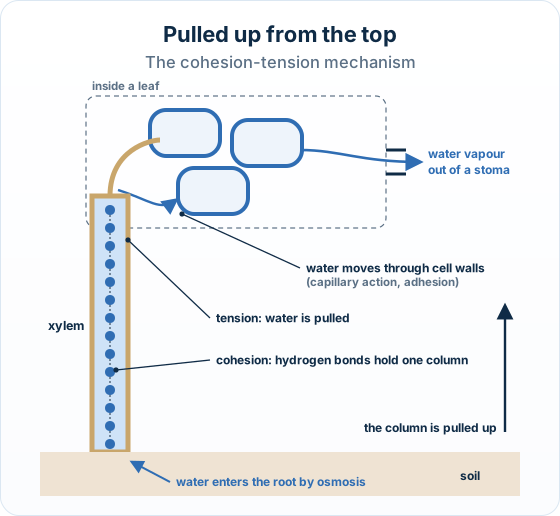
Remember it as: Evaporate at the top, pull through the walls, the column follows.
Real example: a giant redwood. Coast redwoods in California grow over 100 m tall. With no pump at all, transpiration from their leaves pulls water from the roots to the top.
Two traps: The water is pulled, not pushed: the force starts at the leaves.
Cohesion is water sticking to water; adhesion is water sticking to other molecules, such as cellulose.
How this is tested: Questions ask how transpiration moves water, how xylem is adapted, and what changes the rate.
What the questions ask
- Explain: how transpiration drives water movement through a plant
- You must link evaporation at the leaf → tension → cohesion → water pulled up
- Outline: two adaptations of xylem vessels (hollow tube, no end walls, lignified walls), or the environmental factors that change the transpiration rate
- One-mark items: what always follows evaporation from the leaf, or locate the xylem in a section
Exam-style question — explain how transpiration moves water up
Explain how transpiration drives the movement of water up through a plant. [3]
How to score all three marks
- Start at the leaf. Water evaporates from the leaf's mesophyll cells and is lost as vapour through the stomata (transpiration), so the leaf cells pull water from the xylem.
- Name the force. This pulling places the water column under tension (it is pulled, not pushed), and the pull is transmitted down the xylem.
- Use cohesion. Because water molecules stick together by cohesion, the column stays unbroken, so water is pulled up from the roots to replace what was lost.
Final answer
Water evaporates from the leaf (transpiration), creating tension that pulls on the water column; because water molecules cohere, the column stays unbroken and water is pulled up the xylem from the roots.
Why this scores full marks: It follows the cause-and-effect chain in order — evaporation, then tension (the pull), then cohesion holding the column.
Naming both key words, tension and cohesion, is what earns the explanation marks; just saying 'water goes up the xylem' is not enough.
The transpiration stream: water enters at the root hairs, travels up the xylem and evaporates from the leaf as water vapour. Evaporation at the top pulls the whole water column up — the water molecules stick together (cohesion).
Interactive diagram
Explore the labelled diagram, charts and maps for this topic in full study mode.
A 3-mark Explain, in the papers' style:
Explain how transpiration drives water movement through a plant.
Model answer plan
See the answer broken into clear points, with guidance on how each point earns marks.