The big idea: Monosaccharides are single sugar units — the monomers (building blocks) of all carbohydrates. Join two together and you get a disaccharide, a 'double sugar'.
Key facts
- Glucose is the most important monosaccharide.
- Its formula is C₆H₁₂O₆, and it is usually drawn as a six-sided ring.
- Disaccharides include maltose, sucrose and lactose.
- Carbohydrate
- A molecule made of carbon, hydrogen and oxygen, with hydrogen and oxygen usually in a 2:1 ratio (as in water). Sugars, starch and cellulose are all carbohydrates.
- Monosaccharide
- A single sugar unit — the monomer of a carbohydrate. Examples: glucose, fructose, galactose.
- Disaccharide
- A sugar made of TWO monosaccharides joined together. Examples: maltose, sucrose, lactose.
- Glucose
- The most common monosaccharide, formula C₆H₁₂O₆, drawn as a six-carbon ring; the main respiratory substrate (the molecule cells break down to release energy).
Count the sugars in the name: 'Mono-' means one and 'di-' means two.
Monosaccharide = one sugar unit. Disaccharide = two sugar units joined.
Many smaller units joined together make a polysaccharide (many sugars) — that is the next micro.
| Disaccharide | Made from (two monosaccharides) | Where you meet it |
|---|---|---|
| Maltose | glucose + glucose | Germinating grain; breakdown of starch |
| Sucrose | glucose + fructose | Table sugar; transported sap in plants |
| Lactose | glucose + galactose | Milk sugar |
Free preview
This is the free notes preview
You're reading the free notes. Aimnova Pro unlocks the full study experience — and you can try it with your first topic free to keep:
- FlashcardsLock in vocabulary and key terms with spaced repetition.
- Practice questionsAnswer exam-style questions and get instant AI marking.
- Mock exams & past-paper vaultSit full mocks and see exactly how examiners award marks.
- Personalised study planA daily plan built around your exam date and weak areas.
Glucose comes in two slightly different forms called alpha-D-glucose and beta-D-glucose.
They are isomers: they have exactly the same formula (C₆H₁₂O₆) and the same atoms, but those atoms are arranged differently at one point on the ring.
- Isomers
- Molecules with the SAME chemical formula but a DIFFERENT arrangement of their atoms.
- Alpha-D-glucose (α-glucose)
- The form of glucose in which the hydroxyl (-OH) group on carbon 1 points DOWNWARDS (below the plane of the ring).
- Beta-D-glucose (β-glucose)
- The form of glucose in which the hydroxyl (-OH) group on carbon 1 points UPWARDS (above the plane of the ring).
- Hydroxyl group (-OH)
- An oxygen joined to a hydrogen; the group on carbon 1 whose direction tells alpha- and beta-glucose apart.
The ONE structural difference to know: Alpha- and beta-D-glucose differ in just one thing: the direction of the -OH group on carbon 1.
Alpha (α): the -OH on carbon 1 points DOWN.
Beta (β): the -OH on carbon 1 points UP.
That tiny difference has huge consequences later — alpha-glucose builds starch and glycogen (energy stores), while beta-glucose builds cellulose (a tough structural fibre).
Alpha- and beta-D-glucose are isomers: the only difference is whether the -OH on carbon 1 points DOWN (alpha) or UP (beta).
Interactive diagram
Explore the labelled diagram, charts and maps for this topic in full study mode.
To make a disaccharide, two monosaccharides are joined by a condensation reaction.
A new bond — the glycosidic bond — forms between them, and one molecule of water (H₂O) is removed. Because water is taken out, condensation is sometimes called a 'water-losing' reaction.
- Condensation reaction
- A reaction that joins two molecules together and releases a molecule of water (H₂O).
- Glycosidic bond
- The covalent bond that links two sugar units together in a disaccharide or polysaccharide.
- Hydrolysis
- The reverse of condensation: a molecule of water is ADDED to break the glycosidic bond and split a disaccharide back into two monosaccharides.
Condensation builds, hydrolysis breaks: Condensation: glucose + glucose → maltose + water. A glycosidic bond forms; one water molecule is released.
Hydrolysis runs it backwards: maltose + water → glucose + glucose. A water molecule is added to break the bond.
Same idea builds all biological polymers — proteins and nucleic acids are also assembled by condensation and broken by hydrolysis.
Condensation: two glucose monosaccharides join, a glycosidic bond forms between them and one molecule of water (H₂O) is released.
Interactive diagram
Explore the labelled diagram, charts and maps for this topic in full study mode.
An easy way to remember: Condensation constructs (and condenses out water). Hydrolysis uses hydro (water) to split a bond.
So: joining sugars loses water; breaking them uses water.
Know your predicted grade
Take timed mock exams and get detailed feedback on every answer. See exactly where you're losing marks.
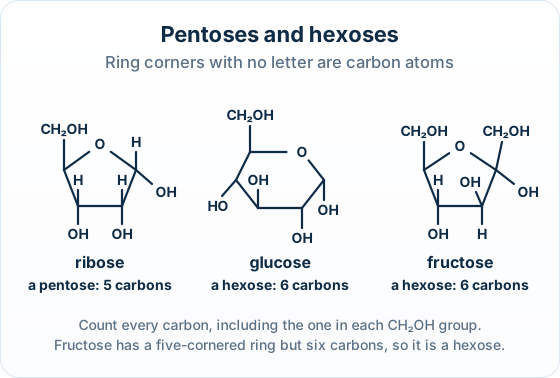
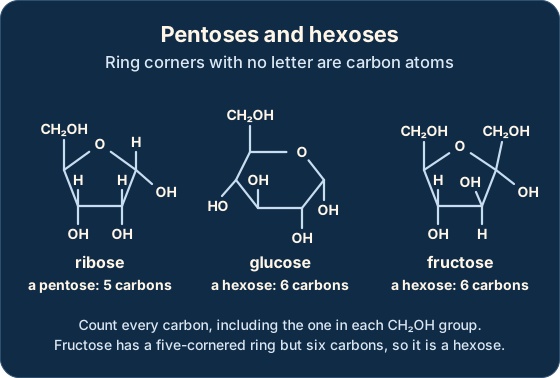
The big idea: To name a monosaccharide from its ring drawing, count its carbon atoms: five makes a pentose, six a hexose.
The points to remember
- A monosaccharide is a single sugar unit, usually drawn as a ring.
- A pentose has five carbon atoms: ribose and deoxyribose.
- A hexose has six carbon atoms: glucose, galactose and fructose.
- Count every carbon: the ring corners and the carbon in each CH₂OH group.
- Ring size can mislead: fructose has a five-cornered ring but six carbons.
Remember it as: Pent = five, hex = six: count the carbons, not the corners.
Real example: ribose in every cell: Ribose, a pentose, is part of every RNA molecule and of ATP, the energy carrier in all your cells.
The big idea: Glucose is the sugar living things use most, because its properties suit transport, storage and respiration.
The points to remember
- Soluble in water, so glucose dissolves in blood plasma and is transported round the body.
- Small and soluble, so it moves easily into cells where it is needed.
- Chemically stable, so it can be joined into starch, glycogen or cellulose and kept.
- Oxidised in respiration, releasing energy that is used to make ATP.
- Its polymers are easily broken down again, so stored glucose can be released when needed.
Remember it as: Soluble to move, stable to store, oxidised for energy.
Soluble
- Dissolves in plasma and sap.
- So it is easy to transport.
Stable
- Does not break down on its own.
- So it can be stored as starch or glycogen.
Energy-rich
- Oxidised in respiration.
- Releases energy to make ATP.
Real example: glucose in your blood: An adult's blood carries about 4 to 5 grams of glucose in total, dissolved in the plasma and delivered to every cell for respiration.
One trap when you write about energy:
Glucose does not produce energy: Say glucose releases energy when it is oxidised in respiration, and that the energy is used to make ATP. "Glucose produces energy" on its own is not enough.
Get feedback like a real examiner
Submit your answers and get instant feedback — what you did well, what's missing, and exactly what to write to score full marks.
How this is tested: Paper 1A (multiple choice) and Paper 2 test this micro in different ways.
What you may be asked
- Paper 1A: state what distinguishes alpha- from beta-D-glucose (the direction of the carbon-1 -OH).
- Paper 1A: identify the products of a condensation reaction (a disaccharide plus water), sometimes from a labelled reaction diagram.
- Paper 2, Outline: how glucose's properties (soluble, stable, transportable, easily respired) make it useful in living things.
Exam-style question — joining two monosaccharides
Two glucose molecules react together to form maltose. Identify the type of reaction and state the products formed. [2]
How to score both marks
- Name the reaction. Two monosaccharides joining together is a condensation reaction — molecules are joined and a small molecule is removed.
- State the products. The products are maltose (the disaccharide) and one molecule of water (H₂O). (Mark 1: condensation. Mark 2: the disaccharide AND water — both products are needed.)
Final answer
A condensation reaction; the products are the disaccharide maltose and water (H₂O).
The marks live in the water: Students often write only 'maltose' and lose the second mark.
In a condensation answer you must also name the water that is released — it is the give-away that the reaction is condensation rather than hydrolysis.
The reaction you are describing: two glucose units join, a glycosidic bond forms, and water is released.
Interactive diagram
Explore the labelled diagram, charts and maps for this topic in full study mode.
Watch for the reverse question: If the diagram shows a disaccharide being split into two sugars with water being added, the reaction is hydrolysis, not condensation — and the products are the two monosaccharides.
Read the arrow direction and look for whether water is released (condensation) or added (hydrolysis).
A two-mark Paper 2 version pairs one property with its function:
Monosaccharides are essential molecules in the body. Outline one property of monosaccharides and its related function.
Model answer plan
See the answer broken into clear points, with guidance on how each point earns marks.