The big idea: Gases diffuse only down a concentration gradient; ventilation and blood flow keep that gradient steep.
The points to remember
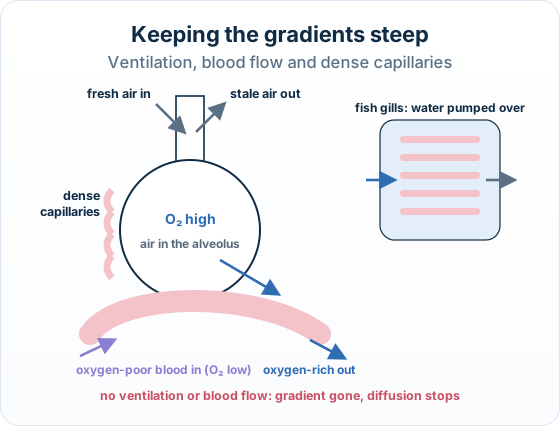
- Ventilation replaces air in the alveoli (or water over gills), keeping oxygen high and carbon dioxide low outside the blood.
- Continuous blood flow carries oxygen-rich blood away and brings oxygen-poor blood, keeping oxygen low in the blood.
- A dense network of capillaries covers the surface, so blood is always close by.
- Lungs are ventilated with air; gills with water.
- If ventilation or blood flow stopped, concentrations would even out and net diffusion would stop.
Remember it as: Fresh air in, blood moving on: the gradient never flattens.
Real example: breathing in exercise: During hard exercise you breathe faster and deeper, and your heart pumps blood faster through the lungs, so the oxygen gradient stays steep even though your muscles use far more oxygen.
Free preview
This is the free notes preview
You're reading the free notes. Aimnova Pro unlocks the full study experience — and you can try it with your first topic free to keep:
- FlashcardsLock in vocabulary and key terms with spaced repetition.
- Practice questionsAnswer exam-style questions and get instant AI marking.
- Mock exams & past-paper vaultSit full mocks and see exactly how examiners award marks.
- Personalised study planA daily plan built around your exam date and weak areas.
Start Studying Free Full access to Aimnova Pro · cancel anytime
How it is asked: Expect a Paper 2 Describe on how gas exchange happens in the lungs or how the gradient is kept, often beside a diagram of an alveolus and a capillary.
IB-style questionDescribe[4 marks]
Describe how a steep oxygen concentration gradient is maintained between the air in the alveoli and the blood.
Model answer plan
See the answer broken into clear points, with guidance on how each point earns marks.