The big idea: The mammalian lung is filled with millions of tiny air sacs called alveoli (singular: alveolus). Each alveolus is where gas exchange happens.
What happens there
- Oxygen diffuses from the air into the blood
- Carbon dioxide diffuses from the blood into the air to be breathed out
How alveoli are **adapted** to make this diffusion fast
- They give a huge surface area
- Walls just one cell thick
- Kept moist
- Wrapped in a rich supply of blood capillaries
Gas exchange at an alveolus: oxygen diffuses from the air sac across the thin, moist wall into the blood capillary, while carbon dioxide diffuses the other way.
Interactive diagram
Explore the labelled diagram, charts and maps for this topic in full study mode.
- Alveolus (plural: alveoli)
- A tiny air sac in the lung where gas exchange between air and blood takes place.
- Gas exchange
- The diffusion of oxygen into the blood and carbon dioxide out of the blood across the alveolar wall.
- Diffusion distance
- How far a gas must travel to cross a surface. The alveolar wall is one cell thick, so the distance is very short.
- Capillary
- A tiny blood vessel with very thin walls; capillaries form a dense network around each alveolus.
Why so many tiny sacs?: Splitting the lung into millions of tiny alveoli packs an enormous surface area into a small chest.
A single large bag would have far less surface — and surface area is exactly what controls how fast gases can diffuse across.
Free preview
This is the free notes preview
You're reading the free notes. Aimnova Pro unlocks the full study experience — and you can try it with your first topic free to keep:
- FlashcardsLock in vocabulary and key terms with spaced repetition.
- Practice questionsAnswer exam-style questions and get instant AI marking.
- Mock exams & past-paper vaultSit full mocks and see exactly how examiners award marks.
- Personalised study planA daily plan built around your exam date and weak areas.
The inside of every alveolus is lined with a thin film of moisture. Cells in the alveolar wall secrete surfactant into this film.
Why surfactant is the star of the topic: Surfactant reduces surface tension in the moist lining. This does two things.
What surfactant does
Stops collapse
It stops alveoli collapsing (or sticking shut) when air leaves on exhalation.
Easier breathing
It makes the lungs easier to inflate on the next breath.
The real-world link: A newborn baby that has not yet made enough surfactant struggles to keep its alveoli open.
Learn what examiners really want
See exactly what to write to score full marks. Our AI shows you model answers and the key phrases examiners look for.
The big idea: A branched network of bronchioles carries air to millions of alveoli, each wrapped in capillaries and lined with surfactant.
The points to remember
- A branched network of bronchioles carries air to every part of the lung.
- Millions of alveoli give a very high surface area for gas exchange.
- Extensive capillary beds cover the alveoli, so blood is close to every part of the surface.
- Alveolar walls are one cell thick: a short diffusion distance.
- Surfactant lines the alveoli: it lowers surface tension, so alveoli do not stick together or collapse, and lets oxygen dissolve.
Remember it as: Branches, sacs, vessels, surfactant: the four features of a lung.
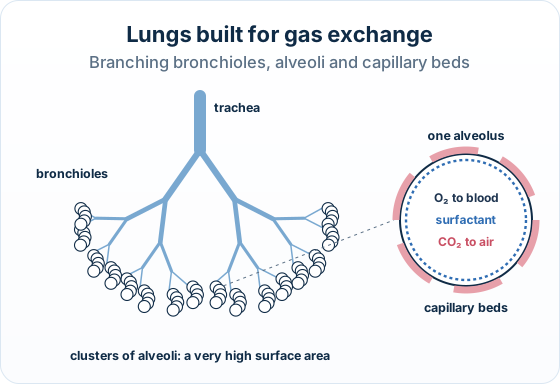
Real example: a branching tree: Between the trachea and the alveoli, the human airways divide about 23 times, so air reaches hundreds of millions of alveoli in every part of both lungs.
How this is tested: Paper 2 asks you to outline the role of surfactant [2], to outline the structural features of the lungs that adapt them for gas exchange [3], or, in Section B, to explain how lung structure and breathing bring about gas exchange [7]. Paper 1A uses contexts such as emphysema.
Exam-style question — outline the role of surfactant
Outline the role of surfactant in the mammalian lung. [2]
How to score both marks
- Name what it does to surface tension. Surfactant lowers (reduces) the surface tension of the moist film lining the inside of each alveolus.
- Give the consequence. This stops the alveoli collapsing (or sticking shut) as air leaves on exhalation, and makes the lungs easier to inflate on the next breath. (Mark 1: reduces surface tension. Mark 2: prevents alveolar collapse / eases inflation.)
Final answer
Surfactant lowers the surface tension of the moist alveolar lining, which stops the alveoli collapsing on exhalation and makes the lungs easier to inflate.
Why this scores full marks: The two marks are a cause and an effect: lowers surface tension (cause) → alveoli do not collapse / lungs inflate more easily (effect).
Writing only 'it helps breathing' is too vague — you must name surface tension and the collapse it prevents.
A 3-mark Outline, in the Paper 2 style:
Outline structural features of human lungs that adapt them for the absorption of oxygen.
Model answer plan
See the answer broken into clear points, with guidance on how each point earns marks.