The big idea: Living things take in oxygen and get rid of carbon dioxide at a gas-exchange surface — the boundary where gases pass between the body and the air (or water) outside.
Key points
- In the mammalian lung, that surface is the wall of the tiny air sacs called alveoli
- Gases cross this surface by diffusion
- They move on their own, from where they are more concentrated to where they are less concentrated, without needing energy
- Gas exchange
- The movement of oxygen into an organism and carbon dioxide out of it, across a surface.
- Gas-exchange surface
- The thin boundary where gases pass between the body and the environment — for example the wall of an alveolus in the lung.
- Diffusion
- The net movement of particles from a region of higher concentration to a region of lower concentration. It is passive — it needs no energy.
- Concentration gradient
- A difference in concentration between two regions. Diffusion happens down the gradient, from high to low.
- Alveolus (plural alveoli)
- One of the millions of tiny air sacs in the lung where gas exchange takes place.
Diffusion is free: Gases are not pumped across the gas-exchange surface.
They simply diffuse down their concentration gradient — oxygen diffuses to where there is less oxygen, carbon dioxide to where there is less carbon dioxide.
Everything about a good exchange surface is designed to make this passive diffusion as fast as possible.
Free preview
This is the free notes preview
You're reading the free notes. Aimnova Pro unlocks the full study experience — and you can try it with your first topic free to keep:
- FlashcardsLock in vocabulary and key terms with spaced repetition.
- Practice questionsAnswer exam-style questions and get instant AI marking.
- Mock exams & past-paper vaultSit full mocks and see exactly how examiners award marks.
- Personalised study planA daily plan built around your exam date and weak areas.
A good gas-exchange surface shares the same set of features in every animal, from a fish gill to a human lung. Each feature has one job: to make diffusion faster.
There are four classic features — the surface is large, thin, moist and permeable — plus a good blood supply that keeps the concentration gradient steep.
A gas-exchange surface: oxygen diffuses from the alveolar air, across the thin moist wall, into the blood; carbon dioxide diffuses the other way. The surface is large, thin, moist and richly supplied with blood.
Interactive diagram
Explore the labelled diagram, charts and maps for this topic in full study mode.
Large, thin, moist, permeable
- Large surface area — millions of alveoli give a huge total area, so a lot of gas can cross at once
- Thin (short diffusion distance) — the wall is just one cell thick, so gases have almost no distance to travel
- Moist — a thin film of water lets the gases dissolve before they cross
- Permeable — the membrane lets oxygen and carbon dioxide pass straight through
| Feature of the surface | What it means | Why it speeds up gas exchange |
|---|---|---|
| Large surface area | Millions of tiny alveoli give a huge total area | More gas can diffuse across at the same time |
| Thin (short diffusion distance) | The wall is only one cell thick (a flattened cell next to a capillary) | Gases have only a very short distance to diffuse, so diffusion is fast |
| Moist | A thin film of water lines the surface | Gases dissolve in the water before crossing the membrane |
| Permeable | The membrane lets oxygen and carbon dioxide pass through | Gases can diffuse freely across, in both directions |
| Good blood supply | A dense network of capillaries presses against the surface | Keeps the concentration gradient steep, so diffusion keeps going |
Why the gradient must be kept steep: Diffusion only continues while there is a concentration gradient. If the oxygen inside the alveolus and in the blood became equal, net diffusion would stop. So the body has to keep refreshing both sides of the surface.
Ventilation (breathing)
- Brings in fresh air
- Keeps the oxygen in the alveolus high
- Keeps the carbon dioxide low
Blood flow
- Carries oxygen-rich blood away and brings oxygen-poor blood in
- Keeps the oxygen in the capillary low
- Keeps the carbon dioxide high
| What keeps the gradient steep | What it does | Effect on the gradient |
|---|---|---|
| Ventilation (breathing) | Brings fresh air in and removes stale air | Keeps O₂ HIGH and CO₂ LOW in the alveolar air |
| Blood flow (circulation) | Carries oxygenated blood away and brings deoxygenated blood in | Keeps O₂ LOW and CO₂ HIGH in the capillary blood |
| Net result | A constant difference in concentration across the wall | The steep gradient is maintained, so diffusion never stops |
Oxygen (O₂)
- More concentrated in the alveolar air
- Less concentrated in the blood
- So O₂ diffuses air → blood
- Ventilation + blood flow keep this gradient steep
Carbon dioxide (CO₂)
- More concentrated in the blood
- Less concentrated in the alveolar air
- So CO₂ diffuses blood → air
- Breathing out the stale air keeps this gradient steep
An easy way to remember: Think 'big, thin, wet — and never let the gap close.'
A big, thin, wet (moist) surface makes each diffusion fast; the constant supply of fresh air and fresh blood keeps the gradient steep so diffusion never stops.
Stop wasting time on topics you know
Our AI identifies your weak areas and focuses your study time where it matters. No more overstudying easy topics.
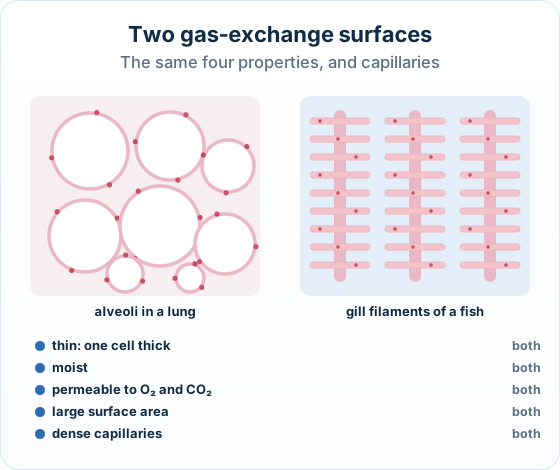
The big idea: Very different organs, the same four properties: permeable, thin, moist and large.
The points to remember
- Permeable: oxygen and carbon dioxide pass easily through the cells.
- Thin tissue layer: often one cell thick, so the diffusion distance is short.
- Moist: gases dissolve in water before they diffuse across.
- Large surface area: more gas diffuses across at the same time.
- Lungs and gills also have a dense capillary network next to the surface.
Remember it as: Permeable, thin, moist, large: every gas-exchange surface.
Real example: human lungs: The two human lungs hold about 480 million alveoli, giving a gas-exchange surface of roughly 70 m², about the floor area of a small flat.
How this is tested: Gas exchange is tested as a Paper 2 Describe question and as Paper 1A/1B identify items.
| Paper | What you are asked | Where the marks come from |
|---|---|---|
| Paper 2 (4 marks) | Describe how the oxygen concentration gradient is maintained between the lungs and the blood capillaries | The two 'pumps' — ventilation keeps alveolar oxygen high, blood flow keeps capillary oxygen low — and the result that the gradient stays steep so oxygen keeps diffusing in |
| Paper 1A/1B | A multiple-choice or data question: identify what happens at the gas-exchange surface | Oxygen diffuses into the blood, carbon dioxide diffuses out, both by passive diffusion down a concentration gradient |
Exam-style question — maintaining the oxygen gradient
Describe how an oxygen concentration gradient is maintained between the air in the alveoli and the blood in the capillaries. [4]
How to score all four marks
- State the gradient. Oxygen is at a higher concentration in the alveolar air than in the blood, so oxygen diffuses from the alveolus into the blood.
- Ventilation keeps one side high. Breathing (ventilation) continually brings in fresh air, keeping the oxygen concentration in the alveoli high.
- Blood flow keeps the other side low. The flow of blood carries oxygenated blood away and brings deoxygenated blood in, keeping the oxygen concentration in the capillary low.
- Explain the result. Because one side stays high and the other stays low, a steep concentration gradient is maintained, so oxygen keeps diffusing into the blood. (Award 1 mark per distinct point, up to 4.)
Final answer
Oxygen is more concentrated in the alveolar air, so it diffuses into the blood; ventilation keeps alveolar oxygen high and blood flow keeps capillary oxygen low, so a steep gradient is maintained and oxygen keeps diffusing in.
Why this scores full marks: Each sentence is a separate scoring point: the direction of diffusion, the role of ventilation, the role of blood flow, and the result (a steep gradient is kept up).
A weak answer just says 'oxygen diffuses in' — it never explains how the difference is maintained, which is the whole point of the question.
| What keeps the gradient steep | What it does | Effect on the gradient |
|---|---|---|
| Ventilation (breathing) | Brings fresh air in and removes stale air | Keeps O₂ HIGH and CO₂ LOW in the alveolar air |
| Blood flow (circulation) | Carries oxygenated blood away and brings deoxygenated blood in | Keeps O₂ LOW and CO₂ HIGH in the capillary blood |
| Net result | A constant difference in concentration across the wall | The steep gradient is maintained, so diffusion never stops |
A 4-mark Outline, in the Paper 2 style:
Outline the properties of a gas-exchange surface that allow rapid diffusion of gases.
Model answer plan
See the answer broken into clear points, with guidance on how each point earns marks.