aımnova
DashboardMy LearningCrash CoursesStudy Plan

Aimnova site navigation

Stay in the loop

Get the latest study resources and updates

New features, study tips and exam insights — straight to your inbox.

IB Diploma

  • IB Past Papers
  • IB Study Notes
  • IB Question Bank
  • IB Mock Exams
  • IB Revision

IB Subjects

  • IB Math AA
  • IB Math AI
  • IB Economics
  • IB Business Management
  • IB Physics
  • IB Biology
  • View all IB subjects→

IB Past Papers

  • IB Math AA HL Past Papers
  • IB Math AA SL Past Papers
  • IB Math AI HL Past Papers
  • IB Math AI SL Past Papers
  • IB Economics HL Past Papers
  • IB Economics SL Past Papers
  • IB ESS Past Papers
  • View all past papers→

Study Resources

  • Study Notes
  • Question Bank
  • Mock Exams
  • Crash Courses
  • Flashcards
  • Revision Guide
  • Exam Skills
  • Command Terms
  • Grade Calculator
  • Exam Timetable 2026

Aimnova

  • Features
  • Pricing
  • For Teachers
  • For Schools
  • For Parents
  • About Us
  • Blog
  • Contact
aımnova

IB study, practice and feedback built around the real exam.

TermsPrivacyCookies·© 2026 Aimnova. All rights reserved.c90f7ab

Aimnova is not affiliated with or endorsed by the International Baccalaureate Organization (IB).

NotesBiologyTopic 1.8Evidence for evolution from homologous structures
Back to Biology Topics
1.8.43 min read

Evidence for evolution from homologous structures

IB Biology · Unit 1

Smart study tools

Turn reading into results

Move beyond passive notes. Answer exam-style questions, get AI feedback, and build the skills that earn top marks.

Get Started Free

Contents

  1. 1Homologous structures: one plan, many jobs
  2. 2Divergent evolution and more homologies
  3. 3Exam-style question (step by step)
The big idea: Homologous structures have the same basic plan but may do different jobs. The shared plan was inherited from a common ancestor.

The points to remember

  • Homologous structures: the same basic structure, often with different functions.
  • The plan was inherited from a common ancestor, then changed in each line.
  • The guide's example is the pentadactyl limb: five-digit limb of amphibians, reptiles, birds and mammals.
  • Its bones: humerus; radius and ulna; carpals; metacarpals and phalanges.
  • The bones are in the same order even when they look very different.
Remember it as: Same bones, different jobs.
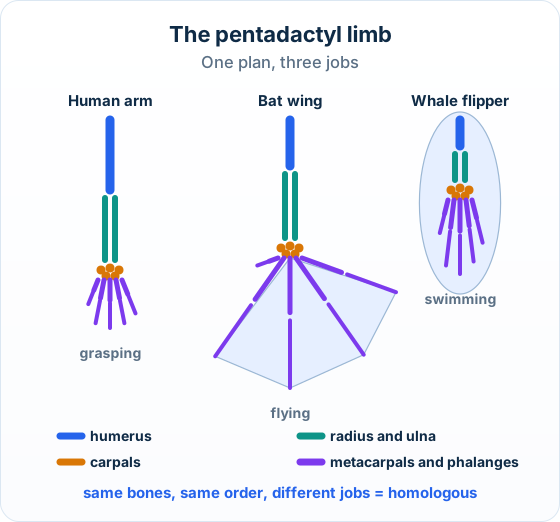
Three forelimbs drawn bone group by bone group in the same colours: humerus, radius and ulna, carpals, metacarpals and phalanges. A human arm for grasping, a bat wing with very long fingers for flying, a whale flipper with short flat bones for swimming
Same bones, same order, different jobs.
Real example: a mole and a seal: A mole digs with a broad, spade-like forelimb; a seal swims with a flipper. Inside, both have one upper arm bone, two forearm bones, wrist bones and five digits, just like your arm.

Watch the test you use:

Plan, not looks: Two structures are homologous because their plan matches, not because they look alike or do the same job. A whale flipper looks nothing like a bat wing, yet the two are homologous.

Free preview

This is the free notes preview

You're reading the free notes. Aimnova Pro unlocks the full study experience — and you can try it with your first topic free to keep:

  • FlashcardsLock in vocabulary and key terms with spaced repetition.
  • Practice questionsAnswer exam-style questions and get instant AI marking.
  • Mock exams & past-paper vaultSit full mocks and see exactly how examiners award marks.
  • Personalised study planA daily plan built around your exam date and weak areas.
Start Studying Free Full access to Aimnova Pro · cancel anytime
The big idea: Homologous structures come from divergent evolution: one ancestral plan, adapted to different jobs as populations met different selection pressures.

The points to remember

  • Divergent evolution: one ancestral form gives rise to several forms with different jobs.
  • It happens by natural selection under different selection pressures.
  • Vestigial structures are homologies too: whales have small hip bones but no back legs.
  • Vertebrate embryos look alike at an early stage, with the same basic body plan.
  • Fossils of early four-limbed animals show the same limb plan, long before mammals.

Divergent evolution

  • One ancestor, many forms
  • Different selection pressures
  • Produces homologous structures

Convergent evolution

  • Unrelated groups, similar forms
  • Similar selection pressures
  • Produces analogous structures

Practice with exam-style questions

Answer exam-style questions and get AI feedback that shows you exactly what examiners want to see in a full-marks response.

Try Practice FreeYour first topic is free to keep • No credit card required
How it is tested: Paper 1A: what type of evidence a drawing of limb bones shows, or which items are evidence for evolution. Higher Level Paper 2: describe the evidence from homologous structures, in four marks.
IB-style questionOutline[2 marks]

The forelimb of a frog and the wing of a bird contain the same arrangement of bones. Outline why this is evidence for evolution.

Model answer plan

See the answer broken into clear points, with guidance on how each point earns marks.

Claim your free topic
Plan, not job: Homologous structures are matched by their plan of bones, not by what they do.

IB Exam Questions on Evidence for evolution from homologous structures

Practice with IB-style questions filtered to Topic 1.8.4. Get instant AI feedback on every answer.

Practice Topic 1.8.4 QuestionsBrowse All Biology Topics

How Evidence for evolution from homologous structures Appears in IB Exams

Examiners use specific command terms when asking about this topic. Here's what to expect:

  • Define

    Give the precise meaning of key terms related to Evidence for evolution from homologous structures.

    AO1
  • Describe

    Give a detailed account of processes or features in Evidence for evolution from homologous structures.

    AO2
  • Explain

    Give reasons WHY — cause and effect within Evidence for evolution from homologous structures.

    AO3
  • Evaluate

    Weigh strengths AND limitations of approaches in Evidence for evolution from homologous structures.

    AO3
  • Discuss

    Present arguments FOR and AGAINST with a balanced conclusion.

    AO3

See the full IB Command Terms guide

Related Biology Topics

Continue learning with these related topics from the same unit:

1.1.1Water as the medium for life1.1.2Hydrogen bonds from the polar covalent bonds in water1.1.3Cohesion of water and its consequences for organisms1.1.4Adhesion of water to polar or charged materials
View all Biology topics
Improve your exam techniqueCommand terms, paper structure, and mark-scheme tips for Biology
Previous1.8.3Evidence for evolution from selective breedingNextConvergent evolution as the origin of analogous structures1.8.5

12 questions to test your understanding

Reading is just the start. Students who tested themselves scored 82% on average — try IB-style questions with AI feedback.

Start FreeView All Biology Topics