aımnova
DashboardMy LearningCrash CoursesStudy Plan

Aimnova site navigation

Stay in the loop

Get the latest study resources and updates

New features, study tips and exam insights — straight to your inbox.

IB Diploma

  • IB Past Papers
  • IB Study Notes
  • IB Question Bank
  • IB Mock Exams
  • IB Revision

IB Subjects

  • IB Math AA
  • IB Math AI
  • IB Economics
  • IB Business Management
  • IB Physics
  • IB Biology
  • View all IB subjects→

IB Past Papers

  • IB Math AA HL Past Papers
  • IB Math AA SL Past Papers
  • IB Math AI HL Past Papers
  • IB Math AI SL Past Papers
  • IB Economics HL Past Papers
  • IB Economics SL Past Papers
  • IB ESS Past Papers
  • View all past papers→

Study Resources

  • Study Notes
  • Question Bank
  • Mock Exams
  • Crash Courses
  • Flashcards
  • Revision Guide
  • Exam Skills
  • Command Terms
  • Grade Calculator
  • Exam Timetable 2026

Aimnova

  • Features
  • Pricing
  • For Teachers
  • For Schools
  • For Parents
  • About Us
  • Blog
  • Contact
aımnova

IB study, practice and feedback built around the real exam.

TermsPrivacyCookies·© 2026 Aimnova. All rights reserved.c90f7ab

Aimnova is not affiliated with or endorsed by the International Baccalaureate Organization (IB).

NotesBiologyTopic 1.8Evidence for evolution from selective breeding
Back to Biology Topics
1.8.34 min read

Evidence for evolution from selective breeding

IB Biology · Unit 1

Exam preparation

Practice the questions examiners actually ask

Our question bank mirrors real IB exam papers. Practice under timed conditions and track your progress across topics.

Start Practicing

Contents

  1. 1Selective breeding: humans choose the parents
  2. 2Breeds and crops: change can be fast
  3. 3Exam-style question (step by step)
The big idea: In selective breeding, humans choose which animals or plants breed. Over generations the chosen heritable features become common: this is evolution, caused by people.

The points to remember

  • There is heritable variation: individuals differ, partly because of their alleles.
  • Humans choose the individuals with the feature they want and breed only from them.
  • The offspring inherit the alleles for that feature.
  • Repeated over many generations, the feature becomes more and more common.
  • This is also called artificial selection: people, not the environment, do the selecting.
Remember it as: People pick the parents.
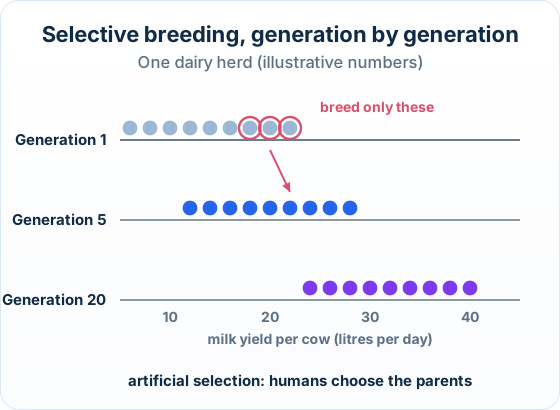
Three number lines of milk yield. Generation 1: dots spread from low to high, the three highest circled; generation 5 shifted to the right; generation 20 far to the right
Humans choose the parents; the herd changes.
Real example: dog breeds: Every dog breed, from the chihuahua to the great dane, descends from wolves that were domesticated more than 15,000 years ago. Most of today's breeds were bred in the last 200 years.

Name the cause correctly:

Not natural selection: A cattle breed that gives more milk was produced by selective breeding: farmers chose the parents. Natural selection is when the environment decides who survives and reproduces.

Free preview

This is the free notes preview

You're reading the free notes. Aimnova Pro unlocks the full study experience — and you can try it with your first topic free to keep:

  • FlashcardsLock in vocabulary and key terms with spaced repetition.
  • Practice questionsAnswer exam-style questions and get instant AI marking.
  • Mock exams & past-paper vaultSit full mocks and see exactly how examiners award marks.
  • Personalised study planA daily plan built around your exam date and weak areas.
Start Studying Free Full access to Aimnova Pro · cancel anytime
The big idea: Domesticated breeds and crop varieties differ hugely from each other and from their wild ancestors. They show how fast heritable change can happen.
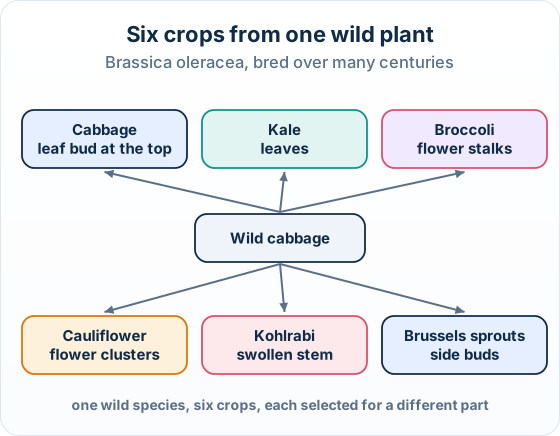
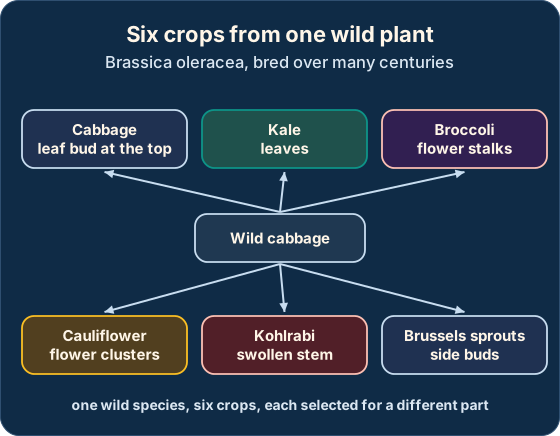
Wild cabbage in the middle, with arrows to six crops: cabbage (leaf bud at the top), kale (leaves), broccoli (flower stalks), cauliflower (flower clusters), kohlrabi (swollen stem) and Brussels sprouts (side buds)Wild cabbage in the middle, with arrows to six crops: cabbage (leaf bud at the top), kale (leaves), broccoli (flower stalks), cauliflower (flower clusters), kohlrabi (swollen stem) and Brussels sprouts (side buds)
Six crops, one wild species.

The points to remember

  • Breeds differ from each other: a chihuahua and a great dane are one species.
  • Breeds differ from the wild species they came from, such as dogs from wolves.
  • These changes took thousands of years or less, far faster than most natural change.
  • So heritable characteristics can change, and quickly: evidence that evolution happens.
  • The mechanism is the same as in nature, selection, but humans are the ones choosing.

Selective breeding

  • Humans choose which individuals breed
  • Selects what people want (milk, size, taste)
  • Can be fast: tens or hundreds of generations

Natural selection

  • The environment decides who survives and breeds
  • Selects what helps survival and reproduction
  • Usually slower: many more generations

Feeling unprepared for exams?

Get a clear study plan, practice with real questions, and know exactly where you stand before exam day. No more guessing.

Get Exam Ready FreeYour first topic is free to keep • No credit card required
How it is tested: Paper 1A: what caused a breed's feature, or which items are evidence for evolution. Paper 2: outline or explain how breeds and crops are evidence, with an example.
IB-style questionOutline[2 marks]

Charles Darwin bred fancy pigeons. Dozens of very different breeds all descend from the wild rock dove. Outline how these breeds provide evidence for evolution.

Model answer plan

See the answer broken into clear points, with guidance on how each point earns marks.

Claim your free topic
Say who selects: Write 'humans chose which individuals bred'. That is what makes it selective breeding, not natural selection.

IB Exam Questions on Evidence for evolution from selective breeding

Practice with IB-style questions filtered to Topic 1.8.3. Get instant AI feedback on every answer.

Practice Topic 1.8.3 QuestionsBrowse All Biology Topics

How Evidence for evolution from selective breeding Appears in IB Exams

Examiners use specific command terms when asking about this topic. Here's what to expect:

  • Define

    Give the precise meaning of key terms related to Evidence for evolution from selective breeding.

    AO1
  • Describe

    Give a detailed account of processes or features in Evidence for evolution from selective breeding.

    AO2
  • Explain

    Give reasons WHY — cause and effect within Evidence for evolution from selective breeding.

    AO3
  • Evaluate

    Weigh strengths AND limitations of approaches in Evidence for evolution from selective breeding.

    AO3
  • Discuss

    Present arguments FOR and AGAINST with a balanced conclusion.

    AO3

See the full IB Command Terms guide

Related Biology Topics

Continue learning with these related topics from the same unit:

1.1.1Water as the medium for life1.1.2Hydrogen bonds from the polar covalent bonds in water1.1.3Cohesion of water and its consequences for organisms1.1.4Adhesion of water to polar or charged materials
View all Biology topics
Improve your exam techniqueCommand terms, paper structure, and mark-scheme tips for Biology
Previous1.8.2Evidence for evolution from DNA, RNA and protein sequencesNextEvidence for evolution from homologous structures1.8.4

7 exam-style questions ready for you

Students who practice on Aimnova improve their scores by 15% on average. Get instant feedback that shows exactly how to improve your answers.

Practice Now — FreeView All Biology Topics