aımnova
DashboardMy LearningPaper MasteryStudy Plan

Aimnova site navigation

Stay in the loop

Get the latest study resources and updates

New features, study tips and exam insights — straight to your inbox.

IB Diploma

  • IB Past Papers
  • IB Study Notes
  • IB Question Bank
  • IB Mock Exams
  • IB Revision

IB Subjects

  • IB Math AA
  • IB Math AI
  • IB Economics
  • IB Business Management
  • IB Physics
  • IB Biology
  • View all IB subjects→

IB Past Papers

  • IB Math AA HL Past Papers
  • IB Math AA SL Past Papers
  • IB Math AI HL Past Papers
  • IB Math AI SL Past Papers
  • IB Economics HL Past Papers
  • IB Economics SL Past Papers
  • IB ESS Past Papers
  • View all past papers→

Study Resources

  • Study Notes
  • Question Bank
  • Mock Exams
  • Flashcards
  • Revision Guide
  • Exam Skills
  • Command Terms
  • Grade Calculator
  • Exam Timetable 2026

Aimnova

  • Features
  • Pricing
  • For Teachers
  • For Schools
  • For Parents
  • About Us
  • Blog
  • Contact
aımnova

IB study, practice and feedback built around the real exam.

TermsPrivacyCookies·© 2026 Aimnova. All rights reserved.bf08e16

Aimnova is not affiliated with or endorsed by the International Baccalaureate Organization (IB).

NotesBiologyTopic 1.1Adhesion of water to polar or charged materials
Back to Biology Topics
1.1.46 min read

Adhesion of water to polar or charged materials

IB Biology · Unit 1

IB exam ready

Study like the top scorers do

Access a smart study planner, AI tutor, and exam vault — everything you need to hit your target grade.

Start Free

Contents

  1. 1Water sticks to other materials: adhesion
  2. 2Capillary action: water climbs narrow spaces
  3. 3Exam-style question (step by step)
The big idea: Water is polar, so it does not only stick to itself. It also sticks to other polar or charged materials. That is adhesion.

The points to remember

  • Adhesion is water sticking to a different material. Cohesion is water sticking to water.
  • Water adheres to materials that are polar or charged: its δ+ hydrogens and δ− oxygen are attracted to their charges.
  • The pull is a hydrogen bond, the same kind of bond that holds water to water.
  • Polar surfaces: glass, cellulose cell walls, soil particles. Water does not stick to wax or oil: no charges.
Remember it as: Co-hesion: water with water. Ad-hesion: water added on to something else.
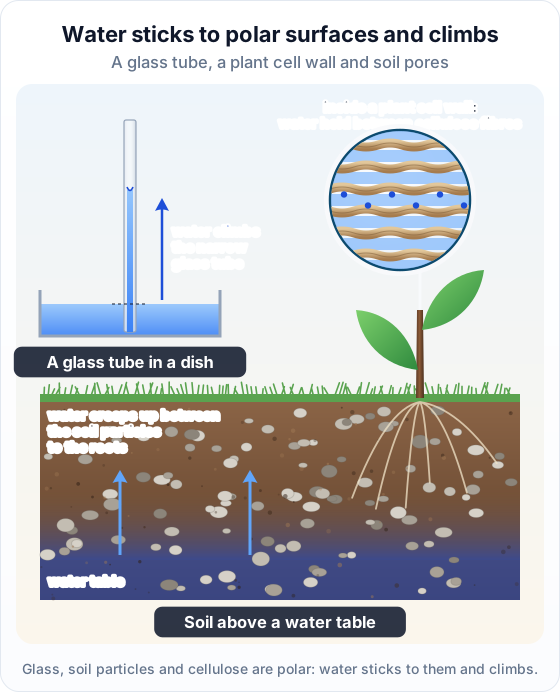
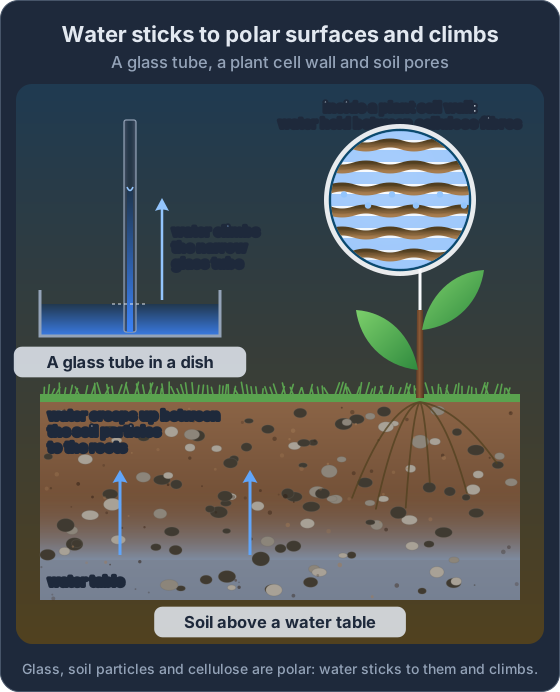
A glass tube standing in a dish with water risen inside it, a magnified plant cell wall with water held between cellulose fibres, and a soil cross-section where water creeps up from the water table to a plant's rootsA glass tube standing in a dish with water risen inside it, a magnified plant cell wall with water held between cellulose fibres, and a soil cross-section where water creeps up from the water table to a plant's roots
Three polar surfaces water sticks to: glass, cellulose and soil particles. In every narrow space, water climbs.

Real example: rain on a window. The drops cling to the glass and slide down slowly instead of falling straight off, because glass is polar and water adheres to it. On a waxed car bonnet the same rain beads up and rolls away: wax has no charges for water to grip.

A trap in the wording: 'Adhesion between water molecules' is wrong: water to water is always cohesion, and surface tension comes from cohesion, not adhesion. Adhesion always needs a second material.

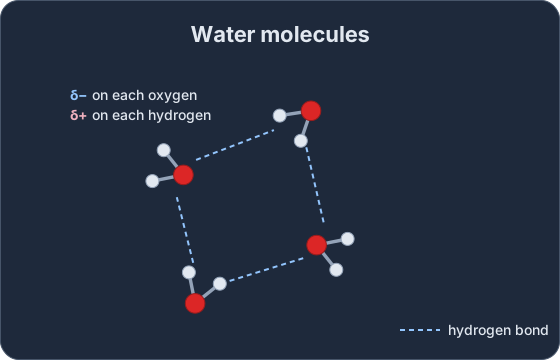
That trap is set with a picture. Look at what this figure can and cannot show:
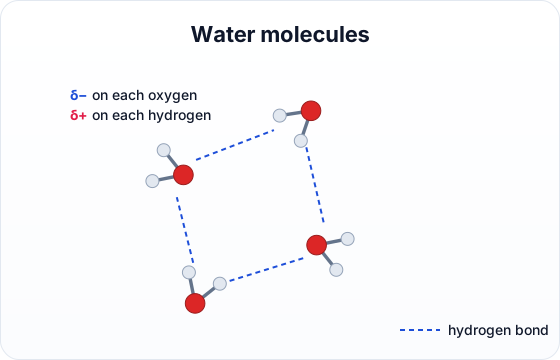
Four water molecules joined by dashed hydrogen bonds, with δ− on each oxygen and δ+ on each hydrogen; nothing else is drawnFour water molecules joined by dashed hydrogen bonds, with δ− on each oxygen and δ+ on each hydrogen; nothing else is drawn
A figure a Paper 1A item uses: only water molecules. It shows polarity, hydrogen bonding and cohesion. It cannot show adhesion: there is no second material.

Free preview

This is the free notes preview

You're reading the free notes. Aimnova Pro unlocks the full study experience — and you can try it with your first topic free to keep:

  • FlashcardsLock in vocabulary and key terms with spaced repetition.
  • Practice questionsAnswer exam-style questions and get instant AI marking.
  • Mock exams & past-paper vaultSit full mocks and see exactly how examiners award marks.
  • Personalised study planA daily plan built around your exam date and weak areas.
Start Studying Free Full access to Aimnova Pro · cancel anytime

Lay the corner of a paper towel in a spill and the water climbs up the towel, against gravity, with no pump. The towel is made of cellulose fibres with tiny gaps between them, and water does the rest.

That climb is capillary action. It happens wherever water meets a narrow space with polar walls.

The points to remember

  • In a narrow space, adhesion pulls water up the walls.
  • Cohesion makes the rest of the water follow, so a whole column rises: this is capillary action.
  • The narrower the space, the higher the water climbs.
  • In soil: water climbs the narrow gaps between soil particles, from wet soil deeper down to the roots.
  • In plant cell walls: water creeps through the gaps between cellulose fibres, and clings to the polar walls of the xylem.
Remember it as: Narrow gap, big climb.
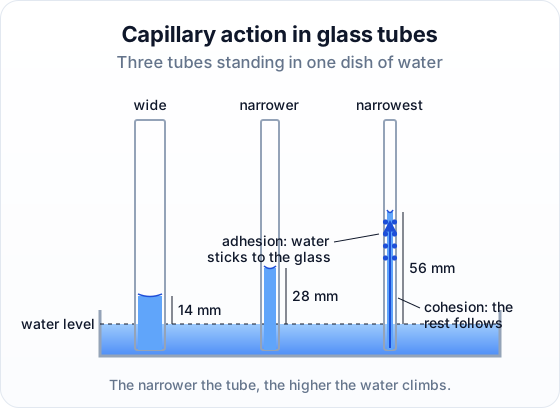
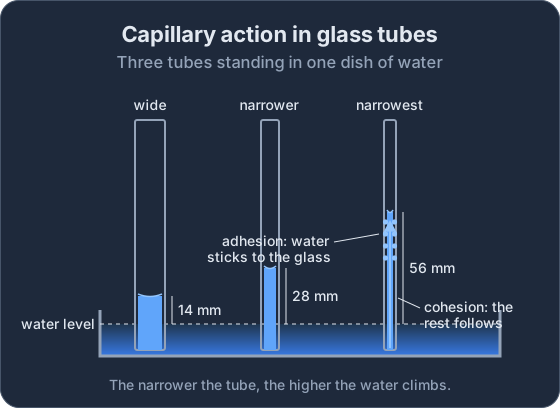
Three glass tubes of different bore standing in one dish of water: the water stands 14 mm up the wide tube, 28 mm up the narrower one and 56 mm up the narrowest, with adhesion and cohesion labelledThree glass tubes of different bore standing in one dish of water: the water stands 14 mm up the wide tube, 28 mm up the narrower one and 56 mm up the narrowest, with adhesion and cohesion labelled
The figure to copy: the narrower the tube, the higher the water climbs.

Draw it yourself, one part at a time:
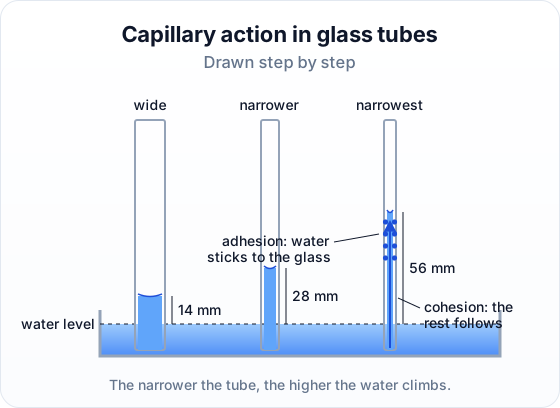
Three capillary tubes in a dish drawn step by step: the dish, each tube, each water column, then the adhesion and cohesion labels
Press Next to draw it one step at a time: tube by tube, then the two forces.

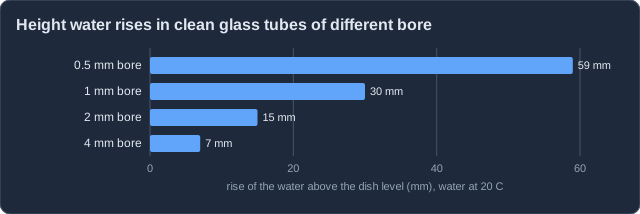
How much does the width matter? Here are real measurements in clean glass tubes:
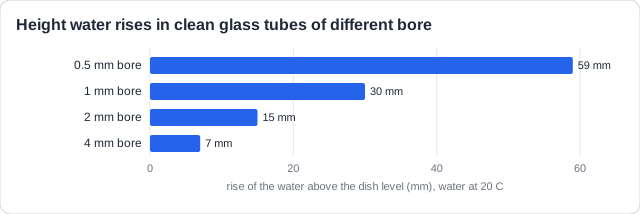
Bar chart: water rises 59 mm in a glass tube of 0.5 mm bore, 30 mm in 1 mm bore, 15 mm in 2 mm bore and 7 mm in 4 mm boreBar chart: water rises 59 mm in a glass tube of 0.5 mm bore, 30 mm in 1 mm bore, 15 mm in 2 mm bore and 7 mm in 4 mm bore
Measured in clean glass tubes: halve the bore and the water climbs twice as high.
Real example: silt and gravel: In silt the gaps between particles are tiny, so water climbs about a metre up from the water table and the soil stays damp for roots in a dry spell. In gravel the gaps are wide and water climbs only a few centimetres.

One limit to keep in mind, because it costs marks when it is forgotten:

Not the tree, not root pressure: Capillary action lifts water a few centimetres, or a metre or so in fine soil. It is not what lifts water to the top of a tall tree, and it is not root pressure.

Water goes up a tree because evaporation from the leaves pulls on the column; adhesion to the xylem walls helps the column hold on. If asked about root pressure or transpiration, do not write 'capillary action'.

Feeling unprepared for exams?

Get a clear study plan, practice with real questions, and know exactly where you stand before exam day. No more guessing.

Get Exam Ready FreeYour first topic is free to keep • No credit card required
How this is tested: Paper 1A asks for one mark: which everyday effect is a consequence of adhesion (water climbing through soil), as opposed to cohesion (surface tension) or water being a solvent (carrying nutrients in blood).

A written part gives a scene and asks you to explain how water moves through soil or a cell wall. Three marks, three steps: adhesion, cohesion, the narrow space.
IB-style questionExplain[3 marks]

A gardener waters seedlings only from a tray under their pots. Within an hour the soil at the top of each pot is damp. Explain how the water reaches the roots near the surface.

Model answer plan

See the mark-by-mark plan — for / against / judgement, with marking guidance — in study mode.

Claim your free topic

Try an IB Exam Question — Free AI Feedback

Test yourself on Adhesion of water to polar or charged materials. Write your answer and get instant AI feedback — just like a real IB examiner.

A drop of water placed on a clean glass slide spreads out and clings to the glass.

what is meant by the adhesion of water.
[1 mark]

Related Biology Topics

Continue learning with these related topics from the same unit:

1.1.1Water as the medium for life1.1.2Hydrogen bonds from the polar covalent bonds in water1.1.3Cohesion of water and its consequences for organisms1.1.5Solvent properties of water: metabolism and transport
View all Biology topics
Improve your exam techniqueCommand terms, paper structure, and mark-scheme tips for Biology
Previous1.1.3Cohesion of water and its consequences for organismsNextSolvent properties of water: metabolism and transport1.1.5

10 exam-style questions ready for you

Students who practice on Aimnova improve their scores by 15% on average. Get instant feedback that shows exactly how to improve your answers.

Practice Now — FreeView All Biology Topics