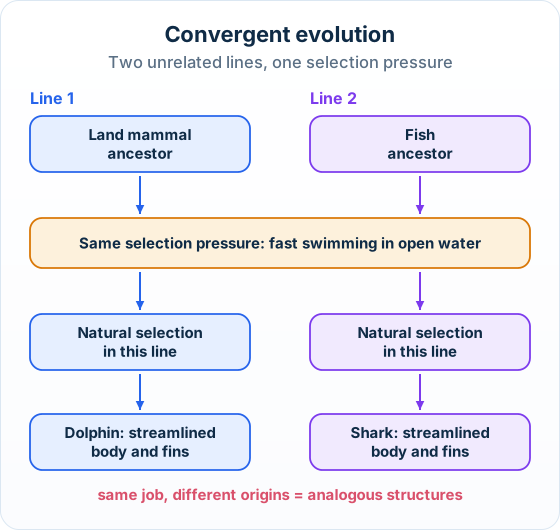
The big idea: Analogous structures do the same job but have different evolutionary origins. They arise by convergent evolution: unrelated groups face the same selection pressure.
First, the two words that are easy to mix up:
The favourite trap: The exam's favourite trap is telling apart two structures that look similar: homologous structures (similar because of a shared ancestor) and analogous structures (similar only because they do the same job).
- Homologous structures
- Structures with the same basic plan but different functions, inherited from a common ancestor (e.g. the matching limb bones of a human, a bat and a whale).
- Analogous structures
- Structures with a similar function but a different basic plan, with no recent common ancestor for that structure (e.g. a bird wing and an insect wing).
- Divergent evolution
- One ancestral form gives rise to several different forms — it produces homologous structures.
- Convergent evolution
- Unrelated species facing similar conditions evolve similar features independently — it produces analogous structures.
- Selective (artificial) breeding
- Humans choosing which organisms reproduce, changing a population quickly — evidence that heritable change really happens.
So when you see two species sharing a feature, ask why they are similar:
- Similar inside plan, different use → homologous → common ancestor (divergent evolution).
- Similar use, different inside plan → analogous → convergent evolution (no recent shared ancestor).
Homologous structures
- Same underlying plan, different jobs
- Inherited from a shared ancestor
- Example: the same arm bones in a human arm, a whale flipper and a bat wing
- Evidence of divergent evolution (one ancestor → many forms)
Analogous structures
- Same job, built on a different plan
- No recent shared ancestor for that structure
- Example: a bird wing and an insect wing (both fly, totally different inside)
- Evidence of convergent evolution (different ancestors → similar form)
The points to remember
- Convergent evolution happens by natural selection, in each line separately.
- Unrelated groups living in similar environments face similar selection pressures.
- So similar adaptations are favoured: the structures end up with a similar function.
- They come from different ancestry, so they are analogous, not homologous.
- Example: the streamlined bodies of sharks and dolphins, for fast swimming.
Remember it as: Same job, different origins.
Real example: moles and mole crickets: The European mole is a mammal and the mole cricket is an insect. Both dig through soil with broad, spade-like front limbs, built in completely different ways: analogous structures.
Watch the reasoning in an answer:
Same job is not a shared ancestor: Do not write that birds evolved from insects because both have wings. Analogous structures show a shared selection pressure, not a shared ancestor.
Free preview
This is the free notes preview
You're reading the free notes. Aimnova Pro unlocks the full study experience — and you can try it with your first topic free to keep:
- FlashcardsLock in vocabulary and key terms with spaced repetition.
- Practice questionsAnswer exam-style questions and get instant AI marking.
- Mock exams & past-paper vaultSit full mocks and see exactly how examiners award marks.
- Personalised study planA daily plan built around your exam date and weak areas.
How this is tested: Evidence for evolution is tested on Paper 1A (multiple choice) and in a longer Paper 2 answer.
Paper 1A
- Most often asks you to identify the type of evidence for a relationship
- Or to distinguish homologous from analogous structures (bat vs insect wing, dolphin vs ichthyosaur, human vs octopus eye)
Paper 2
- The headline question is a 4-mark Explain: how do analogous structures arise through convergent evolution?
- Build your answer step by step around natural selection
Exam-style question — convergent evolution
Sharks (fish) and dolphins (mammals) both have a streamlined body and a dorsal fin, yet their most recent common ancestor had neither. Explain how these analogous structures arose through convergent evolution. [4]
How to score all four marks
- Set up the variation. Within each population there was heritable variation in body shape, caused by mutation — some individuals were slightly more streamlined than others.
- State the shared pressure. Both groups live in the same kind of environment (open water), so they face the same selection pressure — a streamlined shape lets you swim faster to catch prey and escape predators.
- Apply natural selection separately. In each population the more streamlined individuals survive and reproduce more, passing the helpful alleles on; over many generations the allele frequency for a streamlined body rises in each group independently.
- Answer the command term — explain why they are analogous. Because the two lineages evolved the feature separately (not from a shared streamlined ancestor), the structures are analogous, and similar form from independent evolution under the same pressure is convergent evolution.
Final answer
Heritable variation in body shape + the same selection pressure (open water) means natural selection favours streamlined individuals in EACH lineage independently; the trait was not inherited from a shared streamlined ancestor, so the structures are analogous and the pattern is convergent evolution.
What scores the marks: Make sure your answer names all four: heritable variation, the same selection pressure, natural selection acting separately in each lineage, and the conclusion that the similarity evolved independently (so it is analogous / convergent).