aımnova
DashboardMy LearningCrash CoursesStudy Plan

Aimnova site navigation

Stay in the loop

Get the latest study resources and updates

New features, study tips and exam insights — straight to your inbox.

IB Diploma

  • IB Past Papers
  • IB Study Notes
  • IB Question Bank
  • IB Mock Exams
  • IB Revision

IB Subjects

  • IB Math AA
  • IB Math AI
  • IB Economics
  • IB Business Management
  • IB Physics
  • IB Biology
  • View all IB subjects→

IB Past Papers

  • IB Math AA HL Past Papers
  • IB Math AA SL Past Papers
  • IB Math AI HL Past Papers
  • IB Math AI SL Past Papers
  • IB Economics HL Past Papers
  • IB Economics SL Past Papers
  • IB ESS Past Papers
  • View all past papers→

Study Resources

  • Study Notes
  • Question Bank
  • Mock Exams
  • Crash Courses
  • Flashcards
  • Revision Guide
  • Exam Skills
  • Command Terms
  • Grade Calculator
  • Exam Timetable 2026

Aimnova

  • Features
  • Pricing
  • For Teachers
  • For Schools
  • For Parents
  • About Us
  • Blog
  • Contact
aımnova

IB study, practice and feedback built around the real exam.

TermsPrivacyCookies·© 2026 Aimnova. All rights reserved.10c8990

Aimnova is not affiliated with or endorsed by the International Baccalaureate Organization (IB).

NotesBiologyTopic 1.2Role of complementary base pairing in replication and expression
Back to Biology Topics
1.2.83 min read

Role of complementary base pairing in replication and expression

IB Biology · Unit 1

Exam preparation

Practice the questions examiners actually ask

Our question bank mirrors real IB exam papers. Practice under timed conditions and track your progress across topics.

Start Practicing

Contents

  1. 1Copying DNA: each strand is a template
  2. 2Reading DNA into RNA
  3. 3Exam-style question (step by step)
The big idea: Because each base has only one partner, each DNA strand holds the information for the other. That is how DNA is copied exactly.

The points to remember

  • Each base pairs with one partner only: A with T, G with C.
  • The pairs are held by hydrogen bonds between the bases.
  • To copy DNA, the hydrogen bonds break and the two strands separate.
  • Each old strand is a template: free nucleotides pair with its bases, A with T, G with C.
  • The result is two DNA molecules with the same base sequence: the information is copied accurately.
Remember it as: One strand tells you the other.
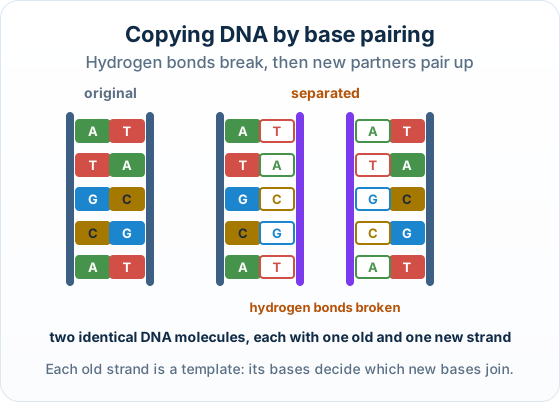
A DNA stretch splits into two strands; new partner bases pair with each, giving two identical molecules
Complementary base pairing makes each strand a template.
Real example: 6 billion bases, copied: Before one of your cells divides, it copies about 6 billion bases of DNA. Thanks to base pairing, very few mistakes are made: each new cell gets the same instructions.

Free preview

This is the free notes preview

You're reading the free notes. Aimnova Pro unlocks the full study experience — and you can try it with your first topic free to keep:

  • FlashcardsLock in vocabulary and key terms with spaced repetition.
  • Practice questionsAnswer exam-style questions and get instant AI marking.
  • Mock exams & past-paper vaultSit full mocks and see exactly how examiners award marks.
  • Personalised study planA daily plan built around your exam date and weak areas.
Start Studying Free Full access to Aimnova Pro · cancel anytime
The big idea: The same pairing rules let the cell read DNA: a gene is copied into RNA, and the RNA is used to make a protein.

The points to remember

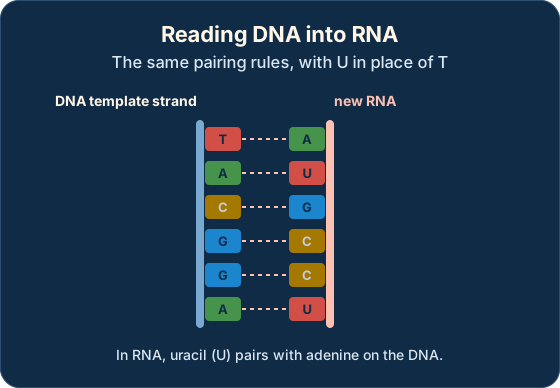
  • To use a gene, one DNA strand is a template for making RNA (transcription).
  • RNA nucleotides pair with the DNA bases: A with U, T with A, G with C, C with G.
  • So the RNA carries an exact copy of the gene's information.
  • In translation, each tRNA pairs with three bases of the mRNA in the same complementary way.
  • Pairing one base with its partner also keeps the two DNA strands an even distance apart, a stable structure.
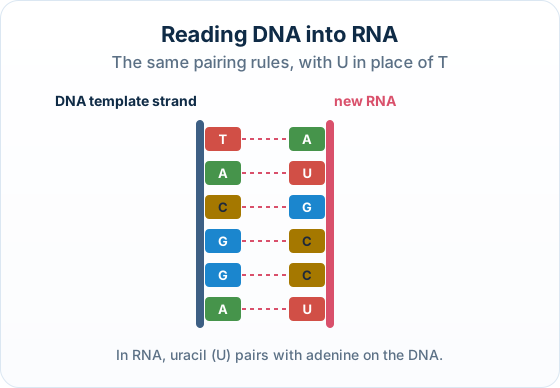
A DNA template strand T A C G G A beside the RNA made from it, A U G C C U, joined base to baseA DNA template strand T A C G G A beside the RNA made from it, A U G C C U, joined base to base
Transcription uses the same pairing, with uracil in place of thymine.
U, not T, in RNA: When RNA is made, adenine on the DNA pairs with uracil, not thymine.

Study smarter, not longer

Most students waste 40% of study time on topics they already know. Our AI tracks your progress and optimizes every minute.

Try Smart Study FreeYour first topic is free to keep • No credit card required
How it is asked: A three-mark Explain on why complementary base pairing matters, and a Paper 1A item on what makes copying accurate.
IB-style questionExplain[3 marks]

Explain the significance of complementary base pairing in DNA.

Model answer plan

See the answer broken into clear points, with guidance on how each point earns marks.

Claim your free topic

IB Exam Questions on Role of complementary base pairing in replication and expression

Practice with IB-style questions filtered to Topic 1.2.8. Get instant AI feedback on every answer.

Practice Topic 1.2.8 QuestionsBrowse All Biology Topics

How Role of complementary base pairing in replication and expression Appears in IB Exams

Examiners use specific command terms when asking about this topic. Here's what to expect:

  • Define

    Give the precise meaning of key terms related to Role of complementary base pairing in replication and expression.

    AO1
  • Describe

    Give a detailed account of processes or features in Role of complementary base pairing in replication and expression.

    AO2
  • Explain

    Give reasons WHY — cause and effect within Role of complementary base pairing in replication and expression.

    AO3
  • Evaluate

    Weigh strengths AND limitations of approaches in Role of complementary base pairing in replication and expression.

    AO3
  • Discuss

    Present arguments FOR and AGAINST with a balanced conclusion.

    AO3

See the full IB Command Terms guide

Related Biology Topics

Continue learning with these related topics from the same unit:

1.1.1Water as the medium for life1.1.2Hydrogen bonds from the polar covalent bonds in water1.1.3Cohesion of water and its consequences for organisms1.1.4Adhesion of water to polar or charged materials
View all Biology topics
Improve your exam techniqueCommand terms, paper structure, and mark-scheme tips for Biology
Previous1.2.7Differences between DNA and RNANextDiversity of DNA base sequences and the capacity to store information1.2.9

4 practice questions on Role of complementary base pairing in replication and expression

Students who practiced this topic on Aimnova scored 82% on average. Try free practice questions and get instant AI feedback.

Try 3 Free QuestionsView All Biology Topics