DNA and RNA are both made of nucleotides, so they share the same three parts. They differ in three specific ways: the sugar, one of the bases, and the number of strands.
DNA vs RNA at a glance — same three parts, but three differences: the sugar, one base (T in DNA → U in RNA), and the number of strands. Read across each row.
Interactive diagram
Explore the labelled diagram, charts and maps for this topic in full study mode.
- Nucleotide
- The monomer of a nucleic acid — a phosphate group, a pentose sugar and a nitrogenous base joined together.
- Pentose sugar
- A sugar with five carbon atoms; deoxyribose in DNA, ribose in RNA.
- Nitrogenous base
- The information-carrying part of a nucleotide: adenine (A), cytosine (C), guanine (G), and either thymine (T, in DNA) or uracil (U, in RNA).
- Strand
- A single chain of nucleotides. DNA has two strands; RNA has one.
DNA
- Sugar is deoxyribose
- Bases: A, C, G and thymine (T)
- Double-stranded (two strands)
- Stores the genetic information long-term
RNA
- Sugar is ribose
- Bases: A, C, G and uracil (U) instead of T
- Single-stranded (one strand)
- Carries / works with the message to make proteins
The three differences to memorise: 1. Sugar: DNA has deoxyribose, RNA has ribose.
2. One base: DNA uses thymine (T), RNA uses uracil (U) in its place.
3. Strands: DNA is double-stranded, RNA is single-stranded.
The phosphate, and the bases A, C and G, are the same in both.
A memory hook: DNA has Deoxyribose and Double strands. RNA swaps Thymine for Uracil — 'U' is the new letter that only appears in RNA.
Phosphorus — needed for more than just DNA: Each nucleotide's phosphate group contains the element phosphorus, so building DNA and RNA needs a supply of phosphorus.
DNA and RNA are not the only ones: two more biochemicals need phosphorus
- ATP (the cell's energy-carrying molecule)
- Phospholipids (the molecules that build cell membranes)
Why it matters: This is why phosphorus is an essential raw material for life — a plant or cell with too little phosphorus cannot make enough DNA, RNA, ATP or phospholipids.
- Biochemical
- A chemical compound made by, and used inside, living organisms (for example a nucleic acid, ATP or a phospholipid).
- DNA and RNA (nucleic acids)
- Their nucleotides each carry a phosphate group, so building them requires phosphorus.
- ATP
- The molecule cells use to carry and release usable energy. The 'P' stands for phosphate — ATP contains three phosphate groups, so it needs phosphorus.
- Phospholipid
- The main molecule of cell membranes. Its 'head' is a phosphate group, so it too contains phosphorus.
If asked to list phosphorus-containing biochemicals: Any two of these score the marks: DNA, RNA, ATP, or a phospholipid.
A safe pair to remember is ATP and phospholipids (or DNA and ATP) — all of them contain a phosphate group, which is the part that holds the phosphorus.
Free preview
This is the free notes preview
You're reading the free notes. Aimnova Pro unlocks the full study experience — and you can try it with your first topic free to keep:
- FlashcardsLock in vocabulary and key terms with spaced repetition.
- Practice questionsAnswer exam-style questions and get instant AI marking.
- Mock exams & past-paper vaultSit full mocks and see exactly how examiners award marks.
- Personalised study planA daily plan built around your exam date and weak areas.
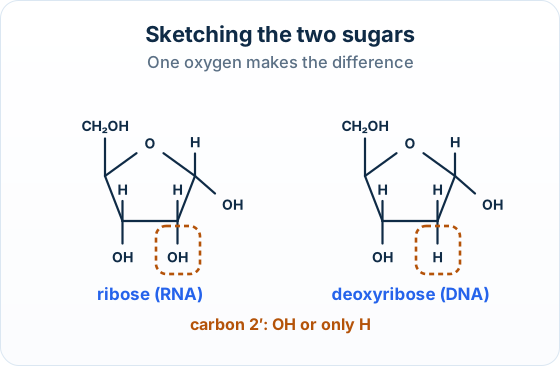
The big idea: Ribose and deoxyribose are the same ring with one difference: deoxyribose has one oxygen fewer, at carbon 2′.
The points to remember
- Sketch both sugars as five-sided rings with an oxygen at the top.
- The only difference is at carbon 2′: ribose has OH, deoxyribose has just H.
- In a diagram, two strands, thymine or A–T and C–G pairs mean DNA; one strand with uracil means RNA.
- DNA molecules are usually much longer than RNA molecules.
Remember it as: Deoxy- means one oxygen missing.
DNA and RNA are found all over the living world:
DNA
- The genetic material in every chromosome.
- Also in mitochondria and chloroplasts, as small loops.
RNA in every cell
- mRNA (messenger RNA): a copy of one gene.
- tRNA (transfer RNA): brings amino acids.
- rRNA (ribosomal RNA): part of every ribosome.
RNA in viruses
- The genetic material of some viruses.
- Influenza and SARS-CoV-2 carry RNA.
Get feedback like a real examiner
Submit your answers and get instant feedback — what you did well, what's missing, and exactly what to write to score full marks.
How it is asked: Distinguish (two contrasts, two marks) and Compare and contrast (similarities and differences). Every difference needs both halves: what DNA has, whereas what RNA has.
A virus that causes the common cold carries RNA, and the human cells it infects carry DNA. Distinguish between the structures of RNA and DNA.
Model answer plan
See the answer broken into clear points, with guidance on how each point earns marks.
And the three-mark version, which also wants what they share:
Compare and contrast the structure of DNA and RNA.
Model answer plan
See the answer broken into clear points, with guidance on how each point earns marks.