The big idea: DNA is the cell's information store. The information is held in the order of its bases — A, T, C and G — along the molecule.
Key points
- Just like the letters in a sentence, it is the sequence that carries the meaning, not the individual letters.
- DNA can also be packaged to fit a huge amount of this information inside a tiny cell.
Why it stores SO much
- Information is the sequence of bases (A, T, C, G)
- A 4-letter code → almost endless combinations
- DNA molecules are very long — millions of bases
Why it stores it SAFELY
- The two strands are complementary — each is a backup
- Bases sit protected inside the double helix
- Packaging condenses the long molecule so it fits and is protected
- Base sequence
- The order of the bases (A, T, C, G) along a DNA strand — this order is the stored information.
- Genetic information
- The instructions, written in the base sequence, that a cell uses to build proteins and run its activities.
- DNA packaging
- The way the very long DNA molecule is folded and condensed so it fits inside the cell.
Free preview
This is the free notes preview
You're reading the free notes. Aimnova Pro unlocks the full study experience — and you can try it with your first topic free to keep:
- FlashcardsLock in vocabulary and key terms with spaced repetition.
- Practice questionsAnswer exam-style questions and get instant AI marking.
- Mock exams & past-paper vaultSit full mocks and see exactly how examiners award marks.
- Personalised study planA daily plan built around your exam date and weak areas.
DNA uses only four bases — A, T, C and G — but it strings them into very long molecules.
Why so much information fits
- The order can vary at every position, so the number of possible sequences is enormous.
- Think of an alphabet: just 26 letters make every book ever written.
- DNA does the same with four letters and millions of positions, so a single molecule can store a huge amount of information.
The information is the ORDER: What matters is the sequence — the specific order of A, T, C and G — not how many bases there are. Change the order and you change the message, just like rearranging letters changes a word.
A human cell holds about two metres of DNA, yet the nucleus is only a few micrometres across. To fit (and to protect the DNA and keep it tidy when the cell divides), eukaryotes package their DNA using proteins called histones.
The DNA wraps around the histones like thread around a spool. This winds the long thread up tightly so it condenses into a compact chromosome.
- Histone
- A protein that DNA wraps around to package (condense) it inside the cell of plants, animals and other eukaryotes.
- Chromosome
- A single long DNA molecule wound around histones and condensed into a compact, organised structure.
- Condense
- To pack the long DNA thread into a much smaller, tighter shape so it fits and is protected.
Histones — what to say: Histones are proteins that DNA wraps around to package / condense it so the long molecule fits inside the cell and is kept organised.
Eukaryotes (plants, animals, fungi) use histones; most prokaryotes do not.
Zooming out: the base sequence forms a double helix, which wraps around histone proteins, condensing into a compact chromosome.
Interactive diagram
Explore the labelled diagram, charts and maps for this topic in full study mode.
Never wonder what to study next
Get a personalized daily plan based on your exam date, progress, and weak areas. We'll tell you exactly what to review each day.
The big idea: With four bases in any order and any length, the number of possible DNA sequences grows by four times with every base added.
The points to remember
- The information is the sequence of bases along the strand.
- Any of the four bases (adenine, cytosine, guanine, thymine) can follow any other: any sequence is possible.
- A stretch n bases long can have 4ⁿ different sequences: 64 for just three bases.
- DNA molecules can be any length, up to hundreds of millions of bases.
- So the capacity is almost limitless, packed into a very small space.
Remember it as: Four letters, any order, any length.
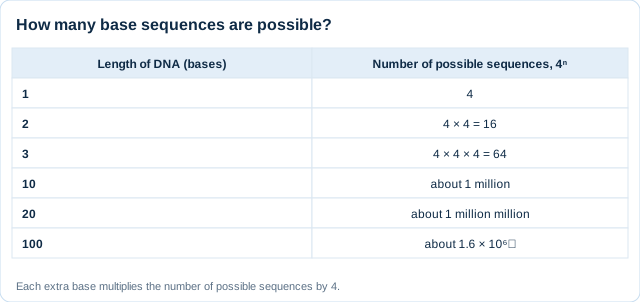
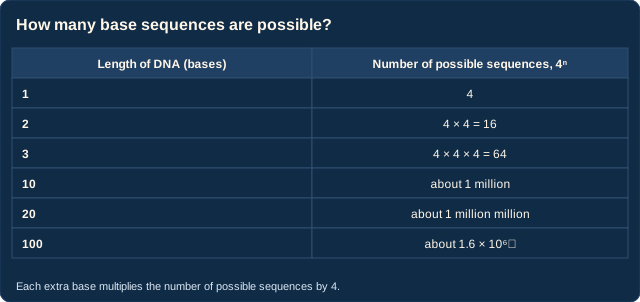
Worked numbers: Number of sequences = 4ⁿ, where n is the number of bases.
For n = 3: 4 × 4 × 4 = 64. For n = 10: 4¹⁰ = 1 048 576, about a million.
All that information takes up almost no room:
Real example: a genome in a nucleus: The 3.1 billion base pairs of the human genome fit inside a nucleus only about 6 micrometres across, smaller than the width of a hair.
How this is tested: Two kinds of question test this: one on Paper 1A, one on Paper 1B / Paper 2.
Two question types
- On Paper 1A (multiple choice) you may be asked to identify the feature of DNA that lets it store very large amounts of information — the answer is its long, variable sequence of bases.
- On Paper 1B / Paper 2 a 1-mark Outline question can ask what histones do in plant and animal chromosomes — they are proteins that DNA wraps around to package it.
IB-style question — what makes DNA a good information store
Outline the feature of DNA that gives it the capacity to store a very large amount of information. [2]
How to score both marks
- State what holds the information. The information is stored in the sequence (order) of the bases A, T, C and G along the molecule.
- Say why the capacity is so large. DNA molecules are very long, and the four bases can be arranged in a huge number of different orders / combinations.
- Answer the command term (Outline). So DNA can store vast information because a long molecule of four bases gives an almost limitless number of possible base sequences.
Final answer
The information is the sequence of the four bases (A, T, C, G); because the molecule is very long, the bases can be ordered in an enormous number of ways, giving a huge storage capacity.
What a full-mark answer needs: Both ideas must appear: (1) the information is the base sequence/order, and (2) a long molecule of four bases gives a huge number of combinations.
Saying only 'DNA is long' or only 'it has four bases' on its own is not enough.