Continuous variation at Higher Level: The same statement as SL. HL data questions ask you to discuss whether a distribution supports polygenic inheritance.
Practise this as you read
- Distinguish continuous from discrete variables.
- Discuss evidence for polygenic inheritance.
Free preview
This is the free notes preview
You're reading the free notes. Aimnova Pro unlocks the full study experience — and you can try it with your first topic free to keep:
- FlashcardsLock in vocabulary and key terms with spaced repetition.
- Practice questionsAnswer exam-style questions and get instant AI marking.
- Mock exams & past-paper vaultSit full mocks and see exactly how examiners award marks.
- Personalised study planA daily plan built around your exam date and weak areas.
The big idea: Some traits fall into separate categories (discrete). Others can take any value in a range (continuous), because many genes and the environment affect them.
See it drawn, step by step
In My Learning, handwritten diagrams build one step at a time. Play, pause and replay each explanation until it clicks. Create your free account to try it.
Discrete variable
- A few distinct categories
- No intermediate values
- Example: ABO blood group
- Usually one gene
Continuous variable
- Any value within a range
- Many intermediates; often a bell-shaped distribution
- Examples: skin colour, height
- Many genes and/or the environment
Remember it as: Categories or a range?
Practice with exam-style questions
Answer exam-style questions and get AI feedback that shows you exactly what examiners want to see in a full-marks response.
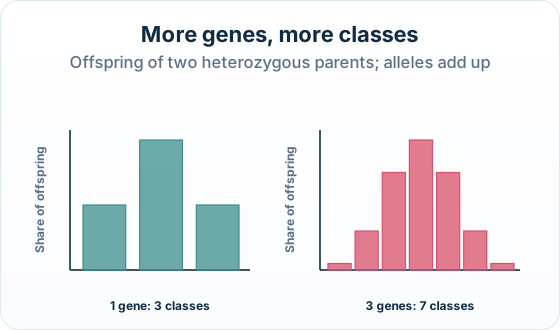
The big idea: Polygenic inheritance: a trait is controlled by several genes, each adding a small effect. The effects add up to give many phenotypes.
The points to remember
- Skin colour: several genes control how much melanin is made; more 'dark' alleles, darker skin.
- The environment adds to it: sunlight raises melanin production, so the classes blur.
- Height: many genes plus diet and health during growth.
- Continuous variation can be due to polygenic inheritance, the environment, or both.
A wide, smooth range of values in a sample is consistent with polygenic inheritance, but it does not prove it: the environment alone can also spread values out.
How it is asked: From a histogram: name the type of variation and justify it, say what causes it, or discuss whether the data support polygenic inheritance. 1A items ask for examples.
| Measure of central tendency | How to find it |
|---|---|
| Mean | Add all the values and divide by the number of values |
| Median | The middle value when the values are in order |
| Mode | The value, or class, that occurs most often |
A histogram of the body mass of 200 adult mice shows a bell-shaped distribution from 18 g to 32 g. State the type of variation shown and justify your answer.
Model answer plan
See the answer broken into clear points, with guidance on how each point earns marks.