aımnova
DashboardMy LearningCrash CoursesStudy Plan

Aimnova site navigation

Stay in the loop

Get the latest study resources and updates

New features, study tips and exam insights — straight to your inbox.

IB Diploma

  • IB Past Papers
  • IB Study Notes
  • IB Question Bank
  • IB Mock Exams
  • IB Revision

IB Subjects

  • IB Math AA
  • IB Math AI
  • IB Economics
  • IB Business Management
  • IB Physics
  • IB Biology
  • View all IB subjects→

IB Past Papers

  • IB Math AA HL Past Papers
  • IB Math AA SL Past Papers
  • IB Math AI HL Past Papers
  • IB Math AI SL Past Papers
  • IB Economics HL Past Papers
  • IB Economics SL Past Papers
  • IB ESS Past Papers
  • View all past papers→

Study Resources

  • Study Notes
  • Question Bank
  • Mock Exams
  • Crash Courses
  • Flashcards
  • Revision Guide
  • Exam Skills
  • Command Terms
  • Grade Calculator
  • Exam Timetable 2027

Aimnova

  • Features
  • Pricing
  • For Teachers
  • For Schools
  • For Parents
  • About Us
  • Blog
  • Contact
aımnova

IB study, practice and feedback built around the real exam.

TermsPrivacyCookies·© 2026 Aimnova. All rights reserved.d9e1c61

Aimnova is not affiliated with or endorsed by the International Baccalaureate Organization (IB).

NotesBiology HLTopic 4.8Pedigree charts to deduce patterns of inheritance of genetic disorders
Back to Biology HL Topics
4.8.135 min read

Pedigree charts to deduce patterns of inheritance of genetic disorders (Biology HL)

IB Biology · Unit 4

Smart study tools

Turn reading into results

Move beyond passive notes. Answer exam-style questions, get AI feedback, and build the skills that earn top marks.

Get Started Free

Contents

  1. 1Pedigree charts at Higher Level
  2. 2Reading a pedigree chart
  3. 3Deducing the pattern
  4. 4Exam-style question (step by step)
Pedigree charts at Higher Level: The same statement as SL. HL items are mostly on sex-linked pedigrees such as haemophilia.

Practise this as you read

  • Deduce genotypes in a sex-linked pedigree.
  • Explain the evidence for sex linkage.

Free preview

This is the free notes preview

You're reading the free notes. Aimnova Pro unlocks the full study experience — and you can try it with your first topic free to keep:

  • FlashcardsLock in vocabulary and key terms with spaced repetition.
  • Practice questionsAnswer exam-style questions and get instant AI marking.
  • Mock exams & past-paper vaultSit full mocks and see exactly how examiners award marks.
  • Personalised study planA daily plan built around your exam date and weak areas.
Start Studying Free Full access to Aimnova Pro · cancel anytime
The big idea: A pedigree chart is a family tree that shows who has a trait. From it you can deduce the pattern of inheritance and then people's genotypes.

See it drawn, step by step

In My Learning, handwritten diagrams build one step at a time. Play, pause and replay each explanation until it clicks. Create your free account to try it.

Claim your free topic
SymbolMeaning
SquareMale
CircleFemale
FilledAffected
EmptyUnaffected
Roman numeralGeneration (I is the oldest)
Remember it as: Shapes for sex, shading for the trait.

See how examiners mark answers

Answer exam-style questions with model answers. Learn exactly what earns marks and what doesn't.

Try Exam Vault FreeYour first topic is free to keep • No credit card required
The big idea: Look for a clue that only one pattern can explain, then test it against the rest of the chart.
Clue in the chartWhat it shows
Two unaffected parents have an affected childRecessive: both parents are carriers
Two affected parents have an unaffected childDominant: both parents are heterozygous
Every affected person has an affected parentProbably dominant
Affected father has an affected sonNot X-linked: sons get his Y
Affected father has an unaffected daughterNot X-linked dominant
Mostly males affected; passed through unaffected mothersSex-linked recessive
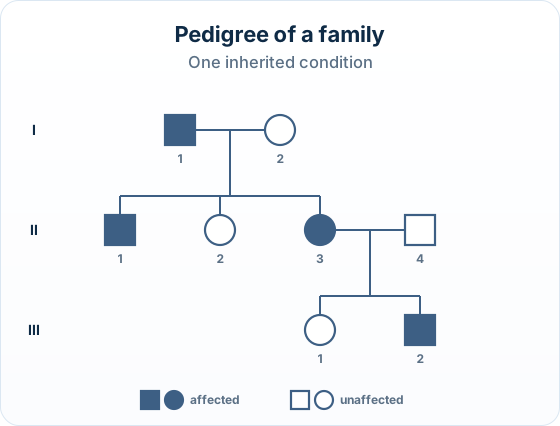
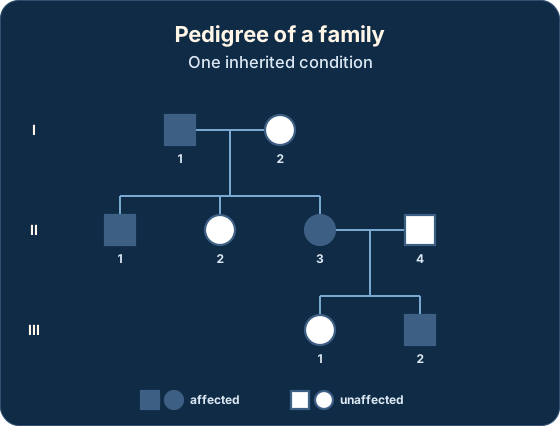
A three-generation pedigree with an affected person in every generation, including an affected father with an affected son and an unaffected daughterA three-generation pedigree with an affected person in every generation, including an affected father with an affected son and an unaffected daughter
A dominant, autosomal pattern.

Two kinds of reasoning. Working out the pattern from some of the individuals is inductive reasoning (from cases to a general rule). Using the pattern to work out one person's genotype is deductive reasoning (from the rule to a case).
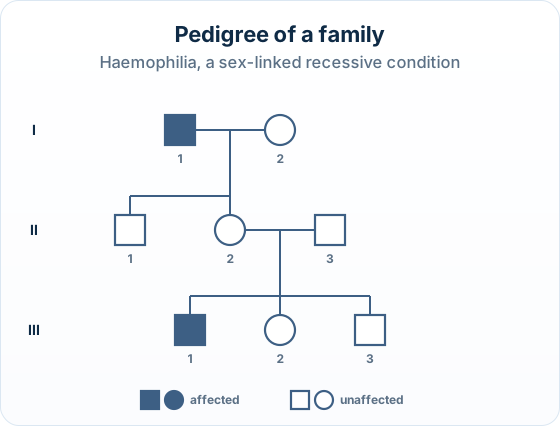
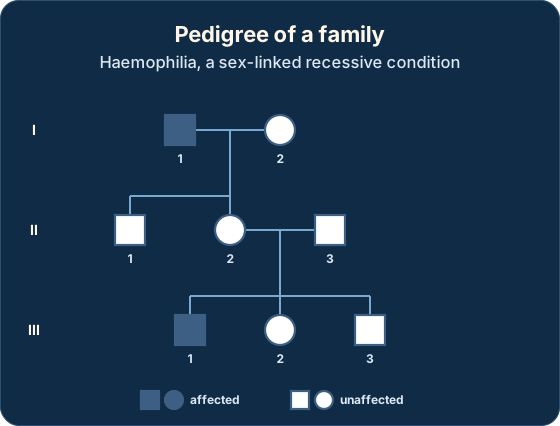
A three-generation pedigree in which an affected grandfather has an unaffected daughter whose son is affectedA three-generation pedigree in which an affected grandfather has an unaffected daughter whose son is affected
A sex-linked recessive pattern: only males affected, passed on through a carrier daughter.

The points to remember

  • A small family can mislead: say 'most likely' and give the evidence.
  • Close relatives often carry the same recessive allele, so their children are more likely to be homozygous recessive.
  • That is the genetic basis for forbidding marriage between close relatives.
How it is asked: Always with a chart: name the pattern (1A), state possible genotypes, calculate the chance for the next child, or explain the evidence for or against sex linkage.
IB-style questionExplain[2 marks]

A pedigree shows a condition caused by a dominant allele. An affected father has an affected son and an unaffected daughter. Explain how this shows that the allele is not on the X chromosome.

Model answer plan

See the answer broken into clear points, with guidance on how each point earns marks.

Claim your free topic

Another question in the papers' style, worked in full:

IB-style questionDeduce / State[5 marks]

In a family, two parents without a genetic condition have three children: a daughter with the condition, an unaffected son and an unaffected daughter. Use A and a for the alleles. (a) Deduce, with a reason, whether the allele for the condition is dominant or recessive. (b) State whether the allele is most likely autosomal or on the X chromosome, with a reason. (c) State the genotype of the mother.

Model answer plan

See the answer broken into clear points, with guidance on how each point earns marks.

Claim your free topic
Why this scores full marks: Each part gives the answer and the reason from the family: the reason is where most of the marks are.

In (c), an unaffected parent of a child with a recessive condition must be a carrier (Aa), not AA: that one deduction is the mark.

Try an IB Exam Question — Free AI Feedback

Test yourself on Pedigree charts to deduce patterns of inheritance of genetic disorders. Write your answer and get instant AI feedback — just like a real IB examiner.

A condition is autosomal dominant.

The allele causing it is H and the normal allele is h.

In a pedigree, a woman labelled Q is affected by the condition, while her brother R is unaffected.

the possible genotype(s) of Q and the genotype of R using the symbols H and h.
[2 marks]

Related Biology HL Topics

Continue learning with these related topics from the same unit:

4.1.1DNA replication as production of exact copies of DNA with identical base sequences4.1.2Semi-conservative nature of DNA replication and role of complementary base pairing4.1.3Role of helicase and DNA polymerase in DNA replication4.1.4Polymerase chain reaction and gel electrophoresis as tools for amplifying and separating DNA
View all Biology HL topics
Improve your exam techniqueCommand terms, paper structure, and mark-scheme tips for Biology HL
Previous4.8.12Haemophilia as an example of a sex-linked genetic disorderNextContinuous variation due to polygenic inheritance and/or environmental factors4.8.14

29 exam-style questions ready for you

Students who practice on Aimnova improve their scores by 15% on average. Get instant feedback that shows exactly how to improve your answers.

Practice Now — FreeView All Biology HL Topics