Semi-conservative replication at Higher Level: The same statement as SL. HL builds on it straight away: the two strands run in opposite directions, so the new strands are made in different ways, and the copy is proofread.
Practise this as you read
- Identify the diagram that shows semi-conservative replication.
- Explain how complementary base pairing makes the copy accurate.
Free preview
This is the free notes preview
You're reading the free notes. Aimnova Pro unlocks the full study experience — and you can try it with your first topic free to keep:
- FlashcardsLock in vocabulary and key terms with spaced repetition.
- Practice questionsAnswer exam-style questions and get instant AI marking.
- Mock exams & past-paper vaultSit full mocks and see exactly how examiners award marks.
- Personalised study planA daily plan built around your exam date and weak areas.
The big idea: Before a cell divides it must make an exact copy of all its DNA. This copying is called DNA replication, and it is semi-conservative.
How semi-conservative replication works
Unzip
The double helix unzips into its two strands.
Use as templates
Each old strand acts as a template for building a new partner strand.
Two identical molecules
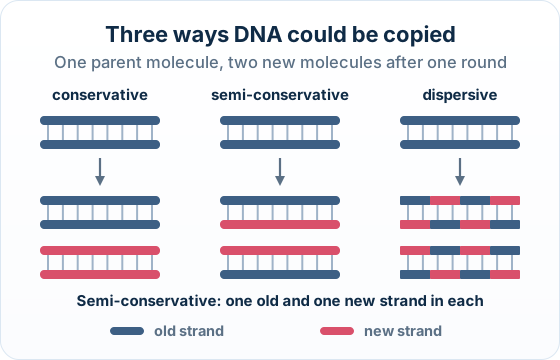
The result is two identical molecules, each with one old (parental) strand paired with one new strand.
'Semi' = half: half of each new molecule is conserved from the original.
Helicase unzips the double helix and DNA polymerase builds a new complementary strand on each template, so each daughter molecule keeps one old (parental) strand and one new strand — this is what 'semi-conservative' means.
Interactive diagram
Explore the labelled diagram, charts and maps for this topic in full study mode.
- DNA replication
- The process of copying a DNA molecule to produce two identical molecules, carried out before a cell divides.
- Semi-conservative replication
- Replication in which each new DNA molecule is made of one original (parental) strand and one newly built strand.
- Template strand
- An old strand of DNA that is used as a pattern to build a new complementary strand.
- Complementary base pairing
- The rule that adenine pairs with thymine (A–T) and cytosine pairs with guanine (C–G), so each template strand specifies exactly one possible new strand.
- Daughter molecule
- One of the two identical DNA molecules produced by replication.
Why each copy keeps an old strand: Because the two strands are held together by complementary base pairing, an old strand already carries all the information needed to rebuild its partner.
So replication does not throw the old strands away — it keeps each one and builds a fresh partner against it. That is exactly why every new molecule ends up half old, half new.
See how examiners mark answers
Answer exam-style questions with model answers. Learn exactly what earns marks and what doesn't.
To see why the copying is semi-conservative, follow the strands through one round of replication.
The key is that the two parental strands are separated but never destroyed — each one is kept and used as a template.
One round of replication, step by step
- The double helix is unzipped, separating the two parental strands.
- Each parental strand acts as a template.
- New nucleotides line up by complementary base pairing (A–T, C–G) against each template.
- The new nucleotides are joined into a continuous new strand.
- Each old strand now sits paired with its own new strand → two identical daughter molecules.
Cause → effect: Cause: the strands separate, and each old strand is copied by complementary base pairing.
Effect: every daughter molecule contains one conserved old strand and one new strand — never two old strands together and never two new strands together.
Conservative (what does NOT happen)
- Both old strands stay in one molecule
- Both new strands go into the other molecule
- One molecule is all old, one is all new
- This was ruled out by the evidence
Semi-conservative (what DOES happen)
- The two old strands are separated
- A new strand is built onto each old strand
- Each molecule = one old + one new strand
- This is the model the evidence supports
| Feature | Conservative (rejected) | Semi-conservative (correct) |
|---|---|---|
| Old strands | Both stay together in one molecule | Split up — one goes to each daughter molecule |
| New strands | Both built into the other molecule | One built onto each old template strand |
| Each daughter molecule | Either all-old or all-new | One old strand + one new strand |
| Generation-1 band | Would be one heavy + one light band | One intermediate band (what was actually seen) |
Three possible models: Before the experiment, three models were possible:
Conservative — the whole old molecule is kept and a whole new one is made separately.
Semi-conservative — each new molecule is one old strand + one new strand.
Dispersive — each strand is a patchwork of old and new pieces.
Meselson and Stahl's experiment decided between them.
An easy way to remember: 'Semi' = half. Each copy keeps half of the original — one old strand. If you remember 'half old, half new', you remember the whole model.
The big idea: Complementary base pairing makes the copy accurate: each base on the template can pair with only one kind of free nucleotide.
The points to remember
- Each old strand is a template: its base sequence decides the new strand.
- A pairs only with T, and C pairs only with G, joined by hydrogen bonds.
- A wrong nucleotide does not fit, so it is rarely added.
- The new strand is complementary to the template, so the new molecule matches the old one.
- Keeping one old strand in each molecule means every copy is checked against the original.
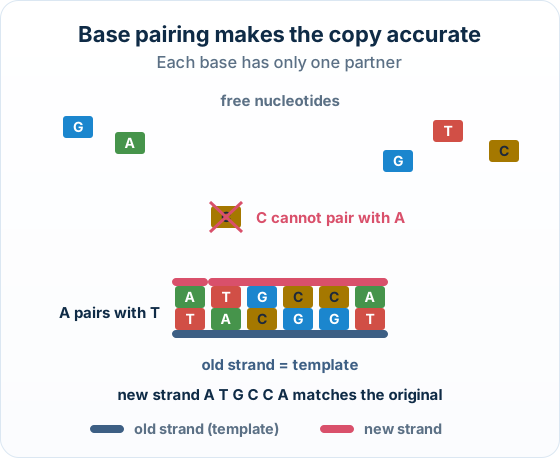
Remember it as: One partner per base: A with T, C with G.
Real example: E. coli. E. coli copies its whole chromosome, about 4.6 million base pairs, in roughly 40 minutes. Base pairing keeps that fast copying accurate: each base lining up must fit its partner.
Say why it is accurate: Do not stop at 'bases pair up'. Say that each base pairs with only one other base, so the new strand is complementary and the copy is identical to the original.
Study smarter, not longer
Most students waste 40% of study time on topics they already know. Our AI tracks your progress and optimizes every minute.
How this is tested: The Meselson-Stahl experiment is a classic data-reasoning question.
The experiment
Heavy DNA
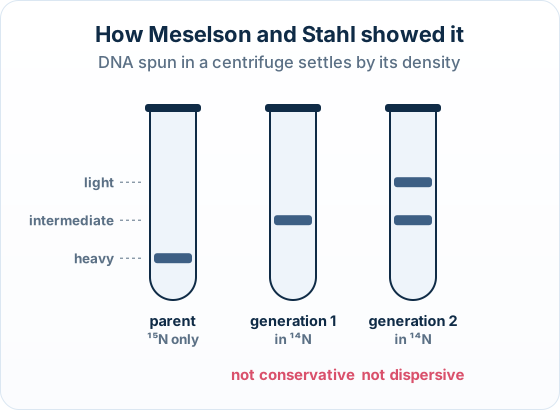
Bacteria are first grown with the heavy nitrogen isotope ¹⁵N so all their DNA is heavy.
Switch to light
They are then switched to light ¹⁴N.
Spin and sort
The DNA from each generation is spun in a centrifuge to sort it by density.
| Paper | What you are asked |
|---|---|
| Paper 2 (2-mark Explain) | Read the banding pattern and say what it shows |
| Paper 2 (1-mark State) | The conclusion (replication is semi-conservative) |
| Paper 1A | Choose the diagram that correctly shows semi-conservative replication — the one where each daughter molecule has one old and one new strand |
Exam-style question — explain the centrifuge banding
Bacteria were grown for many generations in a medium containing only the heavy isotope ¹⁵N, then transferred to a medium containing only the light isotope ¹⁴N. After one round of replication in ¹⁴N, the DNA formed a single band at an intermediate density. After a second round, the DNA formed two bands — one at intermediate density and one at a light density. Explain how these results support semi-conservative replication. [2]
How to score both marks
- Read generation 1. After one round there is only one intermediate band, so every molecule is half-heavy and half-light — one old (¹⁵N) strand paired with one new (¹⁴N) strand. This rules out the conservative model, which would have left a separate heavy band.
- Read generation 2. After a second round there is one intermediate band and one light band, so some molecules are now fully light. This rules out the dispersive model (which would keep all DNA at an intermediate density). Only semi-conservative replication fits both results.
Final answer
Generation 1 forms a single intermediate band — each molecule has one ¹⁵N (old) and one ¹⁴N (new) strand, ruling out the conservative model. Generation 2 forms an intermediate band and a light band, ruling out the dispersive model. Only semi-conservative replication explains both.
Why this scores full marks: It does the two things a data Explain needs: it describes each band (intermediate; then intermediate + light) and links each one to a model it rules out.
Just writing 'replication is semi-conservative' with no reference to the bands would score the State mark but not the Explain marks.
| Sample | Density of the DNA band | What it tells you |
|---|---|---|
| Parent (grown only in ¹⁵N) | One heavy band | All DNA contains the heavy ¹⁵N isotope |
| Generation 1 (one round in ¹⁴N) | One intermediate band | Every molecule is half-heavy, half-light → no fully heavy DNA left → conservative model is wrong |
| Generation 2 (two rounds in ¹⁴N) | One intermediate band AND one light band | Half the molecules are now fully light → dispersive model is wrong → only semi-conservative fits |
The three tubes, one result at a time: