The big idea: Your DNA sequence is fixed for life — yet which genes are actually switched on or off can change. The environment is one of the things that does the switching.
How the environment does it
- What you eat, the stress you meet, toxins you are exposed to and even the temperature you grow in can add or remove epigenetic marks.
- These marks are chemical tags (like methyl groups) sitting on top of the DNA.
- Those marks change gene expression without changing a single letter of the DNA.
- So the same genotype can give a different phenotype depending on the environment and on a cell's history.
An environmental signal (diet, stress, a toxin, temperature) can add methyl (–CH₃) marks to the DNA, packing it tightly so RNA polymerase cannot bind — the gene is switched OFF. Compare the two panels: the DNA SEQUENCE is identical in both, only the marks on top of it differ. That is the whole idea of epigenetics — the environment changes expression WITHOUT changing the genotype.
Interactive diagram
Explore the labelled diagram, charts and maps for this topic in full study mode.
- Gene expression
- Whether a gene is switched on (transcribed and used) or off (silenced) in a particular cell.
- Epigenetic mark
- A chemical tag added on top of the DNA (e.g. a methyl group) or its histones that changes expression without changing the base sequence.
- Methylation
- Adding methyl (–CH₃) groups to DNA. This usually packs the DNA tightly and switches the gene OFF.
- Genotype
- The DNA base sequence an organism carries — its actual genes.
- Phenotype
- The observable characteristics an organism shows, set by which genes are expressed.
- Environment
- The external and internal conditions a cell meets — diet, stress, toxins, temperature — that can alter epigenetic marks.
Marks sit ON the DNA, not IN it: Picture the DNA sequence as the text of a book and the epigenetic marks as sticky notes and highlighter on the pages.
The words never change — but the notes decide which pages get read and which get skipped.
That is why epigenetics changes expression without changing the genotype.
Free preview
This is the free notes preview
You're reading the free notes. Aimnova Pro unlocks the full study experience — and you can try it with your first topic free to keep:
- FlashcardsLock in vocabulary and key terms with spaced repetition.
- Practice questionsAnswer exam-style questions and get instant AI marking.
- Mock exams & past-paper vaultSit full mocks and see exactly how examiners award marks.
- Personalised study planA daily plan built around your exam date and weak areas.
Read this as a chain of cause and effect: an environmental signal reaches a cell, the cell adds or removes epigenetic marks, and those marks change which genes are expressed — giving a different trait, all from the same DNA.
Environment → epigenetic mark → changed expression
- An environmental factor acts on the cell — for example a change in diet, a burst of stress, a toxin, or the temperature during development.
- The cell responds by adding or removing epigenetic marks (e.g. methylating a stretch of DNA, or modifying its histones).
- Those marks change how tightly the DNA is packed, so they switch a gene on or off — they change gene expression.
- The result is a different phenotype even though the DNA sequence is unchanged — the genome has interacted with the environment.
| Environmental factor | Example of how it acts | Epigenetic outcome |
|---|---|---|
| Diet | A nutrient supplies the methyl groups used to mark DNA | More (or fewer) genes silenced by methylation → a changed trait |
| Stress | Stress hormones reach cells and alter which marks are placed | Genes for the stress response are turned up or down |
| Toxins | A pollutant or chemical changes the pattern of marks | A gene is wrongly silenced or switched on |
| Temperature | The growth temperature sets the pattern of marks early in development | A temperature-dependent trait (e.g. sex in some reptiles) |
Epigenetic marks are inherited — through mitosis: When a cell divides by mitosis, it copies its epigenetic marks onto both daughter cells along with the DNA.
Why this matters
- This is how a differentiated state is maintained.
- Once a liver cell has switched the right genes on and off, all its descendants stay liver cells — they inherit the same pattern of marks.
- So epigenetic marks are heritable through cell division.
- That is exactly why a single environmental event early on can have a lasting effect on a tissue.
Sometimes across generations: Most marks are wiped and reset when gametes form, but some escape the reset and can be passed to offspring — so an environmental effect can occasionally show up in the next generation.
Reversible, and not a mutation
- Crucially, epigenetic changes are reversible: a mark can be removed as easily as it was added, and the gene goes back to its original state.
- They never change the DNA base sequence.
- This is the line that separates epigenetics from a mutation — a mutation rewrites the letters of the DNA and is normally permanent.
Real examples to quote
- Identical twins. Twins start with the same DNA but diverge over time — by middle age their pattern of methylation differs, because they ate, stressed and lived differently. Same genotype, different epigenome → different traits and disease risks.
- Diet sets coat colour in mice. In a well-known mouse strain, mothers fed a methyl-rich diet have pups whose coat-colour gene is methylated (silenced) — the pups are brown and lean; genetically identical pups on a plain diet are yellow and obese. Same genes, the diet flipped the switch.
- Temperature sets traits. In some plants and reptiles the temperature during development sets the epigenetic marks, fixing a trait such as flowering time or even sex — the same genome gives different outcomes at different temperatures.
The one-line summary: Epigenetics explains how one genotype can give many phenotypes — the environment and a cell's history decide which genes are on, the marks are inherited through mitosis (and sometimes further), yet they are reversible and leave the DNA sequence untouched.
Know your predicted grade
Take timed mock exams and get detailed feedback on every answer. See exactly where you're losing marks.
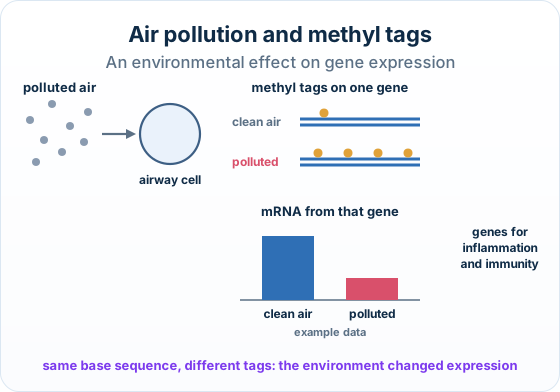
The big idea: Air pollution is an environmental factor that changes methyl tags on DNA, and so changes gene expression, without changing the base sequence.
The points to remember
- Fine particles in polluted air, for example from traffic exhaust, are breathed deep into the lungs.
- People who breathe more polluted air show different methyl tags on some of their genes.
- Changed tags alter how much those genes are expressed.
- The changes are linked to genes for inflammation and immunity.
- The base sequence stays the same: this is an epigenetic effect, not a mutation.
Remember it as: Breathe it in, tag the DNA.
Real example: traffic pollution. Studies of people exposed to more traffic pollution have found changes in the DNA methylation of their blood cells.
How it is asked: Short answers using a named example (air pollution, diet, temperature) to show the environment changing gene expression; 1A items on what such an example shows.
Using air pollution as an example, explain how the environment can affect gene expression.
Model answer plan
See the answer broken into clear points, with guidance on how each point earns marks.
Not a mutation: Say the base sequence does not change; otherwise the answer reads like a mutation.