The big idea: A cell can end up making a different protein, or a different amount of a protein, for two completely different reasons — and you need to tell them apart.
Mutation
- The DNA base sequence is changed — the actual letters of the gene are different.
- This is permanent (not normally reversible).
- It is passed to daughter cells.
- It can change the structure of the protein.
Epigenetic change
- The base sequence is NOT changed.
- Instead a chemical tag (methylation of the DNA, or a change to the histones) switches a gene up or down.
- This is reversible.
- It changes how much protein is made — not what the protein is.
One liner: A mutation rewrites the gene; an epigenetic change just changes the volume at which the gene is read.
- Mutation
- A permanent change to the DNA base sequence (the order of A, T, C, G). It is heritable and not normally reversible, and it can change the structure of the protein the gene codes for.
- Epigenetic change
- A change in gene EXPRESSION caused by chemical tags (DNA methylation or histone modification) — without altering the base sequence. It is reversible and changes how much protein is made.
- Gene expression
- Whether a gene is switched on, and how strongly — i.e. how much mRNA (and protein) the gene produces.
- DNA methylation
- Adding a methyl (–CH₃) tag to the DNA, usually silencing a gene (turning expression down) without changing the base sequence.
- Reversible
- Able to be undone — an epigenetic tag can be added or removed, switching a gene back; a mutation usually cannot be reversed.
The fastest way to tell them apart: Ask one question: did the DNA base sequence change?
Yes → it's a mutation (permanent, can change the protein's structure).
No, but expression changed → it's an epigenetic change (reversible, changes the amount of protein).
Free preview
This is the free notes preview
You're reading the free notes. Aimnova Pro unlocks the full study experience — and you can try it with your first topic free to keep:
- FlashcardsLock in vocabulary and key terms with spaced repetition.
- Practice questionsAnswer exam-style questions and get instant AI marking.
- Mock exams & past-paper vaultSit full mocks and see exactly how examiners award marks.
- Personalised study planA daily plan built around your exam date and weak areas.
Line the two up side by side. The key contrast is what is altered — the sequence (the gene's letters) or just the expression (how loudly the gene is read).
That single difference explains every other property in the table.
| Mutation | Epigenetic change | |
|---|---|---|
| What changes? | The DNA base sequence itself (e.g. A→G, a base added or lost) | Gene expression — whether/how strongly a gene is read — via methylation / histone tags |
| Base sequence altered? | Yes — the letters of the DNA are changed | No — the sequence is left exactly the same |
| Reversible? | Not normally — once the sequence is changed it usually stays changed | Yes — a methyl/histone tag can be added or removed, switching the gene back |
| Heritable? | Yes — copied to daughter cells (and to offspring if in a gamete) | Can be — some tags are copied to daughter cells (and sometimes to offspring) |
| Effect on the PROTEIN | Can change the protein's structure (a different amino acid → a different/faulty protein) | Changes the amount of protein made (the protein itself is normal — there is just more or less of it, or none) |
Why each property follows from that one difference: Both properties below come down to what was altered: the DNA letters themselves, or only a chemical tag on them.
Reversibility
- A mutation has changed the actual DNA letters, and cells don't normally 'un-change' a sequence — so it's permanent.
- An epigenetic tag is just a chemical label that an enzyme can add or strip off — so it's reversible.
Effect on the protein
- A mutation can swap an amino acid, so the protein's structure can change (it may fold wrongly or not work).
- An epigenetic change leaves the gene's sequence intact, so any protein made is normal — there is just more or less of it (or none, if the gene is silenced).
Measuring gene expression — read the mRNA: You can't see 'expression' directly, so biologists use a proxy: how much mRNA (or finished protein) a gene produces.
The rule
- More mRNA from a gene = the gene is more highly expressed.
- Little or no mRNA = the gene is barely expressed / switched off.
- To compare how active a gene is in two different cell types or two conditions, you compare the amount of mRNA (or protein) each makes.
- The cell with more mRNA is expressing that gene more strongly.
Reading an expression data set
- Find the gene (row) and the two cells/conditions (columns) you're comparing.
- Compare the mRNA amounts: the larger value = the gene is more highly expressed there.
- If mRNA is near zero, the gene is essentially switched off in that cell.
- Same gene, different amounts in different cells → the cells differ by expression, not by their DNA — they have the same genes, but read them differently (often an epigenetic difference).
| Gene | mRNA in skin cells | mRNA in pancreas cells | What it tells you |
|---|---|---|---|
| Insulin gene | Almost none | Very high | Strongly expressed in the pancreas, essentially off in skin |
| Keratin gene | Very high | Almost none | Strongly expressed in skin, essentially off in the pancreas |
| Housekeeping gene (respiration) | Moderate | Moderate | Expressed in both — every cell respires |
What the data shows: Skin cells and pancreas cells contain the same genes, yet the insulin gene makes lots of mRNA in the pancreas and almost none in skin.
A difference in expression: Because the mRNA amount differs, the insulin gene is expressed much more strongly in the pancreas — even though the DNA sequence is identical in both cells. That is a difference in expression, not in the genes themselves.
Never wonder what to study next
Get a personalized daily plan based on your exam date, progress, and weak areas. We'll tell you exactly what to review each day.
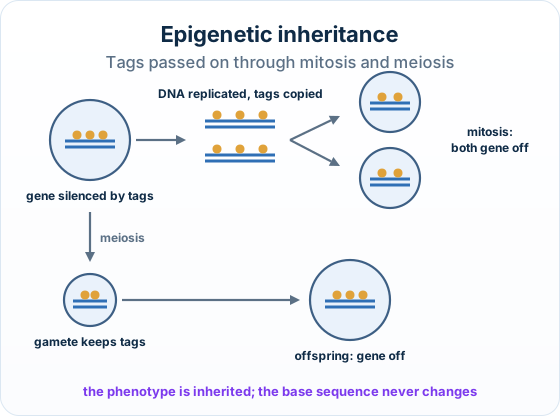
The big idea: A change in gene expression can be inherited without any change in the base sequence, if the epigenetic tags stay in place when a cell divides.
The points to remember
- Epigenetic tags are DNA methylation and histone modification.
- If the tags stay in place through mitosis, the daughter cells inherit the same pattern of expression.
- If some tags stay in place through meiosis, they can reach the offspring.
- What is inherited is a change in phenotype, not in the nucleotide sequence.
Remember it as: Same sequence, same tags, same phenotype.
Real example: peloric toadflax. Some toadflax plants have unusual, symmetrical flowers. The cause is heavy methylation that silences a flower-shape gene, not a change in its sequence, and the methylation is passed on through seeds.
How it is asked: Short answers distinguishing an epigenetic change from a mutation, reading mRNA data, and explaining how a change in expression is passed on.
Explain how a change in gene expression can be inherited without a change in the base sequence.
Model answer plan
See the answer broken into clear points, with guidance on how each point earns marks.
Phenotype, not genotype: In epigenetic inheritance the phenotype is passed on; the nucleotide sequence is not changed.