The big idea: Every cell in your body carries the same DNA — yet a nerve cell, a muscle cell and a skin cell all look and behave completely differently.
Why the cells differ
- Each cell switches different genes ON and OFF.
- The DNA letters are identical; what changes is which genes are expressed.
- Epigenetics is the study of these switches.
- An epigenetic change alters gene expression without changing the DNA base sequence.
- The change can be inherited by daughter cells when the cell divides.
The base sequence is identical in both panels — only the epigenetic switches differ. GENE OFF (silenced): methyl (CH₃) groups are added to the DNA and the DNA/histones are tightly packed, so RNA polymerase cannot bind and no mRNA is made. GENE ON: the DNA is open, so it can be transcribed.
Interactive diagram
Explore the labelled diagram, charts and maps for this topic in full study mode.
- Epigenetics
- Heritable changes in gene expression that do NOT change the DNA base sequence (the A, T, C, G order stays the same).
- Gene expression
- Whether a gene is switched on (transcribed into mRNA and used) or off.
- Heritable
- Passed on — here, copied to the daughter cells when a cell divides, so the same genes stay on or off.
- Methyl group
- A small chemical tag, written CH₃, that can be attached to cytosine bases in DNA or to amino acids in histones.
- Histone
- A protein that DNA is wound around; how tightly the DNA wraps controls whether genes can be read.
Epigenetic ≠ mutation: A mutation changes the actual DNA base sequence (it rewrites the letters).
An epigenetic change does not touch the sequence — it only changes whether a gene is read, like a sticky note on a page rather than crossing words out.
Where the word comes from: epi- means 'on top of' — epigenetic marks sit on top of the DNA, they don't rewrite it.
Free preview
This is the free notes preview
You're reading the free notes. Aimnova Pro unlocks the full study experience — and you can try it with your first topic free to keep:
- FlashcardsLock in vocabulary and key terms with spaced repetition.
- Practice questionsAnswer exam-style questions and get instant AI marking.
- Mock exams & past-paper vaultSit full mocks and see exactly how examiners award marks.
- Personalised study planA daily plan built around your exam date and weak areas.
There are two main epigenetic mechanisms, and both work by controlling whether the transcription machinery can reach a gene.
Read each as a chain of cause and effect: a chemical mark is added, that changes how the DNA is exposed, and that decides whether the gene is read or silenced.
1 — DNA methylation (usually SILENCES a gene)
- Methyl groups (CH₃) are attached to the DNA, on cytosine bases, often in the gene's promoter (the start signal).
- The methyl marks block RNA polymerase from settling on the promoter.
- With the start signal blocked, the gene cannot be transcribed — no mRNA is made.
- So methylation at a promoter usually switches the gene OFF (silenced).
Focus on the lower panel: methyl (CH₃) groups on the DNA plus tightly packed DNA/histones keep RNA polymerase out — the gene is silenced. Remove those marks and loosen the packing and the same gene can be read again.
Interactive diagram
Explore the labelled diagram, charts and maps for this topic in full study mode.
2 — Histone modification (changes how tightly DNA is packed)
- DNA is wound around histone proteins; chemical tags added to the histones change how tightly it wraps.
- Tightly packed (condensed) DNA is hidden — RNA polymerase cannot reach the gene, so it is OFF.
- Loosely packed (open) DNA is exposed — RNA polymerase can reach the gene, so it is ON.
- So the packing state set by histone tags decides whether a gene is accessible and expressed. Methyl tags on histone amino acids can either repress or activate transcription, depending on where they are added.
| DNA packing | Is the gene accessible? | Can RNA polymerase bind? | Gene state |
|---|---|---|---|
| Loosely packed (open) | Yes — the DNA is exposed | Yes | ON (expressed) |
| Tightly packed (condensed) | No — the DNA is hidden | No | OFF (silenced) |
Both come down to one thing: access: Both mechanisms control whether RNA polymerase can reach the gene.
Methylation blocks the promoter directly; tight histone packing hides the whole stretch of DNA. Either way, a blocked or hidden gene is silenced (OFF).
Open, unmethylated DNA is accessible, so the gene is expressed (ON).
The sequence never changes: Crucially, in none of this does the base sequence change — and the marks can be copied to daughter cells, so the same genes stay on or off after division (heritable).
| DNA methylation | Histone modification | |
|---|---|---|
| What is added/changed | Methyl (CH₃) groups are attached to the DNA, often at a gene's promoter | Chemical tags are added to the histone proteins that DNA is wound around |
| What it changes | Whether RNA polymerase can read the gene | How tightly the DNA is packed around the histones |
| Effect on the gene | Methylation at a promoter usually SILENCES the gene (transcription blocked) | Tightly packed (condensed) = gene OFF; loosely packed = gene ON |
| Does the base sequence change? | No — the A, T, C, G order is untouched | No — the base sequence is untouched |
| Reversible / heritable? | Reversible, and can be copied to daughter cells (heritable) | Reversible, and can be copied to daughter cells (heritable) |
Why this matters: These switches are how one genome produces many cell types — every cell keeps all the genes, but each expresses a different subset.
Because epigenetic marks are reversible, they also let cells respond to the environment and, in some cases, change which genes are on across a lifetime — without ever altering the DNA sequence itself.
Memorize terms 3x faster
Smart flashcards show you cards right before you forget them. Perfect for definitions and key concepts.
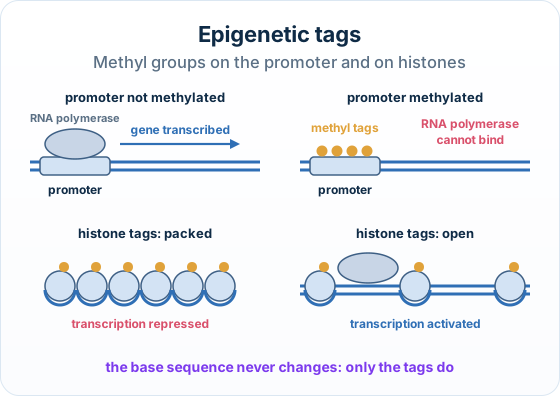
The big idea: Epigenetic tags are chemical groups added to DNA or to histones. Methyl tags on a promoter switch a gene off; methyl tags on histones can switch genes off or on.
The points to remember
- Methyl groups can be added to cytosine bases in the DNA of a promoter.
- A methylated promoter represses transcription: RNA polymerase cannot bind, so the gene is off.
- In the nucleus, DNA is wound around histones; each unit is a nucleosome.
- Methylation of histone amino acids can repress or activate transcription.
- The tags never change the base sequence.
Remember it as: Promoter tags: off. Histone tags: off or on.
Real example: tortoiseshell cats. In each cell of a female mammal one X chromosome is switched off, partly by methylation of its DNA. In tortoiseshell cats a fur-colour gene sits on the X, so patches of fur show which X is switched off.
How it is asked: 1A items reading data on methylation and transcription, short answers on how histone methylation affects transcription, and longer answers comparing promoter and histone tags.
Explain how methylation of the promoter of a gene affects its expression.
Model answer plan
See the answer broken into clear points, with guidance on how each point earns marks.
Histone tags work both ways: Promoter methylation only switches genes off; histone methylation can switch them off or on.