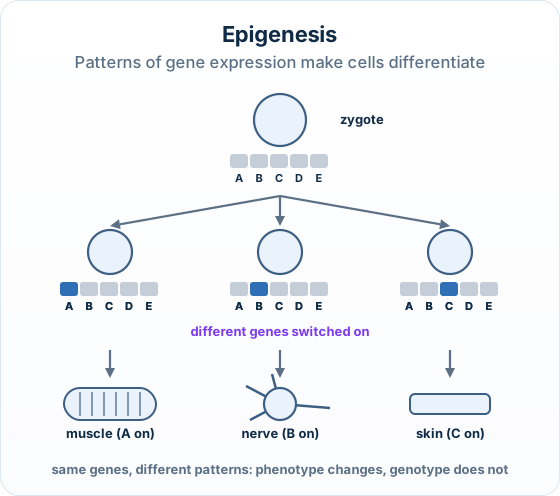
The big idea: Epigenesis is how a multicellular organism develops its different cell types: cells with the same DNA develop different patterns of gene expression and so differentiate.
The points to remember
- Every cell made from the zygote by mitosis has the same genome.
- During development, signals switch on different genes in different cells.
- Each cell's pattern of gene expression decides what it differentiates into.
- The base sequence of the DNA is not changed by epigenetic changes.
- So the cells' phenotype changes, but their genotype does not.
Remember it as: One genotype, many phenotypes.
Real example: liver and nerve cells. A liver cell and a nerve cell from the same person carry exactly the same DNA. They became so different during development because each switched on a different set of genes.
Free preview
This is the free notes preview
You're reading the free notes. Aimnova Pro unlocks the full study experience — and you can try it with your first topic free to keep:
- FlashcardsLock in vocabulary and key terms with spaced repetition.
- Practice questionsAnswer exam-style questions and get instant AI marking.
- Mock exams & past-paper vaultSit full mocks and see exactly how examiners award marks.
- Personalised study planA daily plan built around your exam date and weak areas.
Start Studying Free Full access to Aimnova Pro · cancel anytime
Phenotype changes, genotype does not: Epigenetic changes alter which genes are expressed, not the genes themselves.
| Muscle cell | Nerve cell | |
|---|---|---|
| Genotype (base sequence) | The same | The same |
| Genes expressed | Muscle proteins such as actin and myosin | Nerve proteins such as ion channels |
| Phenotype | Long, contracts | Long branches, carries impulses |
The pattern is kept: When a differentiated cell divides by mitosis, its daughter cells keep the same pattern of gene expression, so a liver cell gives rise to more liver cells.
Feeling unprepared for exams?
Get a clear study plan, practice with real questions, and know exactly where you stand before exam day. No more guessing.
Get Exam Ready FreeYour first topic is free to keep • No credit card required
How it is asked: Short written answers on how cells with the same DNA become different, or why daughter cells keep their parent's identity; 1A items on what differentiation is.
IB-style questionExplain[3 marks]
Explain how cells with identical DNA can develop into different cell types.
Model answer plan
See the answer broken into clear points, with guidance on how each point earns marks.