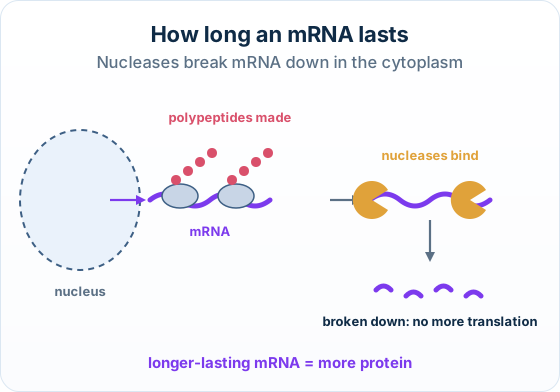
The big idea: Translation can be controlled by how long mRNA lasts. Nucleases break mRNA down; once it is gone, no more of its protein can be made.
The points to remember
- One mRNA molecule can be translated many times while it lasts.
- Nucleases are enzymes that break mRNA down into nucleotides.
- In human cells an mRNA can last from minutes to days.
- Short-lived mRNA gives a short burst of protein; long-lived mRNA gives more protein.
- Controlling degradation is a way to control translation.
Remember it as: No mRNA, no more protein.
Real example: mRNA vaccines. The mRNA in an mRNA vaccine is translated by the body's cells into a virus protein for a short time, then broken down within days, so the protein is made only briefly.
Free preview
This is the free notes preview
You're reading the free notes. Aimnova Pro unlocks the full study experience — and you can try it with your first topic free to keep:
- FlashcardsLock in vocabulary and key terms with spaced repetition.
- Practice questionsAnswer exam-style questions and get instant AI marking.
- Mock exams & past-paper vaultSit full mocks and see exactly how examiners award marks.
- Personalised study planA daily plan built around your exam date and weak areas.
Start Studying Free Full access to Aimnova Pro · cancel anytime
Short-lived and long-lived mRNA: Cells can make some mRNAs break down quickly and protect others.
| Short-lived mRNA | Long-lived mRNA | |
|---|---|---|
| Lasts | Minutes | Hours to days |
| Protein made | A little, briefly | A lot, for a long time |
| Useful for | Proteins needed only for a moment | Proteins needed in large amounts |
| Control | Production stops soon after transcription stops | Production goes on after transcription stops |
Two levels of control: Transcription controls how much mRNA is made; degradation controls how long it stays. Together they set how much protein a cell makes.
See how examiners mark answers
Answer exam-style questions with model answers. Learn exactly what earns marks and what doesn't.
Try Exam Vault FreeYour first topic is free to keep • No credit card required
How it is asked: 1A items: what happens when nucleases bind mRNA (it cannot be translated again), or how a cell stops making too much of a protein (nucleases break down its mRNA).
IB-style questionExplain[2 marks]
Explain how breaking down mRNA can regulate the amount of a protein made by a cell.
Model answer plan
See the answer broken into clear points, with guidance on how each point earns marks.