The big idea: Every cell in your body carries the same DNA, yet a liver cell and a nerve cell make different proteins. How? Cells control which genes are switched on.
Transcription is the switch
- The main control point is transcription — deciding whether a gene is even copied into mRNA in the first place.
- The switches are proteins called transcription factors.
- They bind to special regulatory sequences in the DNA.
- They decide whether RNA polymerase is allowed to start reading the gene.
On or off: Transcription factor present (right kind) → gene ON. Absent or blocked → gene OFF.
Gene ON (top panel): an activator transcription factor binds the regulatory sequence, which helps RNA polymerase settle on the promoter and transcribe the gene → mRNA is made. The lower panel previews the OFF state (covered in the next micro).
Interactive diagram
Explore the labelled diagram, charts and maps for this topic in full study mode.
- Gene expression
- Switching a gene on so its information is used — the gene is transcribed (and then usually translated into a protein).
- Transcription
- Copying a gene's DNA into a strand of mRNA, carried out by RNA polymerase. This is the MAIN point at which genes are switched on or off.
- Transcription factor
- A protein that binds a regulatory DNA sequence and controls whether a gene is transcribed.
- Regulatory sequence
- A specific stretch of DNA (such as a promoter or enhancer) that transcription factors bind to, controlling a nearby gene.
- Promoter
- The regulatory sequence just before a gene where RNA polymerase must bind to begin transcription.
- RNA polymerase
- The enzyme that binds the promoter and transcribes the gene into mRNA.
Why control transcription, not later steps?: A cell could block a gene's product after the mRNA or protein is made — but that wastes energy building things it will throw away.
Controlling it at transcription is the most efficient point: if the gene is never copied to mRNA, nothing downstream is made. That is why transcription is the main switch.
Free preview
This is the free notes preview
You're reading the free notes. Aimnova Pro unlocks the full study experience — and you can try it with your first topic free to keep:
- FlashcardsLock in vocabulary and key terms with spaced repetition.
- Practice questionsAnswer exam-style questions and get instant AI marking.
- Mock exams & past-paper vaultSit full mocks and see exactly how examiners award marks.
- Personalised study planA daily plan built around your exam date and weak areas.
There are two kinds of transcription factor, named by what they do.
Read each as a chain of cause and effect: the protein binds a regulatory sequence, and that binding either helps or blocks RNA polymerase at the promoter — which switches the gene on or off.
ACTIVATOR → gene ON
- An activator (a transcription factor) is present in the cell.
- It binds a regulatory sequence in the DNA (e.g. the promoter or an enhancer).
- This helps RNA polymerase bind the promoter.
- RNA polymerase starts transcription and reads the gene.
- mRNA is made — the gene is switched ON (expressed).
Follow the top panel: transcription factor bound → RNA polymerase on the promoter → transcription → mRNA produced. No transcription factor (or a repressor in the way) = no RNA polymerase = no mRNA.
Interactive diagram
Explore the labelled diagram, charts and maps for this topic in full study mode.
REPRESSOR → gene OFF
- A repressor (a transcription factor) is present in the cell.
- It binds a regulatory sequence at or near the promoter.
- This blocks RNA polymerase from binding the promoter.
- Transcription cannot start.
- No mRNA is made — the gene is switched OFF.
Same enzyme, opposite outcome: Notice that RNA polymerase is the same in both cases. What differs is the transcription factor sitting on the DNA:
An activator helps the polymerase on → gene ON.
A repressor blocks the polymerase → gene OFF.
So a gene's state is decided by which transcription factors are bound to its regulatory sequences.
| Activator | Repressor | |
|---|---|---|
| What it is | A transcription factor (a protein) | A transcription factor (a protein) |
| Where it binds | A regulatory sequence in the DNA (e.g. promoter / enhancer) | A regulatory sequence in the DNA (often at or near the promoter) |
| Effect on RNA polymerase | HELPS RNA polymerase bind the promoter | BLOCKS RNA polymerase / the promoter |
| Effect on transcription | Transcription STARTS | Transcription is PREVENTED |
| The gene is therefore | Switched ON (mRNA is made) | Switched OFF (no mRNA made) |
Why different cells express different genes: Because the DNA is the same in every cell, the difference between cell types comes from which transcription factors each cell makes.
One genome, many cell types
- A liver cell contains the activators that switch on liver genes.
- A nerve cell contains a different set that switches on nerve genes.
- So the set of transcription factors present in a cell determines which genes are transcribed — this is what makes a liver cell a liver cell.
Responding to a signal: hormones: Transcription-factor control also lets a cell respond to signals.
How a steroid hormone switches genes on
- A steroid hormone such as oestrogen can pass into a target cell and bind a receptor.
- The hormone–receptor complex then acts as a transcription factor.
- It binds regulatory sequences and switches specific genes on.
- So a signal arriving at the cell can change which genes are transcribed, changing what the cell does.
- The same logic underlies a bacterium switching on sugar-digesting genes only when that sugar is present.
See how examiners mark answers
Answer exam-style questions with model answers. Learn exactly what earns marks and what doesn't.
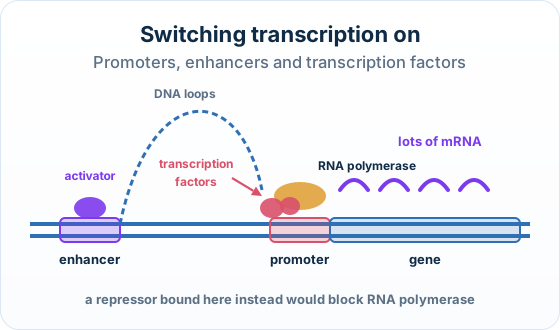
The big idea: Transcription is controlled by transcription factors: proteins that bind to specific base sequences in the DNA, at the promoter and at enhancers.
The points to remember
- The promoter is a base sequence just before a gene, where RNA polymerase binds to start transcription.
- Transcription factors are proteins that bind to specific base sequences in the DNA.
- Some transcription factors help RNA polymerase bind to the promoter.
- An enhancer is a base sequence, often far from the gene, where an activator binds to increase transcription.
- A repressor binds the DNA and blocks transcription, switching the gene off.
Remember it as: Promoter: where to start. Enhancer: how fast.
Real example: lactase in adults. In many people of European descent, a change in an enhancer far upstream of the lactase gene keeps the gene transcribed in adulthood, so they can still digest milk sugar as adults.
How it is asked: A long Paper 2 answer on how gene expression is regulated at transcription (promoters, enhancers, transcription factors, and epigenetic tags), or short items on what a transcription factor does.
Explain how transcription factors regulate the transcription of a gene.
Model answer plan
See the answer broken into clear points, with guidance on how each point earns marks.
For a seven-mark answer: Add the other controls too: methylation of the promoter and of histones (4.5.6), hormones (4.5.11), and how the protein made gives the phenotype.