The big idea: A gene is just a set of instructions in DNA. On its own it does nothing — it must be expressed.
When a gene is expressed
Transcribed
The gene is copied into mRNA.
Translated
The mRNA is read by a ribosome.
Protein
The cell builds the protein that the gene codes for.
Gene expression = transcription + translation, ending in the gene's protein product.
A switched-off gene: A gene that is switched off is never transcribed, so no mRNA and no protein are made — even though the gene is still sitting in the DNA.
Gene expression = transcription + translation. A gene is 'expressed' when its DNA is transcribed into mRNA and that mRNA is translated into a protein. A gene that is NOT expressed is never copied into mRNA, so its protein is never made.
Interactive diagram
Explore the labelled diagram, charts and maps for this topic in full study mode.
- Gene
- A length of DNA that codes for one protein (the gene's product).
- Gene expression
- The transcription and translation of a gene to make its protein. A gene is 'expressed' when its protein is being produced.
- Gene product
- The protein that a gene codes for — the end result of expressing that gene.
- Switched on / off
- An expressed gene is 'switched on'; a gene that is not transcribed is 'switched off' (silent), so its protein is not made.
- Genome
- The complete set of genes (all the DNA) in a cell.
Having a gene ≠ using a gene: Every cell has thousands of genes, but only uses some of them at any time.
Think of the genome as a cookbook and expression as actually cooking a recipe. Owning the recipe does nothing — the dish only appears when you read it and cook (transcribe and translate).
Free preview
This is the free notes preview
You're reading the free notes. Aimnova Pro unlocks the full study experience — and you can try it with your first topic free to keep:
- FlashcardsLock in vocabulary and key terms with spaced repetition.
- Practice questionsAnswer exam-style questions and get instant AI marking.
- Mock exams & past-paper vaultSit full mocks and see exactly how examiners award marks.
- Personalised study planA daily plan built around your exam date and weak areas.
Here is the puzzle. A neuron in your brain and a cell in your liver look and behave completely differently — yet they contain exactly the same DNA.
Why it can't be different genes
- Every body cell came from one zygote by mitosis.
- Mitosis copies the whole genome faithfully.
- So the difference between cell types cannot come from different genes — they all carry the same set.
The answer: differential gene expression: Cells differ because they express different genes. Out of the same full genome, each cell type switches on only a subset of its genes and leaves the rest off. This is called differential gene expression.
Why that changes the cell: Because different genes are switched on, each cell type transcribes and translates a different set of proteins — and it is the proteins that give a cell its structure and function.
The cause → effect chain
- Every cell carries the same DNA (the same full genome).
- Each cell type switches on a different subset of genes (differential expression).
- The switched-on genes are transcribed and translated into proteins.
- So each cell makes a different mix of proteins.
- Those proteins build and run the cell → different structure and function.
| Step | What happens | Why cells end up different |
|---|---|---|
| 1. Same DNA | Mitosis copies the whole genome into every body cell | Difference is NOT in the DNA — all cells share it |
| 2. Differential expression | Each cell type switches ON only a subset of its genes | Different genes are transcribed in different cells |
| 3. Transcription + translation | The switched-on genes are made into mRNA, then protein | Each cell makes a different MIX of proteins |
| 4. Structure & function | Those proteins build and run the cell | Neuron ≠ liver cell, even with identical DNA |
| Neuron | Liver cell | |
|---|---|---|
| Genes switched on | Ion channels and neurotransmitter enzymes | Detox enzymes and glycogen handling |
| Genes kept off | — | Ion-channel and neurotransmitter genes |
| What it is built for | Carrying electrical signals | Processing the blood |
Worked example — neuron vs liver cell: Same DNA, different genes expressed → different proteins → different cell. A red-blood-cell precursor makes the difference obvious: it switches on the haemoglobin gene (which stays off in a neuron), so it fills with haemoglobin while the neuron never does.
| Neuron (nerve cell) | Hepatocyte (liver cell) | |
|---|---|---|
| Genome (DNA) | The SAME full set of genes | The SAME full set of genes — identical to the neuron's |
| Genes switched ON | Genes for ion channels, neurotransmitter enzymes, signalling proteins | Genes for detox enzymes, glycogen-handling enzymes, blood-protein production |
| Genes switched OFF | Most liver-specific genes are silent | Most neuron-specific genes are silent |
| Proteins actually made | Mostly nerve-signalling proteins | Mostly liver-metabolism proteins |
| Result | A long, branched cell that carries electrical signals | A cube-shaped cell that filters blood and stores glucose |
Two cells with identical DNA differ because they run this pathway for DIFFERENT genes. A neuron expresses its set of genes; a liver cell expresses a different set — so each ends up with a different mix of proteins, structure and function.
Interactive diagram
Explore the labelled diagram, charts and maps for this topic in full study mode.
Differentiation = a stable expression pattern: When a cell differentiates (becomes a neuron, a liver cell, a muscle cell), it settles into a stable pattern of which genes are switched on.
What that means
- That pattern is kept up over the cell's life.
- It is usually passed to its daughter cells, which is why a liver cell keeps making liver-cell daughters.
- So a 'cell type' is really just a particular set of expressed genes.
See how examiners mark answers
Answer exam-style questions with model answers. Learn exactly what earns marks and what doesn't.
The big idea: Gene expression is how the information in a gene has an effect on the phenotype: the gene is transcribed, the mRNA is translated, and the protein made does a job, often as an enzyme.
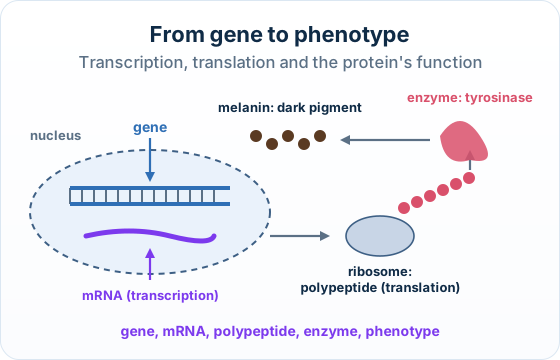
The points to remember
- Transcription: the gene's base sequence is copied into mRNA.
- Translation: ribosomes use the mRNA to join amino acids into a polypeptide.
- The polypeptide folds into a protein with a function, such as an enzyme.
- What the protein does produces a characteristic: part of the phenotype.
- A gene that is not expressed has no effect on the phenotype.
Remember it as: Gene, mRNA, protein, trait.
Real example: albinism. The gene for tyrosinase is needed to make melanin. In people with one kind of albinism, the gene does not give a working enzyme, so little melanin is made and hair, skin and eyes are very pale.
How it is asked: Often as data: expression levels of genes after a treatment (outline the effect on each gene), then a longer answer linking a gene's expression to a trait.
Explain how the information in a gene can affect the phenotype of an organism.
Model answer plan
See the answer broken into clear points, with guidance on how each point earns marks.
Read the error bars: If the error bars of two bars overlap, say there is no significant difference in expression.